Please Follow us on Gab, Minds, Telegram, Rumble, Gettr, Truth Social, Twitter, YouTube, Instagram
Connecticut’s media has consistently presented Governor Ned Lamont to the general public as being “fiscally conservative” and “socially liberal,” a faulty distinction. Now that progressive Democrats have put an end to effective Republican resistance in the General Assembly – only three (3) Republican senators survived the midterm bloodbath, and Republican representation in the state House has dwindled to thirty five (35) – the distinction, as a practical matter, will in the future become far less important than caucus politics. This means that political decision making will move from open legislative sessions to closed caucus rooms.
If the rest of the nation wants to know what politics in the future will look like under an authoritative single party dominance, it has only to keep its eye on Connecticut.
Here in Connecticut, the future will be directed by Democrats who are not fiscal conservatives. It should come as no surprise to left of center journalists in the state that cultural progressivism usually trumps fiscal conservativism -- because conservatives have always been right in insisting 1) that all politics lies downstream from culture, and 2) that the distinction often deployed in Connecticut campaigns – “fiscally conservative but socially liberal” – is, and always has been, a false dichotomy.
In Connecticut, all past Republican members of the state’s U.S. Congressional Delegation who had presented themselves as “fiscally conservative but socially liberal” have been picked off by Democrats who were political and social progressives. The “fiscal conservative” mask donned by Connecticut Democrats is useful chiefly as a campaign ploy to ward off potentially damaging campaign attacks from moderate to right of center Republicans, all wiped out in the midterm Connecticut elections.
Susan Collins of Maine, the last Republican congresswomen in the Northeast, fell in the midterm election to Troy Jackson, a “progressive logger.” Collins said she was a victim of a Trump undertow. And other Northeast Republicans vying for the U.S. Congress, all defeated by Northeast progressives, were victims of whom, pray tell? Nearly all of them were displaced by progressives before Trump’s first election to the presidency. Among state Republicans who lost their seats to Democrats in the most recent election were Republican leaders John Kissel, Heather Somers and Steve Harding, none of whom may plausibly be accused of unreasonably supporting Trump.
The battle for the future in Connecticut will not be waged by fiscally conservative socially liberal Republican state senators and progressives. There are but three Republicans of any stripe left in the state senate. No, the coming political battle for the future will be waged by Connecticut leftists against lame duck governor Ned Lamont, a very thin reed whipped forward by ascendant progressivism. President Donald Trump, it should be noted, is also a lame duck.
Following the Election Day tsunami in Connecticut, an accommodating Lamont issued the following invitation to all: “I’ve got a big table, but I’ve got an open door. I want the very best ideas. They can come from progressive Democrats, moderate Democrats, Republicans … Come in. Give me a constructive idea, and I’m all ears to make it happen. That’s what we’ve got to do. That’s how we come together as a state.”
But there no longer is a need, anywhere in the state, for political accommodation. A majority of Democrats in the General Assembly know that accommodation is a useful tool in a legislature in which political power is shared between parties. What is the point in having absolute power if you are not prepared to abuse it?
Some critical contrarian analysis – not nearly enough – is beginning to trickle down from a few Democrat Party indentured political reporters.
Both parties, even in Connecticut, differ greatly on solutions to the problem of affordability. In an after-election story, CTMirror asks “Is CT’s blue wave a mandate on affordability or endorsement of status quo? Officials disagree.” Solving the problem of unaffordability is, according to conservative/libertarian analysis, deceptively simple: prices are high because they include hidden taxes recovered by product and service producers through price increases. The simplest way to reduce these price increases is 1) to eliminate a variety of consumption taxes, and 2) to reduce the inflationary price cycle by reducing, when possible, needless and costly regulatory impositions. The right answer to the question presented in the title of the CTMirror story is -- the blue wave election we’ve just witnessed is both a mandate to reduce unaffordability and an endorsement in Connecticut of a 30+ year status quo ascendency of progressive, Democrat controlled governance.
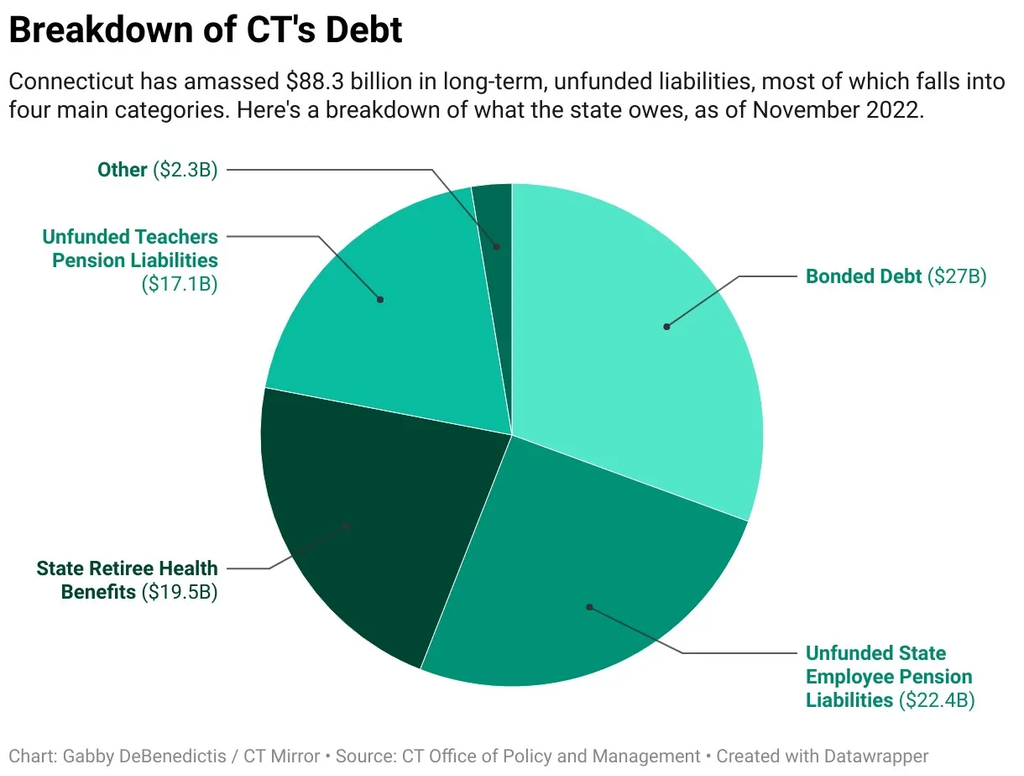
The architects of the political and cultural problems that have made Connecticut unaffordable are status quo Democrats, and the rising arc of spending in the state is a Democrat caucus production. A three member Republican caucus in Connecticut’s General Assembly is no indicator of political control in the state legislature. And the same may be said of the state’s executive department, its judicial department and its complex – some would say “corrupt’ -- administrative apparatus.
Lamont may soon feel the tug of a progressive movement he is in no position to resist because he will have no political force to deploy against it.
The Hartford Courant puts it this way: “’The numbers [in the last election] position us more strongly than in years past to be more assertive,’ said House Majority Leader Jason Rojas of East Hartford. He leads a Democratic caucus that will hold 116 out of 151 House seats, numbers not seen since immediately post-Watergate. ‘We’ve been duly elected, and we have a mandate to improve affordability,’ said Norwalk Democrat Bob Duff, majority leader in the Senate, where his party’s 33-3 advantage will be the widest in state history.”
Spending reductions and tax cuts are not on the progressive agenda. Both are viable solutions to the affordability crisis that has been for the past thirty years the signature accomplishment of ascendant Connecticut progressives. Those who place their faith in Lamont as a stop-gap in spending may yet regret their votes. Democrat progressives cannot be expected to renounce deficit spending until, in the words of conservative British Prime Minister Maggie Thatcher, they run out of other people’s money. The unaffordability crisis confronting Connecticut taxpayers suggests that day is at hand.






Stay updated with the latest in the Constitution State with The CT Centinal