Please Follow us on Gab, Minds, Telegram, Rumble, Gettr, Truth Social, Twitter, YouTube, Instagram
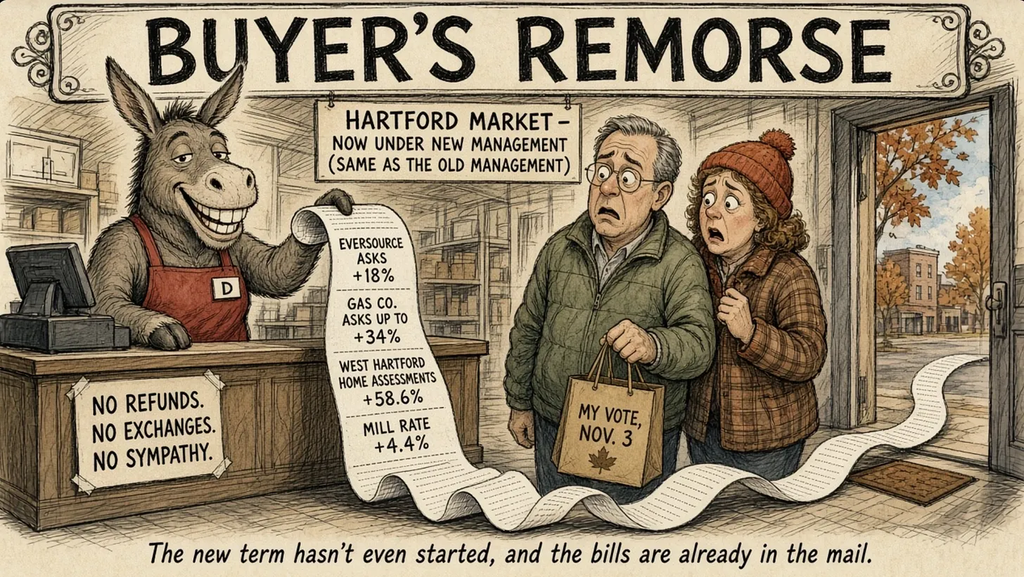
Connecticut, you got exactly what you voted for. And the receipts started showing up before the confetti was swept off the floor.
Twelve days in. Go check the mailbox.
On November 3rd you gave Ned Lamont a third term, 773,756 votes to Ryan Fazio's 525,015. By the unofficial count, you took the state Senate from 25 Democrats and 11 Republicans to 33 and 3. Three. In the House, 102 to 49 became 116 to 35. Every statewide office, blue. You didn't elect a government. You handed one party the keys, the car, the garage and the driveway.
And then you went to the mailbox.
Let's start in West Hartford, because West Hartford deserves it.
On Wednesday the town started mailing out new assessment notices. According to Town Assessor Joe Dakers, residential property values in West Hartford went up an average of 58.6 percent since the last revaluation in 2021. Condos up 57 percent. Apartments up 56. Commercial property? Up 31.
Read that again. The houses went up almost twice as fast as the businesses.
Now the town is very careful to tell you not to panic. Don't multiply your new assessment by the old mill rate, they say. The Town Council won't set the new mill rate until April, and the bills based on these numbers don't land until June 2027. Over in Portland the first selectman told NBC Connecticut his advice was, quote, "Take a deep breath."
Okay. Deep breath. Here's what I see when I breathe in.
Back in April, the West Hartford Town Council passed a $387.3 million budget. Up 5.3 percent. The mill rate went up 4.4 percent, from 44.78 to 46.77. Deputy Mayor Deb Polun said it would raise taxes an average of $573 per family. And the mayor, Shari Cantor, said it herself: "we're at a 4.4% tax increase, which is high. And it is too high." Then she voted for it. All six Democrats on that council voted for it.
Mayor Cantor also said, that same night, that with home values climbing, the mill rate would come down "and costs may shift." Her words. Shift. When the houses go up 58.6 percent and the businesses go up 31, it doesn't take a math degree to guess which way that could shift. (Hint: probably toward the guy with the lawn.)
And here's my favorite part. One of the six Democrats who voted for that too-high budget, Councilor Tiffani McGinnis, just got elected to the state House out of West Hartford with 79 percent of the vote. Her campaign promise on electricity, per the Yankee Institute, was clean-energy policies that would "reduce long-term costs." No details. Congratulations, West Hartford. You promoted her.
Oh, and one more thing about West Hartford. CT Mirror reported it was the town that drew more early voters to the polls than any other community in the state. Lamont rallied there on the Sunday before the election. You showed up. You showed up early. You showed up big.
So let's talk about what you showed up for.
Eversource wants a raise. On July 14th the company asked PURA, the state's utility regulators, for a rate increase on the local delivery part of your bill, the poles and the wires. Eversource's own number is $727 million a year. That's about a 50 percent jump in the delivery portion. For an average home using 700 kilowatt-hours, Eversource says your total bill goes up about $33 a month. Eighteen percent. AARP Connecticut put it at $32.91 a month, nearly $400 a year.
The state's own Office of Consumer Counsel told NBC Connecticut it would be the largest rate increase in Connecticut history.
The largest. In history. In the state that's had, in the governor's own words, "the highest electric prices in the country going back 50 years."
Now, I want to be fair here, because that's what we do. It's a request. PURA decides, and PURA often trims these. Eversource says if the storm costs get pulled out and collected separately, it's more like 11 percent, about $20 a month. If approved, the new rates kick in July 1, 2027. There's a public hearing in New London Monday night and one in Danbury on the 23rd. Go. Seriously, go.
But don't tell me you didn't know. This filing went in back in July. It was sitting right there on the table the entire campaign. And you voted for the same people anyway.
Then there's the gas.
On Friday, Connecticut Natural Gas and Southern Connecticut Gas, both owned by Avangrid, filed notice that they want $212 million more over two years. About 400,000 customers. If they get it all, CNG's average residential bill goes from about $127 a month to about $157. That's 24 percent. Southern Connecticut Gas goes from about $125 to about $165. That's 34 percent. Hartford Business Journal put the range at 19 to 25 percent more, starting December 2027. If they get the whole thing, down on the shoreline you're looking at a third more to heat your house.
And here's the part that should make you put your coffee down. According to the companies, $54 million of that request is unfunded costs from the expanded state payment assistance program for low-income customers. Those costs have gone up about 300 percent since the former PURA chairwoman, Marissa Gillett, widened eligibility in 2024.
Marissa Gillett. Nominated to PURA by Governor Ned Lamont in 2019.
So the bill for a Hartford policy, signed off by a Lamont appointee, is now coming back to you on your gas bill. That's not a conspiracy theory. That's in the filing.
Look, I'm not saying nobody should get help paying their heat. I'm saying somebody has to pay for it, and in Connecticut that somebody is always you, and the people who designed it never once have to put their own name on the bill.
And if you're a Yankee Gas customer, you already got yours. The Consumer Counsel figures PURA's decisions in that rate case add about $15.75 a month to the average residential bill. That one's already decided.
(For the record, I checked the pump too. AAA had Connecticut regular at about $4.04 a gallon Saturday, and it's been falling for a month. So the gas going up a third is the gas that heats your house, not the gas in your car. Small mercies.)
Now, here's the thing that gets me.
Every one of these decisions gets made right here in Connecticut. Poles and wires in Connecticut. A rate case at PURA in New Britain. A payment program built by a Connecticut regulator. A mill rate set by a West Hartford town council. A school funding formula, the ECS formula, that Mayor Cantor herself said hasn't changed its base since 2013. That's Hartford. All of it is Hartford.
And what was the closing argument? What was the big pitch the weekend before you voted?
Ned Lamont, Sunday, November 1st, according to the CT Mirror. Democrats wanted to win by a margin that sends a message, he said, rejecting President Trump in the midterm. "It means the first day of the end of the Trump regime."
That was the pitch. Not your Eversource bill. Not your gas bill. Not your mill rate. Trump.
Back in September, when Ryan Fazio pinned the cost of electricity on him, the governor blamed Trump. Tariffs on hydro from Quebec. Revolution Wind. And meanwhile Fazio stood up there the whole campaign telling you to hold the governor, not the president, responsible for what it costs to live here.
You heard him. You voted for the message instead.
Well, the message got sent. And the bill got sent right behind it.
And the new term hasn't even started. The legislature doesn't gavel in until January 6th. This is the preview. This is the trailer. The movie hasn't even opened yet.
So let me save everybody some time, because I already know what's coming. Next year, when the PURA decision on Eversource comes down, and the gas companies get their number, and that June tax bill hits the kitchen table in West Hartford, somebody's going to go on TV and blame Donald Trump.
Not this time.
Donald Trump doesn't sit on PURA. Donald Trump didn't nominate Marissa Gillett. Donald Trump didn't vote for a 4.4 percent mill rate increase on the West Hartford Town Council. Donald Trump didn't write the ECS formula. Donald Trump wasn't on your ballot on November 3rd.
You were.
You were offered a guy talking about your bills, and you picked the guy talking about Trump. You traded your checkbook for a little revenge. You wanted to send Washington a message so bad you forgot who actually sends you the bill.
This was all you. Every bit of it.
So when the bill comes, and it's coming, don't call me. Don't call this show looking for sympathy. You won't get it from me, and you won't get it from the rest of us who tried to tell you.
You voted for it. Now pay for it.
Idiots.





Stay updated with the latest in the Constitution State with The CT Centinal