Please Follow us on Gab, Minds, Telegram, Rumble, Gettr, Truth Social, Twitter, YouTube, Instagram
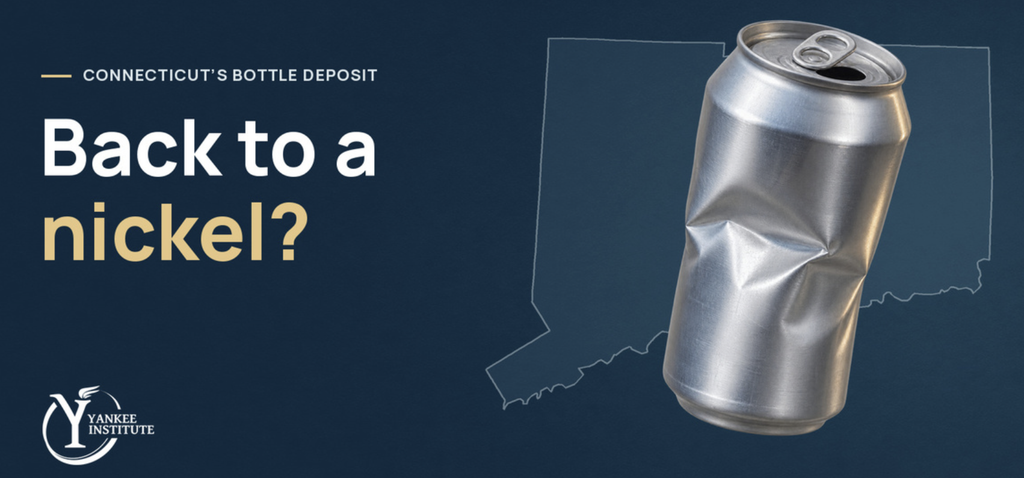
In 2021, Rep. Joe Gresko (D-Stratford) co-sponsored legislation that doubled Connecticut’s bottle deposit. Now he’s having second thoughts. At a Nov. 20 summit hosted by UConn’s Connecticut Institute for Resilience and Climate Adaptation, Gresko said he wants to explore going back to five cents until New York and Massachusetts move to a dime.
The Senate had a chance to revisit the dime this spring. A bill that could have brought back the nickel cleared the Finance, Revenue and Bonding Committee, then sat on the Senate calendar until the session ended without a vote.
Lawmakers had heard the case for keeping the nickel before they ever voted for the dime. It came from a bottle return operator in Gresko’s own town. In March 2021, Stratford’s Frederick Miers warned in written testimony that if Connecticut went to a dime on its own, people would haul their empties here from New York and Massachusetts for the extra five cents.
In June 2021, when the House debated raising the deposit to a dime, House Minority Leader Vincent Candelora (R-North Branford) brought up Kramer’s bottle-deposit scheme from Seinfeld. If Connecticut was going to pay twice what New York paid, how would a redemption center know which cans were bought here?
Candelora asked the bill’s proponent, Rep. Mike Demicco (D-Farmington), whether the barcode requirement was supposed to sort that out. Demicco said that was his understanding. But the law required a standard product barcode. If the same soda carried the same code in both states, a machine in Connecticut could accept a can bought in New York and issue a 10-cent refund.
Gresko spoke later in favor of the bill. He told the House that the original five-cent deposit would be worth about 19 cents if it had kept up with inflation, “but we’ll settle for the dime.” The bill passed both chambers, and Connecticut got its dime. New York and Massachusetts kept the nickel.
Six weeks before the dime took effect on Jan. 1, 2024, the Department of Energy and Environmental Protection told its Bottle Bill Advisory Group that the state had limited capacity to investigate cross-border returns and that their volume was hard to measure. Yankee Institute reported that warning at the time. In fall 2024, DEEP’s Chris Nelson told CT Mirror the agency had heard reports of vehicles loaded with empties showing up with license plates from as far away as New Jersey. The reports were anecdotal, and the state still couldn’t say how many containers had crossed the border.
When a store or redemption center gives you a refund, the distributor pays it back. If an out-of-state can slips through, the distributor is stuck refunding a deposit it never collected. As of December 2025, the businesses that had taken more out of their deposit accounts than they put in were a combined $19.2 million in the red, according to the legislature’s Office of Fiscal Analysis. The fiscal note stops short of saying how much of that $19.2 million shortfall came from refunds of bottles and cans coming across the border.
The rollback bill introduced in the 2026 session would have used the number of containers sold and returned to decide whether to bring back the nickel. If more containers came back than were sold in 2026, either statewide or for even one distributor, the deposit on soda, beer and other covered carbonated drinks would have dropped to five cents across Connecticut. It would have stayed there until the tax commissioner could certify, with “irrefutable evidence,” that every container redeemed here had originally been sold in Connecticut.
Gresko’s idea is simpler. Match New York and Massachusetts at a nickel and revisit the dime if they raise theirs. That would take away the extra five cents on containers carrying a nickel deposit in those states.
Connecticut’s reported redemption rate was 50.4% in the last quarter before the dime took effect. It peaked at 96.9% in the final quarter of 2025, then fell to 79% in the quarter ending June 2026, the latest DEEP has posted. A dime may have encouraged more Connecticut residents to return their empties. The figures show how many containers came back for every hundred sold here, and they leave us guessing where those empties were bought. And a bigger refund only goes so far if getting it back takes too long. At the summit, Gresko said some constituents told him they’d quit returning their empties because of the lines.
The 2025 budget found $2 million in the General Fund to deal with the mess. Lawmakers originally set aside $250,000 for State Police enforcement and $1.75 million for grants to businesses that paid out more in refunds than they took in deposits. By March 31, 2026, legislative fiscal analysts said just $30,500 of the grant money was still available.
In February, lawmakers passed an emergency-certified bill requiring redemption centers to get a license and lowering the daily return limit. It also redirected that $250,000 to DEEP to run the licensing program.
That same bill gave distributors a second round of relief. They could apply for a one-time rebate if their bottle-deposit accounts were in the red on June 30, 2026, and they earned at least 80% of their revenue that fiscal year from distributing alcoholic beverages. The money had to go toward the shortfall. The state capped the rebates at $8 million combined, based on the $10 million it expected to collect as its share of unclaimed deposits in fiscal year 2027. How much it actually paid is still unclear. If distributors keep getting stuck with refunds on deposits they never collected, lawmakers could be back writing a third relief bill.
Lawmakers passed a separate bill adding criminal penalties for willfully collecting refunds on large volumes of containers bought out of state. Since Oct. 1, deliberately cashing in 5,000 out-of-state empties in a calendar year can get you charged with a misdemeanor.
If a nickel bill reaches the Senate in 2027, it deserves more than a spot on the calendar. Senators should put it to a vote and pass it. Lawmakers were warned that paying more for the same empty can would draw returns across state lines. They doubled the deposit anyway, then added paperwork at the counter, put criminal penalties on the books and authorized two rounds of financial relief. That’s a lot of government to defend a five-cent mistake.




Stay updated with the latest in the Constitution State with The CT Centinal