Please Follow us on Gab, Minds, Telegram, Rumble, Gettr, Truth Social, Twitter, YouTube, Instagram
Gov. Ned Lamont won a third term last week after telling voters he saw no need for higher taxes. Asked on WPLR’s Chaz and AJ show in August whether another term would bring tax increases, new fines or new fees, he answered, “I sure as hell hope not,” adding, “I don’t see any need to raise any taxes.”
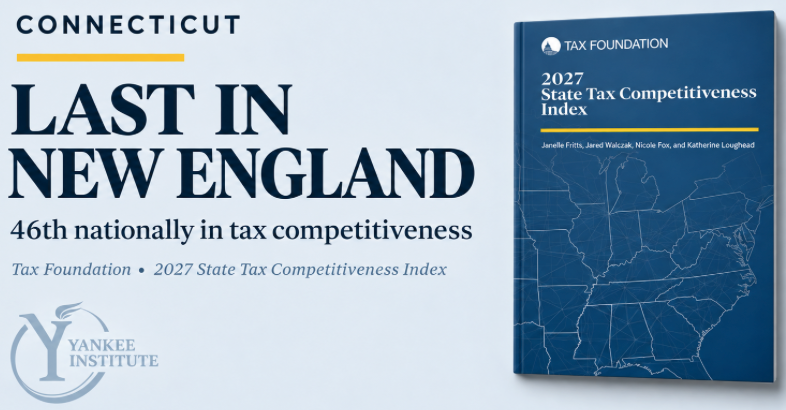
Connecticut taxpayers have reason to want him to stick to that position. The state’s tax system ranks 46th nationally and last in New England in the Tax Foundation’s latest assessment. Yet another income tax increase is being proposed as a way to make living here more affordable.
The Connecticut Citizens’ Assembly, a group of residents brought together to recommend property tax reforms, wants an additional tax of at least 1 percentage point on annual taxable income above $1 million. Its October recommendations would direct the money toward education, child care and health care, with the stated goal of offsetting property tax burdens. The idea is for state funding to cover costs that otherwise fall on local property taxpayers.
Lamont has repeatedly said Connecticut needs “more taxpayers, not more taxes,” warning that higher income tax rates on wealthy residents would drive them out of the state.
Homeowners’ frustration is understandable. Connecticut ranks 49th in the study’s property and wealth tax category. But raising another tax carries costs of its own — and nearby states offer warnings.
The Tax Foundation, a nonpartisan research organization, released its 2027 State Tax Competitiveness Index on Nov. 5. It evaluates how states structure their tax systems, using policies in place as of July 1, 2026. It favors simpler taxes, broader tax bases and lower rates; it does not grade the public services those taxes purchase.
Connecticut moves up one place, from 47th to 46th. Forty-five states still do it better, including every other state in New England. Connecticut finishes last in the region for the eighth consecutive edition.
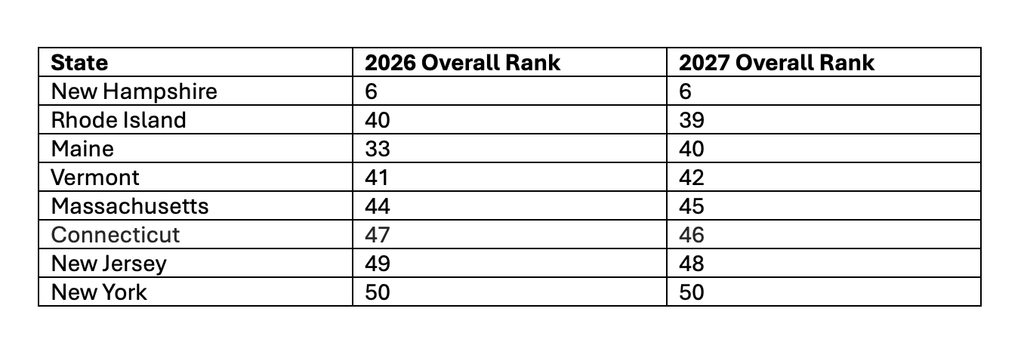
A new tax on high earners helped send Maine tumbling seven places in the rankings. Its 2 percentage point surcharge raises the top income tax rate to 9.15 percent on income above $1 million for single filers and $1.5 million for joint filers. The foundation directly attributes Maine’s decline to that change and also criticizes its marriage penalty.
The warning for Rhode Island comes before the higher tax bills. Lawmakers adopted a surtax on million-dollar incomes in June, but it begins taking effect in 2027. Over three years, the top rate will rise from 5.99 percent to 8.99 percent. The foundation says its standing will suffer in future editions.
Voters in Massachusetts approved their millionaires tax in 2022. The additional 4 percent tax took effect in 2023, with the income threshold adjusted annually for inflation. Massachusetts now ranks 45th overall and 43rd on individual income taxes, although this year’s one-place overall decline cannot simply be blamed on a tax adopted several years ago.
Connecticut’s assembly recommendation is separate from the tax bills proposed during the last legislative session. Those proposals included increasing the top income tax rate from 6.99 percent to 7.99 percent, adding a capital gains surcharge and creating a statewide property tax on high-value residential real estate.
Asked during a preview briefing whether a millionaires tax would hurt Connecticut’s score, Janelle Fritts, a senior policy analyst at the Tax Foundation, answered directly: “yes, that would definitely drop a score back down for sure.”
Fritts pointed to Maine as an example. “Just like we saw with Maine this year, any state that is imposing a new tax bracket on really high earners is going to see pretty significant reductions in their individual income tax score,” she said.
A ranking alone cannot tell us how much revenue a surcharge would raise or whether residents would leave. But states do compete for taxpayers, a concern New York Gov. Kathy Hochul acknowledged in March.
“I am in competition with other states who have less of a tax burden on their corporations and their individuals,” she said.
Hochul said she has no philosophical objection to higher taxes on the rich. But she warned that driving them out would mean losing taxpayers who help fund New York’s programs. Connecticut should pay attention before counting on a bigger check from the same taxpayers Lamont says he wants to keep.
Even California voters said no. Proposition 40, the proposed billionaire wealth tax, lost 52.8% to 47.2% in the Nov. 3 election. An October Hoover Institution study warned the tax could backfire: Billionaires who left would take their future income tax payments with them.
The researchers projected that, after accounting for future tax losses, California would come out $38.9 billion behind. California’s proposal targeted billionaires’ wealth; Connecticut’s targets million-dollar incomes. The study doesn’t predict Connecticut’s results. It does show why revenue estimates must account for taxpayers’ responses and not just the higher rate.
Connecticut already ranks 45th on individual income taxes. The foundation calls it “one of the most complex and least neutral individual income tax systems in the nation.”
Its seven brackets come with a catch called “recapture.” Earn enough, and the state takes back some or all of the savings from the lower rates.
Connecticut doesn’t adjust its income tax brackets or personal exemption for inflation. A raise that barely covers higher prices can still push more of your income into a higher tax bracket.
Homeowners deserve lower property tax bills, too. The assembly’s proposal would collect more income tax to finance its promised relief. Connecticut should instead be looking at the spending and mandates driving those property tax bills — and bringing the bills down without sending someone else a bigger one.




Stay updated with the latest in the Constitution State with The CT Centinal