Please Follow us on Gab, Minds, Telegram, Rumble, Gettr, Truth Social, Twitter, YouTube
Nearly 20 years ago when I first emersed my mind in the American Revolution, I wondered if George Washington was overrated. I also wondered if King George III was truly stubborn or if that was a bit of a myth. I ended up comparing the two men at the start of my devotional book, Stories of Faith and Courage from the Revolutionary War. This project was lifechanging and gave me perspective that I have drawn from ever since. Washington remains my favorite president. Enjoy these excerpts.

The news was false. He was not dead.
“Dear Jack,” he began his urgent letter, dated July 18, 1755, to his brother.
Fatigue swept over this English soldier, but rumors of his death drove him to write no matter how weary his hand or heavy his heart. Explaining the truth was the only way to prevent the smoke of misinformation from needlessly suffocating his family.
“I take this early opportunity of contradicting both [my death and final words] and of assuring you that I now exist and appear in the land of the living by the miraculous care of Providence, that protected me beyond all human expectation,” he explained.
After the indescribable battle in the Ohio Valley, this young colonel fell into the warm embrace of Maryland’s Fort Cumberland. The terror he had just experienced plagued him worse than any nightmare. He couldn’t shake the sight of his bullet-pierced coat. “I had 4 Bullets through my Coat, and two Horses shot under me, and yet escaped unhurt,” he recounted to Jack of how Providence had protected him.
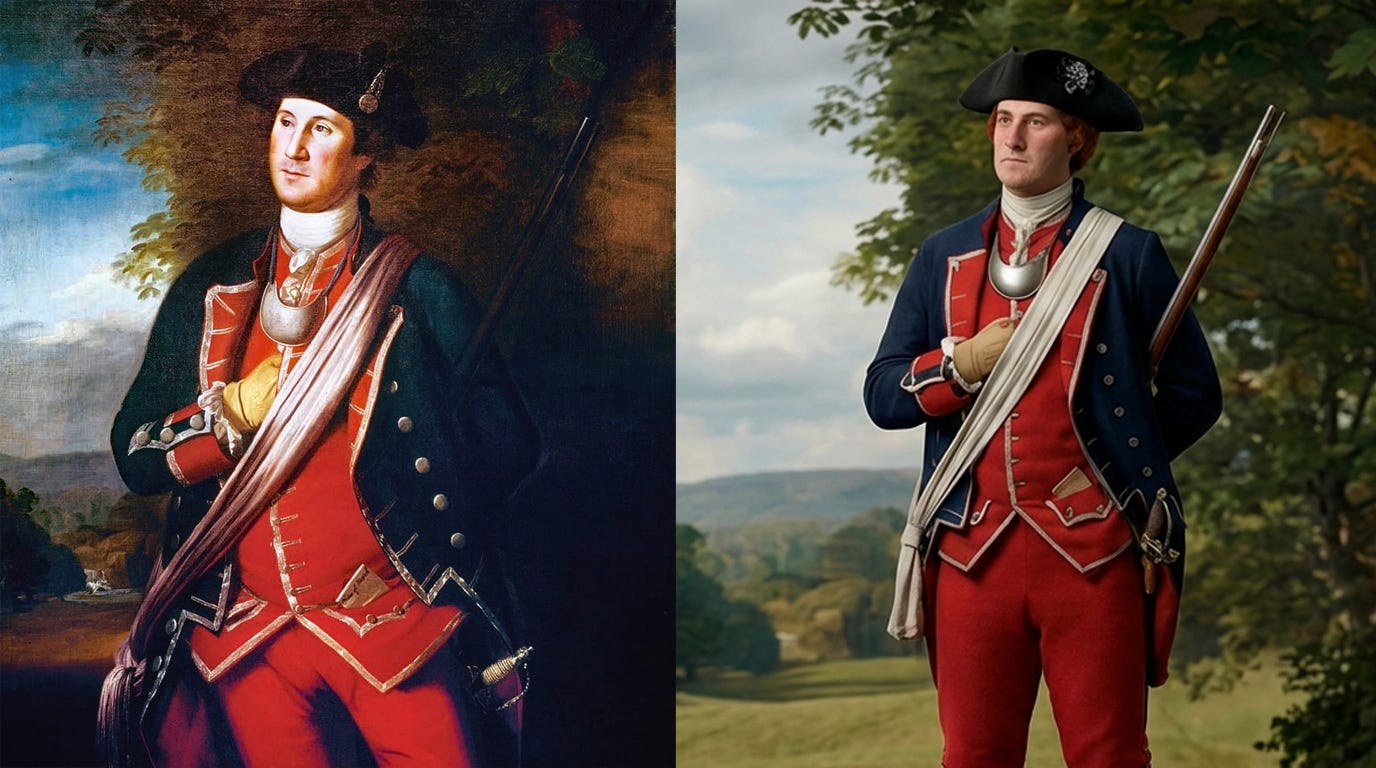
Although he felt no physical injuries, the battle left his heart wounded. This new war was partially his responsibility. His earlier expedition for the British had resulted in the death of a French diplomat. The incident caused England’s problems with the French and Indians to escalate faster than a ship could carry British soldiers to the American colonies. When the war came, he dutifully joined General Edward Braddock and his Virginia regiment. Their mission was to protect America’s boundaries against the trespassing French and Indians in the Ohio Valley. But they failed.
“We have been most scandalously beaten by a trifling body of men; but fatigue and want of time prevents me from giving any of the details till I have the happiness of seeing you at home; which I now most ardently wish for,” he wrote, knowing he would need a few days to regain his strength before traveling again.
Fort Cumberland’s position along the Potomac River likely reminded him of another estate, a place he considered home. Located one hundred and fifty miles down the same river in Virginia was the house and farm of his deceased brother Lawrence. He had no idea how important that place would one day become to him.
“I may thereby be enabled to proceed homewards with more ease; You may expect to see me there on Saturday or Sunday,” he wrote.
“I am Dr. Jack, y’r most Affect. Broth’r.”
And with that, twenty-two-year-old George Washington closed his letter. The awe of Providence’s protection had sparked something inside him. Why had he survived? What was the meaning behind the four bullet holes in his coat and the horses shot from under him? While he recovered, he reveled in the mystery and meaning behind the miracle, evidence of the fingerprints of angels.[i]
“The angel of the LORD encamps around those who fear him, and he delivers them” (Psalm 34:7).
Prayer: Lord, be my shield and protector. May I live today knowing you have given my life purpose and meaning.
There’s something about George, James, the second Earl Waldegrave, may have thought as he began his memoirs one day in 1758.

James Waldegrave, once a prime minister of England, probably hesitated to put his concerns into writing. But something in his princely pupil’s behavior perturbed him. Perhaps writing about it would clarify what it was about Prince George that bothered him.
“The Prince of Wales is entering into his twenty-first year, and it would be unfair to decide upon his character in the early stages of life, when there is so much time for improvement. His parts, though not excellent, will be found very tolerable, if ever they are properly exercised,” James began.
And while George’s character was tolerable, neither good nor bad, James doubted his protégé had the motivation to attempt greatness. He knew the next king of England would need to soar above mediocrity to end wars and make peace.
James may have stopped writing at that moment to reflect. He had treasured his friendship with George’s grandfather, King George II, and respected him. James also knew the workings of the British government. When the king asked him to be the governor of his grandson George III, James dutifully accepted the mentoring assignment.
Perhaps I should reflect on the prince’s good points, James may have thought as he penned the next line. “He is strictly honest,” he wrote, “but wants that frank and open behaviour which makes honesty appear amiable.”
James thought about young George’s handling of money, which was inferior to his grandfather’s business savvy. “It was one of his favorite maxims that men should be just before they are generous: his income is now very considerably augmented, but his generosity has not increased in equal proportion,” wrote James.
James probably put down his pen in frustration. The truth was harder to chew than month-old bread. Unless something changed, George’s character would not make him a great king. The reason? George lacked the motivation to improve.
The mathematics of the situation was also troubling. George’s father was dead, and his grandfather the king was seventy-five. It wouldn’t be long before this uninspiring young man would become King George III. The thought of George the Mediocre as king was a constant source of concern.
The words and tune of a new song, introduced to the court a few years earlier, may have surfaced in the mind of James, the second Earl Waldegrave, at that moment: God Save the King.
Indeed. God save us, everyone.[iii]
“By justice a king gives a country stability, but one who is greedy for bribes tears it down” (Proverbs 29:4).
Prayer: Father, examine my heart today. Remove any mediocrity that prohibits me from seeing and understanding you and the areas you want to change in my life.
[i] George Washington, “Letter to John Augustine Washington, July 18, 1755,” in The Writings of George Washington from the Original Manuscript Sources, 1745–1799. ed. John C. Fitzpatrick. Library of Congress. Printed from http://memory.loc.gov/ [accessed June 2006].
[ii] George Washington, “Letter to His Mother,” in America, Vol. 3, 51. Printed from http://www.originalsources.com [accessed June 2006].
[iii] James [2d] Earl Waldegrave, Memoirs from 1754 to 1758, ed. H. R. V. Fox, (London, 1821), 8–10. Printed from http:www.originalsources.com [accessed June 2006].
[iv] Ibid.


Stay updated with the latest in the Constitution State with The CT Centinal