Please Follow us on Gab, Minds, Telegram, Rumble, Gettr, Truth Social, Twitter, YouTube, Instagram
Earlier this week I found out that my new Great and Grateful Nation book received the 2026 Christian Living Book of the Year award from the Advanced Writers and Speakers Association. I am as surprised as I am grateful. Thank you AWSA!

Below is the final excerpts from my book, War of Lies: When George Washington Was the Target and Propaganda Was the Crime. If you’ve seen the new movie Young Washington, you’ll recognize this story of George Washington’s near-death miracle during the French and Indian War years to life. Now is a great time to revisit this relevant story.

When False News is Deadly
The news in July 1755 was false. How did Washington know? The truth was as obvious as the warmth of his breath. He was not dead. He was still alive.
“As I have heard since my arrival at this place, a circumstantial account of my death and dying speech, I take this early opportunity of contradicting the first, and of assuring you that, I have not yet composed the latter,” Washington urgently wrote from the crude, pathetic post known as Fort Cumberland, Maryland, to his brother Jack on July 18, 1755. Cumberland was named for one of King George II’s sons, William Augustus, who was the Duke of Cumberland.
After the worst battle he’d ever witnessed, Colonel Washington had arrived at Fort Cumberland only to see shock on the sunburned faces of the regular British redcoats when they realized that he was alive. Though they’d concluded that he’d died in the enemy attack near Ohio’s Monongahela River, he knew that their intent wasn’t malicious. Their assumption was understandable. After all their commander, General Edward Braddock, had also died, as had most of the officers. Sir Peter Halkett, the Scottish baronet and former member of Parliament, who led the 44th Regiment was shot dead on the spot. Colonel Washington was the only aid-de-camp to Braddock who wasn’t killed or wounded.
After Braddock’s injury, Washington had stepped in to issue the general’s orders to complete the retreat. As a result, he was one of the last to leave the battle and make the one-hundred twenty-mile journey back to Fort Cumberland.
With his name on the killed-in-action list, Washington feared that the survivors who’d already left Fort Cumberland to travel back to Virginia would deliver the false report of his death to his family. Hence, he speedily wrote separate letters to his mother and brother to assure them that he was alive.
“As I doubt not but you have heard of our defeat, and perhaps have had it represented in a worse light (if possible) than it deserves,” he wrote delicately and diplomatically to his mother.
Seeing Washington walk into Fort Cumberland wasn’t just shocking to his fellow soldiers. It was also miraculous. How did Washington survive? After all, the repeated fire of muskets in the forest created a cloud of smoke that hovered under the canopy of trees. This prevented the soldiers from being able to see both their fellow soldiers and the enemy, who hid behind the trees with their bellies on the ground and fired.
“But by the all-powerful dispensation of Providence, I have been protected beyond all human probability and expectation for I had four bullets through my coat, and two horses shot under me, and yet although death was leveling my companions on every side of me, escaped unhurt,” Washington explained with awe to Jack over the mystery of his preservation seemingly at the hands of angels. With so many bullet holes in his coat, he, too, was astonished that he hadn’t been injured or killed.
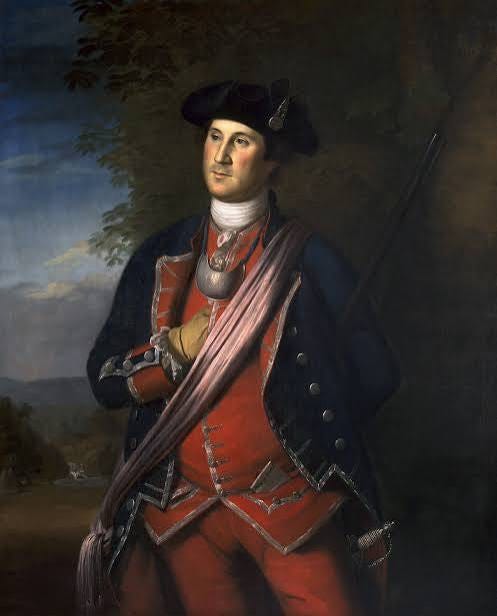
In this near-death experience, Washington showed his sincere respect for God by crediting Providence for his survival. In contrast to the modern definition of good luck, in the 1700s, ministers defined Providence as God’s presence among his people. Likewise, the 110 Rules of Civility had taught that: “When you speak of God or his attributes, let it be seriously and with reverence.” In Washington’s world, Providence was a respectful way of invoking and celebrating God’s divine intervention.
Washington also gave his mother a few details of the battle. “I have taken this earliest opportunity to give you some account of the engagement, as it happened within seven miles of the French fort on Wednesday the 9th Inst (July 9).”
In response to the construction of French forts in the Ohio River valley, King George II and the Duke of Cumberland had sent General Braddock with regiments of regular British soldiers to the colonies. Along with militia from Virginia, this combined English force of regulars and militia left Fort Cumberland in late May 1755 to march to France’s Fort Duquesne. The advance parties literally cleared paths and built the roads on their route. Sometimes the hills were so steep and the paths so rough, that they had trouble hauling their wagons, which carried supplies, cannon, and the sick. This included Washington for several days.
On their final advance toward Fort Duquesne on July 9, Braddock ordered his men to march with their British flags flying while the band played the Grenadiers’ March. Such an ear and eye-catching spectacle was typical of European warfare, but not common among the area’s native tribes, who fought from behind trees.
Hearing the rhythmic music and marching and seeing the red and buff uniforms of the English, the nearby French troops and their native allies fanned out in a crescent shape among the trees on both sides of the route and prepared for an ambush. Colonel Thomas Gage led Sir Peter Hackett’s regiment, the 44th, in the English procession. General Braddock was next with the 48th Regiment. As an aid-de-camp to Braddock, Washington accompanied him. Behind them were the soldiers from Virginia. As the advance regiment approached, the natives fired single shots at particular officers.
“We were attacked by a party of French and Indians, whose number, I am persuaded, did not exceed three hundred men; while ours consisted of about one thousand three hundred well-armed troops, chiefly regular soldiers, who were struck with such a panic that they behaved with more cowardice than it is possible to conceive,” Washington angrily revealed to his mother about his brothers-in-arms, the redcoats.
Gage ordered his men to maintain their rows and return fire, which was a signal to the French and natives to ambush them. Letting out a war cry, they fired at Braddock’s soldiers from the forest. They continued to fire at specific officers, especially Washington, who stood out because of his tall height. Though the officers tried to rally the soldiers, the 44th and 48th regiments broke and retreated. The Virginians continued to fight, often taking positions behind trees, for three hours. In the midst of the fire, Washington had successfully moved the mortally-wounded General Braddock to a wagon, which carried him across the knee-deep river.
“I was the only person then left to distribute the general’s orders, which I was scarcely able to do, as I was not half recovered from a violent illness, that had confined me to my bed and a wagon for above ten days,” Washington wrote, referring to his recent bout with dysentery, a diarrhea disease.
During a pause in the action while the enemy scalped some of the wounded, Washington organized some of the fleeing troops into a rear guard. He brought wagons and medical supplies to remove the wounded. While assuring his family of his survival, he also fumed about the regular regiments, who failed to support the Virginia militia and instead fled in a panic.
“In short, the dastardly behavior of those they call regulars exposed all others that were inclined to do their duty to almost certain death; and at last, in despite of all the efforts of the officers to the contrary, they broke, and run as sheep pursued by dogs; and it was impossible to rally them,” he wrote with disdain.
Washington had also experienced snubbing and snobbery against him by the British officers before the battle. Refusing to recognize his rank as a lieutenant colonel, they had tried to place him under the authority of English officers in the regular army of lower rank than Washington’s. To avoid being under the command of a junior officer in the British regular army, Washington had kept his self-respect intact by serving as an unpaid volunteer aid-de-camp for Braddock.
Whatever frustrations he may have had before the battle with his fellow officers from England, their behavior and abandonment left a seed of distrust against the British in his heart that only grew stronger with time.
After such a devastating loss, Washington longed not for his stern mother’s home but for sturdy Mount Vernon, where his brother Jack lived. “We have been most scandalously beaten by a trifling body of men; but fatigue and want of time will prevent me from giving you any of the details till I have the happiness of seeing you at Mount Vernon; which I now most ardently wish for,” he wrote to Jack, hinting that he needed a few days to regain his strength before traveling home. No doubt relief washed over him when he arrived at Mount Vernon on July 26, 1755.
The Pennsylvania Gazette published an article about the Battle of Monongahela River and Braddock’s death along with the fate of his other two aide-de-camps. “The general had five horses killed under him and at last received a wound through his right arm and into his lungs of which he died the 13th instant; Secretary Shirley was shot through the head; Captain Morris wounded.”
Because Washington had intercepted the erroneous military report of his death, the Pennsylvania Gazette reported the truth of his status while also praising his valor on July 31. “Mr. Washington had two horses shot under him and his clothes shot through in several places, behaving the whole time with the greatest courage and resolution.”
Washington was not alone in his awakening to the cowardice of the British regulars.
The fallout from Braddock’s defeat was discussed in London. Accusations of corruption and contempt poured from the pens of Englishmen reeling from the resounding loss. Many were angry that the regiments had abandoned their duty to the Americans.
The prestigious publication of record published this story in London. “The Virginians who formed the rear still stood unbroken, and continued the engagement on very unequal terms near three hours, but were then compelled to retire,” the Gentleman’s Magazine praised the American fighters while also blaming the British regulars. “The European troops, whose cowardice has thus injured their country and (are) the same that ran away.”
Likewise, private letters sent to Dublin, Ireland, from London were published in the Pennsylvania Gazette on October 30, 1755. The letters declared that “the regiments of foot commanded by Colonel Dunbar and Sir Peter Halkett being struck with a panic refused to fight, and laid down their arms, by which 62 of their officers, who fought bravely with the Americans, are killed or wounded.” The author of this letter faulted the British soldiers. “Had these private men of the above regiment done their duty; victory would have been on our side.”
Still others pointed to corruption as a reason for the failure. A report from London printed in the Boston Evening Post in December 1755 revealed that the crown rewarded Governor Dinwiddie in Virginia by sending the troops there. “That our land forces were sent to Virginia instead of Pennsylvania to their inseparable disadvantage, merely to answer the lucrative use of a friend to the ministry, to whose share the remittances would then fall at the rate of two and a half per cent profit.”
This report believed that Braddock should have landed his troops in New York or Philadelphia and attacked France’s Niagara fort instead. The assertion implied that someone in the British government was paying Governor Dinwiddie a political and financial favor by sending Braddock to Virginia. Though corruption may have played a role, General Braddock and his bosses failed to understand that the Potomac River was too narrow to carry troops by boat from Virginia into Maryland. They under-estimated the difficulty of clearing paths and building roads.
Braddock had been advised to be aware of being surprised and to listen to the Americans, who knew the territory and had allies with certain native tribes. “Your courage is undoubted, but accidents may happen; and they will be forgiven. What you were expected above all to guard against is a surprise and to keep in with the Americans, who will prove your best instructors in the important expedition you are engaged in,” an anonymous source revealed about his advice to Braddock.
The fallout from Braddock’s defeat was a widespread war. “This unfortunate and unexpected change of our affairs will deeply affect every one of his Majesties colonies,” the lieutenant governor of Pennsylvania declared in a speech to the general assembly. Benjamin Franklin published this speech alongside the account of Braddock’s loss and Washington’s miraculous preservation in the Pennsylvania Gazette.
Washington’s near-death experience gave him a bond with those who’d also survived. Another officer who was wounded was thirty-six-year-old Lt. Colonel Thomas Gage, who led the 44th Regiment. Also shot in the chest was another British regular soldier, Horatio Gates. Both Gage and Gates had what Washington desired, a regular commission. Both men would later influence Washington’s life in ways he couldn’t possibly imagine in 1755. He had no idea he’d become a commanding officer over Gates and an enemy combatant to Gage.
Another man’s name in particular would later play a role in the Revolution’s War of Lies decades later. His ancestry was associated with treason and an officer who died under Braddock.
“Sir Peter Halkett was killed in the field,” Washington reported to his mother, Mary Ball Washington. of the aristocrat with a haughty history and questionable loyalty. This was possibly the first member of Parliament that Washington had ever met.
Though Halkett was a prestigious Scottish baronet who had lived in a castle, he had a notorious history as did his regiment. Led by Colonel John Lee, the 44th Regiment was raised in 1741. When Prince Charles Edward Stuart landed in Scotland in 1745, and claimed the British throne for his father, an armed conflict broke out known as the Jacobite Rebellion. Lee was conspicuously absent when this conflict erupted. This forced Halkett, a lieutenant at the time, to lead the 44th in Lee’s place against the Jacobines at the Battle of Prestonpans in October 1745.
The battle was a swift victory for Stuart. Halkett and fifteen of his soldiers surrendered. The Jacobines freed them. In exchange, Halkett and the 44th Regiment did not participate in the British government’s remaining battles with the Jacobines. Suspecting Halkett of treason, King George II and his son, the Duke of Cumberland, fired Halkett. Though the king later rehired him, he and others viewed him and his regiment with cowardice and incompetence.
Colonel John Lee was under similar suspicion for a time, though he was later promoted to a general. His son Charles Lee joined his father’s old regiment under Halkett’s leadership. General John Lee died before the conflict in Ohio broke out.
When the Duke of Cumberland chose the 44th Regiment to serve under Braddock, Captain Charles Lee was enjoying the spa resort town of Bath, England. “I fancy you have heard that our regiment is order’d to Virginia,” he wrote to his sister, cancelling his visit to see her. He wrote his will and traveled to Cork, Ireland, where the 44th led by Halkett departed for Alexandria, Virginia.
In Washington’s view, Charles Lee was like a sheep pursued by dogs for fleeing the battlefield with the 44th in Ohio. He was likely at Fort Cumberland when Washington arrived after Braddock’s defeat. From the start of their relationship, the two were destined to be rivals.
News of Washington’s miraculous preservation soon caught the attention of many colonists. Some wondered publicly if Washington’s life had been preserved for a special task. His survival inspired many Virginians to sign up to fight, including Captain Overton’s Independent Company of Volunteers in Hanover County, Virginia. They gathered on August 17, 1755, to hear from a minister who’d been part of the spiritual revival that had swept the colonies in the 1740s called the Great Awakening.
The Reverend Samuel Davies was a Presbyterian minister who’d recently traveled throughout England and Scotland to raise money to train ministers at a new college in New Jersey, which was later called Princeton. He’d returned to his ministry in Hanover County, Virginia, at the same time that Braddock had landed in Alexandria with this troops.
Davies spoke to Overton’s company and pointed out the heroism of Colonel Washington, whom Providence had preserved for important service to his country. During this era, publishing sermons was common but ministers only published the sermons they considered to be their best. Fond of this one, Davies published this sermon with the footnote about Washington’s miraculous survival and distributed it throughout the colonies and England in 1755. This sermon, along with newspaper articles, spread Washington’s name and fame on both sides of the Atlantic Ocean. Washington’s near-death experience elevated him to hero’s status and erased any doubts the alleged assassination story may have created. Washington was more than a newsmaker. He was a media darling and a well-deserved war hero.
Within three months of returning to the comforts of Mount Vernon, Washington received urgent news that required him to leave again. “By an express just arrived (in Williamsburg) from Fort Cumberland,” the Pennsylvania Gazette was informed on October 30, 1755, that the enemy had “lately appeared in that neighborhood, and have killed and captured upwards of 20 families.”
Governor Dinwiddie convinced Virginia’s House of Burgesses to fund money for raising recruits to go to Ohio to fight. The Burgesses also gave Colonel Washington a new mission. The Pennsylvania Gazette reported that Washington would “take upon him the command of such of the recruits already raised, in order to go in pursuit of them.”
Defeating the French now required Washington to mount his horse and ride to several places to recruit regiments of soldiers. For the first time, people in other colonies had the chance to meet their hero. His arrivals in Philadelphia, New York, and Boston were so significant, that each made the newspapers in the winter of 1756.
The Pennsylvania Gazette reported on February 12: “Last week Colonel Washington arrived here from Virginia.” A few days later on February 16, the New York Mercury reported that upwards of one hundred recruits had arrived: “Last night Colonel Washington arrived here (New York) from Philadelphia.”
“Colonel Washington, of and from Virginia . . . left this city (New York) for Boston on Friday last, there, ‘tis thought to consult with General Shirley, measures proper to be taken with several tribes . . . particularly the Cherokees, some hundreds of whom, from the back parts of the two Carolinas, it is reported, have assured the Western governments of their coming in, and firmly adhering to the Indians of the English in opposition to the French.”
Washington also lobbied Governor Shirley for a commission in the Royal Army. Though he didn’t give him what he wanted, Shirley issued an order that officers in the Virginia militia would outrank officers of lower rank in the British army.
Recruiting wasn’t easy. “You may, with almost equal success, attempt to raise the dead to life again, as the force of this country,” Washington wrote sarcastically to his brother Jack about the challenges of convincing men to fight. Little did he know at the time, but by dutifully recruiting men from New York, Pennsylvania, and Massachusetts, he developed knowledge of these colonies and a kinship with the men he recruited. Such ties of brotherhood strengthened over time.
Parliament officially declared war in May of 1756. In North America, the conflict was called the French and Indian War while in Europe it was called the Seven Year’s War. More Virginians rallied to Washington’s heroism. The prominent Randolph family stepped forward. Though he’d failed to convince the king’s Privy Council to repeal the tax issued by Dinwiddie, Virginia Attorney General Peyton Randolph had returned from London to Williamsburg. There he raised three hundred reservists called the associators.
“Some public spirited gentlemen have done me the honor to fix upon me as their leader, till we can come to the place where you command; when we shall be very glad to follow such orders, as you shall think most conducive to the public good,” Peyton Randolph wrote to Washington on May 3, 1756. Not every member of the Randolph family would prove as loyal to Washington in the decades to come. One would become a viable suspect in the Revolution’s War of Lies.
Within a year of his recruiting efforts, Washington came face to face with false news that once again threatened his public image. As he soon discovered, the most convincing misleading news is a report that mixes truth with fiction, leaving people confused about what to believe.
The terms of his surrender after the Battle of Fort Necessity in 1754 had forced Washington to turn his journal over to the French. Three years later in 1757, the French commander of Fort Duquesne published Washington’s journal in French. When Washington saw the English translation of the French version of his English journal, he instantly recognized that part of it was a forgery. At least some of the diary entries published under his name were fabricated.
Washington was traveling when he received a request from historian William Smith of Philadelphia to respond to the French publication of his journal. “In regard to the journal . . . rough minutes of occurrences I certainly took, and find them as certainly and strangely metamorphosed,” Washington defended.
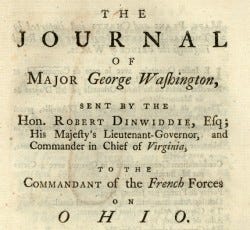
He made general observations about this translation of his journal, writing that “some parts (were) left out, which I remember were entered, and many things added that never were thought of; the names of men and things egregiously miscalled; and the whole of what I saw Englished is very incorrect and nonsensical.”
Unlike the false report of his death at Fort Cumberland, this was maliciously fake, a forgery. Up until this point in his life, false news was largely the result of inaccurate information. The delay of weeks before news from the frontier could arrive in places such as Philadelphia led to simple mistakes, such as calling Washington a major when he’d been promoted to a colonel. His commitment to linger at the Battle of Monongahela to care for the wounded and dead resulted in the redcoats’ erroneous assumption that he’d died.
In contrast, by publishing his journal and removing or adding passages in 1757, the French committed a malicious act, a form of war propaganda. This was a direct attempt to take the shine off an English hero’s chivalrous, shining public image. Great Britain’s enemy was deliberately falsifying Washington’s words.
Did Washington tell the public that his journal was a forgery? No. In this letter, he didn’t have time to go into great detail or “point out such errors as might conduce to your use, my advantage, and the public satisfaction; but now it is out of my power.”
This was one of several occasions where Washington didn’t directly and publicly refute false information about him in the newspapers. Without time to let it bother him, Washington put his faith in his fellow English subjects. Relying on his character and reputation, he believed that they would see the publication for what he believed it was: rubbish from their enemy. He seemed to be putting his faith in civility rule “50: “Be not hasty to believe flying reports to the disparagement of any.” What mattered most to him was the big picture. He had a war to win for his country and king.
Deciding to reorganize their forces in America in 1758, the British military gave the command to General John Forbes. Colonel Washington and his Virginia regiment served under Forbes along with Colonel William Byrd’s regiment. Forbes planned and organized the effort that culminated in an expedition to Fort Duquesne in 1758. Once again, the newspapers chronicled Colonel Washington’s role in these events.
“Since our last we have had several imperfect accounts of a skirmish between a party of our army, and another of the French, near Loyal Hanna, from which the best account we can at present give is as follows,” the Pennsylvania Gazette reported on November 30, 1758. Loyal Hanna was roughly forty miles east of Fort Duquesne. “That on the 12th instant, Colonel Washington being out with a scouting party, fell in with a number of the enemy, about three miles from our camp, who he attacked, killed one, (and) took three prisoners.”
The only good news that came out of this incident was that one of the prisoners, Mr. Johnson of Pennsylvania, knew a lot about the French at Fort Duquesne. If enough pressure was put on him, he just might tell them everything. Best of all, they didn’t need a translator. Johnson spoke English.
Warning him not to give “false intelligence,” an interrogator said that he’d “forfeited his life by being found in arms against his king and country; the only way left to save it, and make atonement, was, to give as full information of the condition of Ft. Duquesne and of the enemy as he could; which being found to be true, his life should be spared.”
Johnson complied, revealing that many of the French Canadians and their native allies had left Fort Duquesne. “The French were very scarce of provisions as well as weak in men.” The sight of nearby horse carcasses was a sign that the French were short on food and had resorted to eating horses. “Whole skins and bones were afterwards found by some of our men.” Convinced that Johnson was telling the truth, Forbes, Washington, and Byrd led their combined force of six thousand men to seize Fort Duquesne. Building a road, in late November of 1758, Washington’s forces led the advance and approached the fort, which the French abandoned and burned. This allowed the British to easily make it their own.
“Pittsburgh, formerly Fort Duquesne,” the letter published by the New York Mercury began. “I have the pleasure to write this letter upon the spot where Fort Duquesne once stood, while the British flag flies over the debris of its bastions in triumph,” an unnamed member of the British forces wrote.
These victorious Englishmen renamed the fort to Pittsburgh after William Pitt, the leader of the House of Commons. This spot on the banks of the Ohio River was “the finest and most fertile country of America.” With the French retreating, the war had turned in Britain’s favor, at least in North America. The war would continue in Europe until 1763.
The victory was bittersweet for Washington. After all he’d sacrificed by risking his life numerous times in Ohio, the British military still withheld the one honor he felt he most deserved: a commission in the regular Royal Army.
Washington resigned his commission in the Virginia militia at the end of 1758. Recently elected to the House of Burgesses, he married Martha Custis, a wealthy widow with two children, on January 6, 1759. Together they lived at Mount Vernon, which he’d inherited from his brother Lawrence, who’d died in 1752. Washington took on a new occupation as a farmer. By this time, his life in one way or another had intersected with key people—Thomas Gage, Horatio Gates, Charles Lee and members of the Randolph and Rivington families—who opposed him in various ways during the American Revolution. One or more of them would play a part in the theatrics of the War of Lies.
Except for occasional mentions in the newspaper as a member of the House of Burgesses or advertising real estate, Washington never envisioned that he’d ever play the role of newsmaker again, much less newsmaker-in-chief. How wrong he was. Five years before the American Revolution began, one chief with the insight of a prophet, made an astonishing prediction.


Stay updated with the latest in the Constitution State with The CT Centinal