Please Follow us on Gab, Minds, Telegram, Rumble, Gettr, Truth Social, Twitter, YouTube
Communities and churches throughout the United States have been celebrating National Marriage Week during this week that ends with Valentine’s Day.
Despite an onslaught of anti-marriage press, researchers from the Institute for Family Studies (IFS) and The Wheatley Institute say that married American men and women are still more likely to be happier and more successful than those who are single.
In a new study released this month, authors Jeffrey Dew, Brad Wilcox, and Jason Carroll found four factors that appear to be strong predictors of both marital happiness and stability for both men and women.
Using data from the 2022 State of Our Unions Survey (SOU22), with responses from 2,000 married men and women in the United States, the researchers were able to identify key predictors of marital quality:
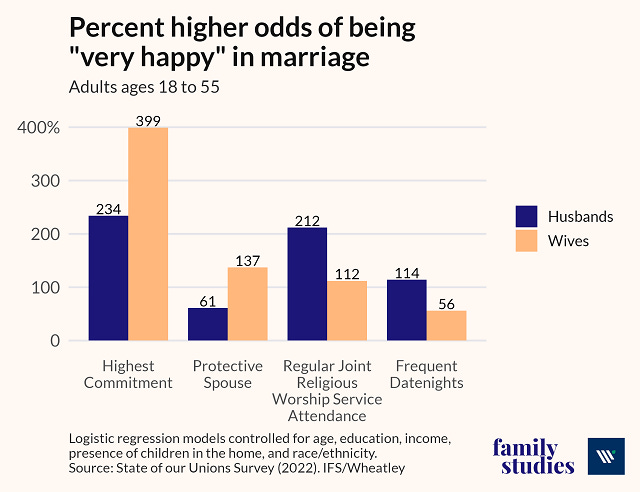
“The odds of being very happy in marriage based on these characteristics are shown in Figure 1,” they reveal.
"It is striking that the same four factors are strong predictors of both happiness and stability in marriage for both men and women,” the researchers observed. “This creates extra confidence that these aspects of marriage are particularly strong in predicting which marriages will be happy and thriving.”
Additionally, they noted that all four factors “are attitudes and behaviors that spouses can actively choose and put into practice in their relationships.”
“Simply put, each factor provides some ‘how-to help’ for couples striving to stay close to each other and make their marriage last.”
The fact that the first factor is full commitment to the marriage appears to be a no-brainer, the authors admit. What they found specifically is that wives who agreed their marriage to their husbands was one of the most important aspects of their lives were 399% more likely to be happily married than those who did not have that same level of commitment.
Husbands who placed their marriage among the most important aspects of their lives were 234% more likely to be happily married compared to those husbands less committed.
For the second factor, wives who said it was “definitely true” that their husbands are protective of them were found to be 137% more likely to be very happily married and 134% more likely to report having a stable marriage than those who rated their husbands as less protective.
Husbands who said their wives were protective of them were found to be 61% more likely to be very happily married and 98% more likely to report being in a highly stable marriage than other husbands.
Shared church attendance was also found to be predictive of a happy and stable marriage.
“Our analysis found that wives who attended church regularly with their husbands had odds of being very happy in marriage that were 112% higher than women who attended less often or not at all,” the researchers observed. “For husbands, regular shared church attendance was associated with a 212% boost in their odds of being very happy in marriage compared with their less religious or non-religious peers.”
As for stability, wives who reported regular shared worship attendance showed odds of perceived marital stability that were 124% higher than those of other wives.
Similarly, husbands who reported consistent worship attendance with their wives were 116% more likely to report stable marriages compared to other husbands.
The authors highlighted as well results of another recent study that found married couples who regularly practice religion in their homes were more likely to report a strong sense of meaning and purpose in their lives, as well as higher levels of life satisfaction and happiness, compared to less religious couples.
“Couples who regularly engage in home religious practices also report significantly higher levels of shared decision making between partners, fewer money problems, and more frequent patterns of loving behavior such as forgiveness, commitment, and kindness than their less-religious peers,” the researchers noted.
The practice of taking regular date nights is the fourth key factor found to increase the chances of experiencing a happy marriage.
“Wives reporting regular date nights had odds of being very happily married that were 56% higher than wives who went on date nights less often, and husbands who reported regular date nights had odds that were 114% higher than their peers who dated less,” the researchers explained, adding that wives with regular date nights also showed 84% greater odds of reporting marital stability.
“The fact that this factor was associated with wives’ sense of relationship stability, but was not associated with husbands’ views of divorce proneness suggests that regular date nights may be particularly important to how women appraise the quality of their marriage,” they noted.

The authors observed the importance of identifying factors that can help couples looking for support in an era when happy and stable marriage and family life often seem out of reach.
“[T]his report indicates that embracing commitment, communion, and a protective spirit towards your spouse—as well as communities that emphasize the importance of the first two virtues in marriage—boosts the odds of being married ‘happily ever after,’” they concluded. “These findings are especially noteworthy for couples looking to form and sustain good marriages in the face of rising elite and popular skepticism regarding our most fundamental social institution.”


Stay updated with the latest in the Constitution State with The CT Centinal