Please Follow us on Gab, Minds, Telegram, Rumble, Gettr, Truth Social, Twitter
Reprinted with permission
Twenty-one months ago, a task force appointed under New York state law came up with a plan to control ticks and their diseases. The goal: Maybe just rein in a scourge that gets worse by the year.
Crafted over three years by seventeen scientists, doctors, and experts from entomology, epidemiology, ecology, pharmacy, and government, the document then went nowhere.
In a state with among the highest rates nationally of Lyme and associated tick diseases—when records are being broken nationwide for tick bites and illness—the New York State Department of Health has yet to release the November 2023 report or announce its recommendations. Some of the measures it calls for, like coordinating health and environmental agencies to quickly respond to soaring trends, might have helped this year, according to task force members.
“It is coming on two years, and the report disappeared,” said Dr. Richard Horowitz, a renowned Lyme disease physician and author, who played an integral role in the year-long effort to draft the report. “I would like to know where the report went, why it was not released, and if it is found and acted upon, why it took almost two years for this to happen during a full-blown tick-borne epidemic.”
“In the time since the submission of the report, the urgency of the epidemic of tick-borne disease in New York State has only grown,” said Dr. Richard Ostfeld, a published disease ecologist at the Cary Institute of Ecosystem Studies in Millbrook, New York. “Adoption of the report’s recommendations would be very likely to protect the health of New Yorkers.”
The fate of the plan, which I obtained from a trusted source, is symptomatic of how government has failed to get ahead of the half-century tick-borne crisis.
In response to my questions on the plan’s status and delay, the Health Department issued this: “The report is currently being reviewed by the executive chamber and legislative leadership. Tick-borne illness prevention is a top priority for Governor Hochul and the Department.”
Its actions suggest otherwise.
Many states are experiencing a fierce year for tick-borne illness, threatening to surpass the nation’s annual Lyme count of nearly a half-million cases. Add to that thousands more infections from other tick-borne bacterial, viral, and parasitic illnesses that are spreading and growing.
Babesiosis, called “American malaria,” grew 9 percent a year from 2015 to 2022;. Characterized by chills, sweats, fevers, and fatigue, four in ten cases of the parasitic infection are also accompanied by Lyme disease, a phenomenon in which one tick bite delivers multiple pathogens.
From confounding co-infections to poor diagnostic tests and treatments, tick-borne illness is a serious medical challenge. Some 10 to 20 percent of patients who are promptly treated for Lyme disease report long-standing arthritis, neurological issues, fatigue, depression, and other disabilities; the rate rises to a third or more in some populations especially when diagnosis is delayed.
The chronic toll is sure to grow in a season of worrisome indicators.
In July and August, emergency room visits from tick bites nationwide soared to the highest number since at least 2017, according to data tracked by the Centers for Disease Control. From June 2024 to June 2025 alone, ER visits in the Northeast rose 37 percent, according to CDC figures reported in the Washington Post.
From the first half of 2024 to the same period this year, twice the number of ticks were submitted for testing, usually after biting people, to a New York lab in Albany.
This summer, Quebec, Canada, reported its first human diagnosis of Rocky Mountain spotted fever, a potentially deadly illness in the U.S. that has led to amputation, hearing loss, and mental disability. Lyme, similarly, moved north into Canada in 1990, showing up on a peninsula in Lake Erie. Spurred by a warmer, adulterated environment favorable to ticks, it has since moved relentlessly north.
One particularly disturbing Lyme-related development is the nation’s first-ever park closure. Pleasure Beach in Connecticut, a curved slip of sand used by thousands of Bridgeport residents, was shuttered on July 1, along with a popular fishing pier, due to tick infestation. The beach will reopen in 2026, officials said ominously, “once it is safe to do so.”
Among the species that riddle the beach’s dunes and fringes is the invasive Asian longhorned tick, which has spread since its 2017 U.S. discovery to nineteen states. The pests are parthenogenic—females breed without needing a mate—but haven’t been linked to human illness.
Yet.
In two other potential harbingers, a longhorned tick in Connecticut was found this summer to carry the bug that causes human monocytic ehrlichiosis, a disease usually associated with the lone star tick. The infection has a 2 percent fatality rate, usually among the elderly, although it claimed a twelve-year-old North Carolina camper in 1997. And Connecticut also recently reported the first human illness in the Northeast with a more mild tick-borne spotted fever called Rickettsia parkeri rickettsiosis.
Significantly, Connecticut is where Lyme first emerged in the late 1960s and 1970s. What happens there clearly does not stay there.

In many articles and a book since 2010, I have documented the unabated, global march of infected ticks and the feeble response by public health authorities. New York State’s sluggish response to the recommendations of its own expert panel is one more example.
“As a state with one of the highest rates of Lyme disease, there has been very little progress made,” said Holly Ahern, a microbiology professor who helped draft the unreleased task force report and is frustrated by government inertia. “This report provides a practical framework to make progress happen.”
To alleviate human suffering from ticks, the report makes recommendations firmly rooted in the scientific literature. They include:
The state has the resources, the plan makes clear, with a half-dozen world-class state and private universities that currently work on tick-borne disease projects—but not in a coordinated way. “As it stands, the work hasn’t translated into real world solutions,” Ahern told me.
While mosquito-borne diseases spur enormous infusions of government money, pathogens delivered by slow-moving crawlers like ticks have engendered little urgency.
In 2016, for one example, Congress quickly appropriated $1 billion to fight the mosquito-borne Zika virus, which had caused fetal loss and abnormalities, mostly in other countries. The U.S. threat was vastly overblown, however, with just seven cases in 2023. Malaria, similarly, gets about $1 billion in funding a year, mostly for global aid; the ratio of malaria to Lyme cases in the U.S. is about 1 to 250 annually, with most U.S. malaria cases, like Zika, contracted abroad.
Meanwhile, $150 million was allocated for tick-borne illness in 2025, which is more than previous years thanks to the dogged work of advocates like the Center for Lyme Action. But far more is needed.
For decades, Lyme and its associated diseases have sickened, crippled, and sometimes killed. Just 107 deaths were officially recorded in the U.S. in 2023, but this figure likely leaves out, for example, some 1,200 Lyme-related suicides annually and Lyme carditis deaths discovered incidentally during transplant studies.
The painful aftermath of a Lyme infection has been abetted by twin medical myths that have insisted, first, that diagnostic tests work, and, second, that short-course antibiotics eliminate the infection.
Neither is true much of the time. Instead, tests have for decades failed 50 percent or more of the infected. Further, some 30 percent of patients who are treated belatedly with recommended antibiotics still go on to develop chronic illness, as recognized in a recent—and woefully overdue—Wall Street Journal article.
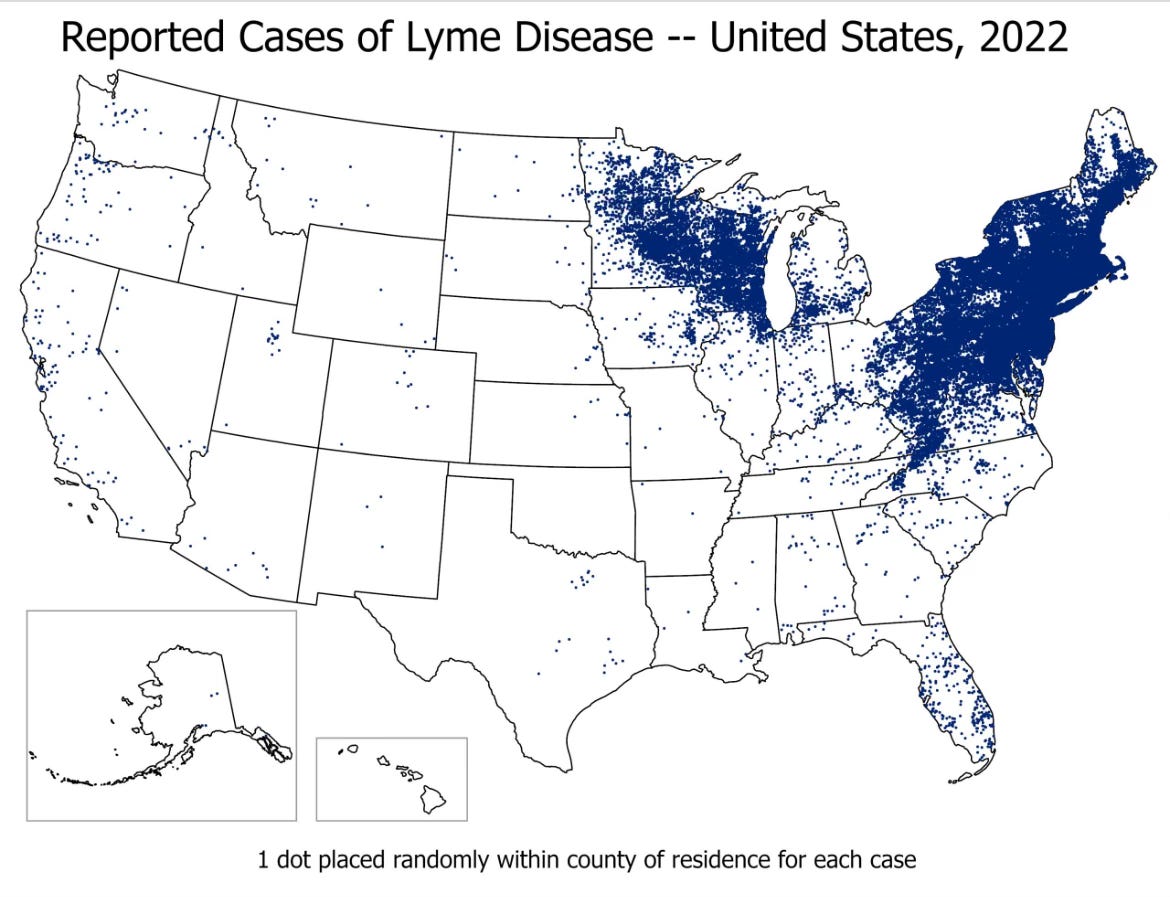
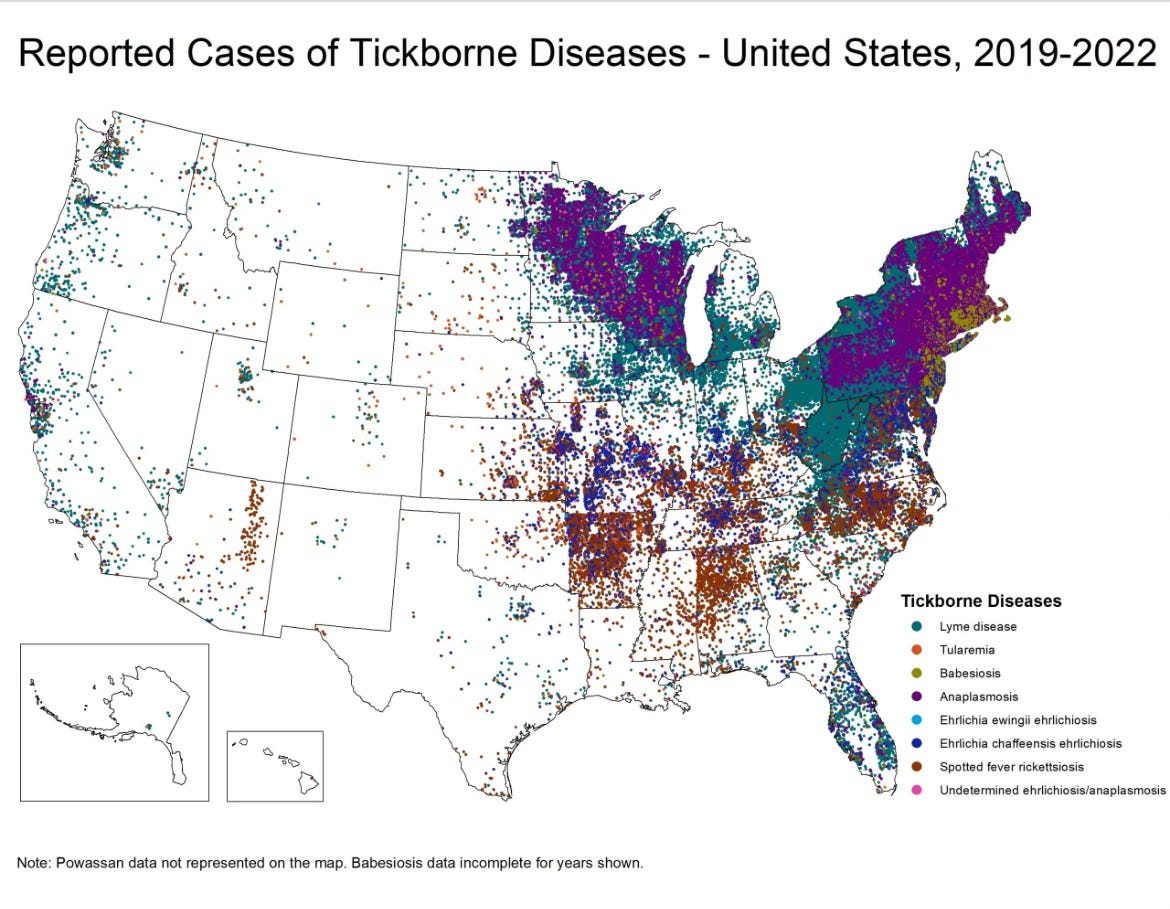
A CDC map of Lyme disease shows the US Northeast blanketed by dots—one for each case—that are so dense they turn New York and its neighboring states completely black. Nevertheless, New York State’s Lyme plan collects dust in the halls of government. When I pressed the department for details on the report’s status, I was told by a spokesperson, Marissa Crary, “Per statute, this report does not require public posting or distribution.”
The problem of ticks is moving so rapidly that it is, admittedly, difficult for any state to keep up.
Case in point: Martha’s Vineyard is seeing what the New York Times recently described an “onslaught” of a perplexing tick-induced allergy called alpha-gal syndrome, or AGS. There, and in many states, bites from lone star ticks are leading to life-threatening anaphylactic reactions and lifelong allergies to a molecule in mammal meat or dairy products for which the syndrome is named.
AGS emerged in the late 2000s in ticks that once resided almost exclusively in southern states. Having spread north to Maine and as far west as Texas, the lone star is called “very aggressive,” by the CDC, crawling quickly and in bright sunshine that can kill other ticks. Homeowners in the high-priced Hamptons of New York’s Suffolk County have reportedly been chased from their sprawling gardens and yards by ticks. Indeed, the county had 3,800 cases of alpha-gal syndrome reports from 2017 to 2022, 4 percent of the national total, the CDC reported.
As if this isn’t bad enough, a new Maine study linked fifty-seven alpha-gal cases to the bite of an entirely different tick—namely the common blacklegged tick, which is the primary vector of Lyme disease. “Public health professionals should be aware,” it stated.
If the New York task force has its way, alpha-gal syndrome will join six other tick-borne illnesses that must be reported to public health authorities. Numbers speak volumes and spur change. So do expert reports, such as the one by the New York State task force, officially titled The Lyme and Tick-borne Diseases Working Group.
The group did its job, which was “to review best practices for the diagnosis, treatment, and prevention of Lyme and tick-borne diseases and to make recommendations regarding improvement of delivery of care, development of collaborations in disease prevention and control, and requirements for disease reporting and data collection.”
“When task forces—state and local—collaborate with community stakeholders and offer solutions,” said Lorraine Johnson, chief executive of LymeDisease.org, a research and advocacy group, “it’s a missed opportunity if their work isn’t loudly shared.”


Stay updated with the latest in the Constitution State with The CT Centinal