Please Follow us on Gab, Minds, Telegram, Rumble, Gettr, Truth Social, Twitter, YouTube
I showed up in support of the hundreds of parents and children who came to oppose HB 5468, HB 5044, and SB 50—and I personally testified on HB 5554, because that bill strikes at something even more fundamental: the system of checks and balances itself.
What I witnessed inside the Legislative Office Building mattered.

There were hundreds of families. It felt like an airport during a major delay—kids everywhere, long waits, overflow rooms packed. But what stood out wasn’t chaos—it was the opposite.

The children were respectful, engaged, and remarkably well behaved. They played together, drew quietly, and spoke thoughtfully. I had real conversations with them. They made eye contact. They communicated clearly. They demonstrated confidence and respect.
That is education.
Not just test scores or bureaucratic benchmarks—but the ability to engage, think, and interact as capable human beings. And I saw that firsthand.
These parents came from all backgrounds. Many identified as independent—unaffiliated, not ideological. But they were united on one thing:
They want a say in how their children are raised and educated.
They showed up—despite long hours, despite discomfort, despite fear of public speaking—because staying silent was no longer an option.
Yes, there was emotion. Yes, there was anger. But when you are talking about people’s children—their most precious responsibility—that emotion is not a flaw. It’s a signal.
Lawmakers should not dismiss emotional testimony—they should listen more carefully to it.
Because these were not lobbyists. Not unions. Not political machines.
They were citizens.
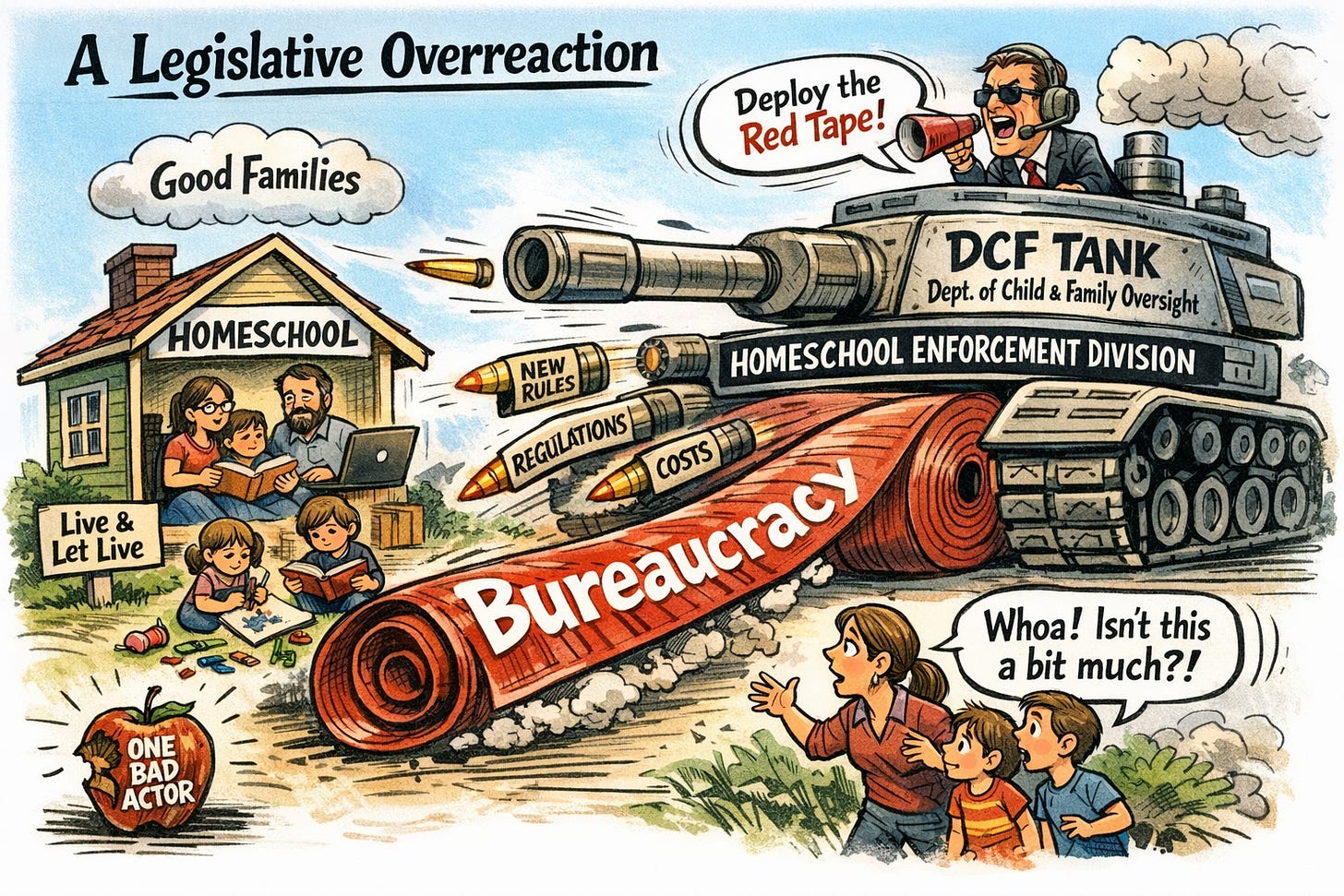
We can all agree on one thing: there are bad apples in every part of society.
But one bad case—however serious—should not trigger a sweeping legislative overhaul that creates new problems, new bureaucracy, and new costs for thousands of families who have done nothing wrong.
Good policy is not written in reaction to the worst-case scenario.
It is built on data, proportionality, and common sense.
If there are gaps, fix the gaps.
If there are bad actors, address the bad actors.
But don’t treat every family like a potential case file.
What’s being proposed goes far beyond that. It moves toward building an entirely new layer of oversight—effectively a homeschooling arm within the Department of Children and Families.
That is not a measured response. That is a structural expansion of government into the daily lives of families.
And with that comes:
Policy should be precise—not punitive.
Targeted—not sweeping.
Proportionate—not reactionary.
Because when government overcorrects, it doesn’t just solve a problem—it creates new ones.
Unfortunately, much of what I observed felt predetermined.
Bills like HB 5468 are advancing despite overwhelming public engagement, and there is a growing sense that outcomes are being driven along party lines rather than through genuine deliberation.
It passed 26-20 with some flip flops, despite agreement to vote against it, which truly frustrated the parents after telling me about specific assurances from their elected representatives.

That’s exactly why HB 5554 matters so much and why I testified.
HB 5554 weakens one of the last meaningful bipartisan checks in Hartford. At a time when people already feel unheard, removing balance from oversight only deepens that divide.
What yesterday proved is simple:
The silent majority is not silent anymore.
A supermajority is not a blank check. It is a greater responsibility—to listen, to engage, and to find common ground.
Many of the families I spoke with live by a simple principle: Live and let live.
The idea that you should be free to raise your children, educate them, and make decisions for your family—as long as you are not infringing on the rights of others.
And the reality is this:
A homeschooled child does not interfere with anyone else’s rights.
So the real question becomes— who is actually threatened?
Because what I saw in Hartford wasn’t a problem.
It was a reminder of what’s worth protecting.




Stay updated with the latest in the Constitution State with The CT Centinal