


Please Follow us on Gab, Minds, Telegram, Rumble, Gettr, Truth Social, Twitter, YouTube
The most infamous answer in pageant history came from Caitlin Upton, who was asked why Americans couldn’t locate the United States on a map and responded with a rambling explanation about “the Iraq,” “South Africa,” and “U.S. Americans” that somehow managed to be both completely confident and completely incoherent.
It didn’t make sense. It didn’t go anywhere. And yet it never stopped.
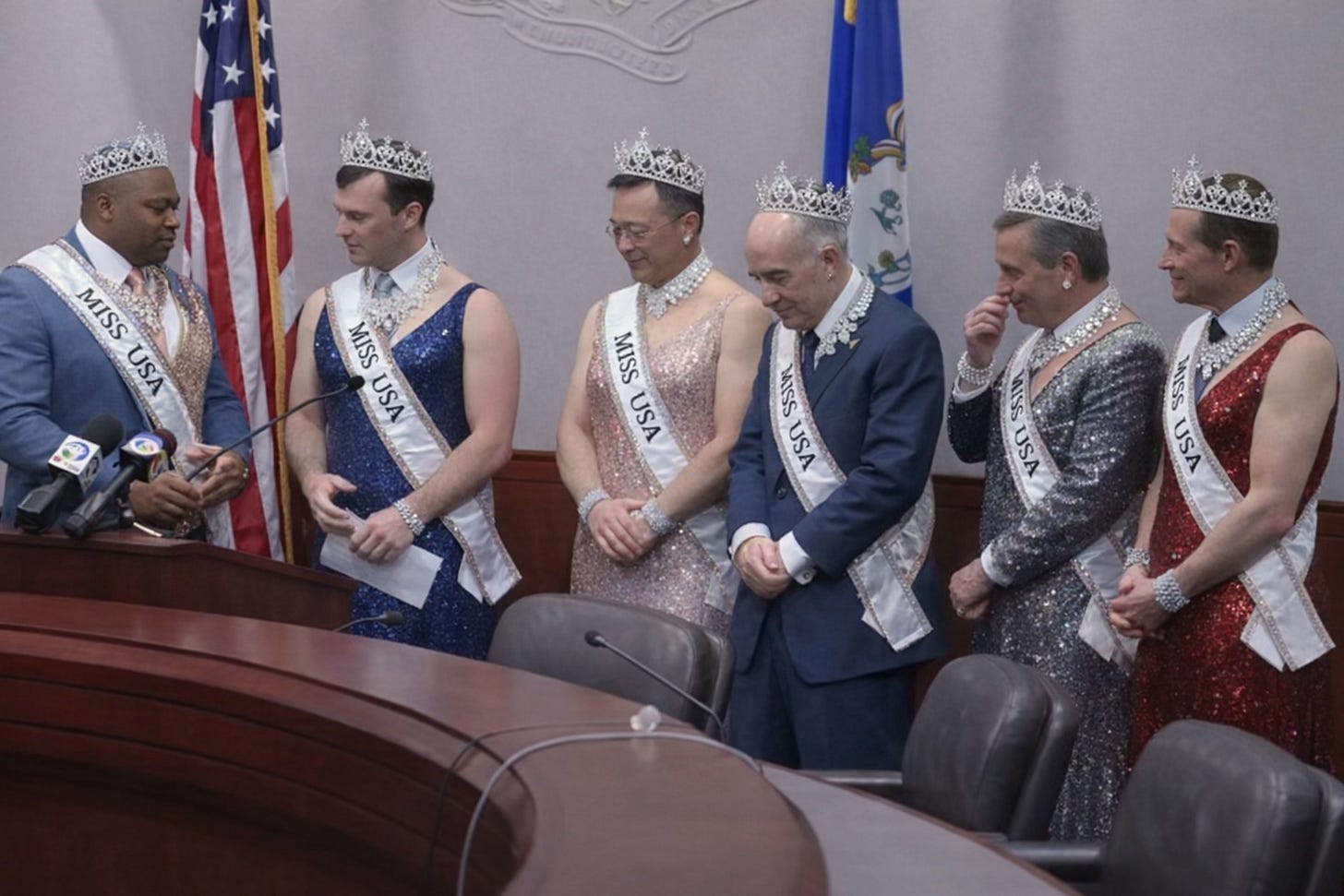
Which brings us to Connecticut’s March 23 Capitol press conference — where state leaders tried to explain a set of immigration and civil rights bills and instead delivered the policy equivalent of a pageant answer — long on emotion, light on anything resembling a clear response.
The goal of the press conference was straightforward: explain the proposed legislation and how it would affect the constitutional rights of Connecticut residents.
The package of bills allows people in Connecticut to sue federal agents in state court, limit enforcement actions in places like schools, hospitals, and churches, and narrow the legal protections federal officers can rely on.
Those are significant policy changes. They raise real legal questions about how far a state can go in regulating federal authority.
But while parts of the bill were explained, much of the press conference drifted between emotional appeals, broad constitutional claims, and incomplete explanations of how those ideas fit together.
Attorney General William Tong opened by declaring Connecticut a “sovereign state” that can “live the way largely we want to live,” emphasizing that only “limited powers” were delegated to the federal government.
It sounded sweeping. It sounded important. It also skipped over the central legal tension — that immigration enforcement is a federal responsibility, and federal law can override conflicting state law.
That didn’t slow the presentation down.
Tong insisted Connecticut is “not a sanctuary state” and is “fully compliant with federal law,” before pivoting into a description of legislation that would set conditions on where and how federal agents can operate and expose them to state-level liability.
Then the press conference stopped explaining the bill and started substituting emotion for substance.
Tong described immigrants as having “a target on their backs” and invoked the experience of watching people “get murdered on your phone.”
In a pageant, this is the part where the music swells and the answer starts sounding meaningful, even if it isn’t.
In a policy discussion, it’s where you expect a clear explanation of how the bill addresses the problem being described. That connection was never fully laid out.
Tong then tried to humanize immigrants by describing them as people who “wash dishes… pick vegetables… mow lawns… clean office buildings.”
Nothing says “we see you” quite like reducing millions of people to a list of chores.
Senate Majority Leader Bob Duff added to the tone, warning about “masked goons coming in and shooting us.”
That kind of rhetoric may convey urgency, but it does little to clarify how the legislation actually works and it sounded less like a policy explanation and more like a contestant talking in circles, hoping something lands.
Sen. Martin Looney followed by invoking the 10th Amendment, explaining that powers not granted to the federal government are reserved to the states.
It sounded polished and authoritative. It also left out the part of the constitutional framework that complicates the argument — namely, how federal law interacts with state law in areas like immigration.
He then pivoted to a swipe at Republicans, arguing they treat the Bill of Rights as if it were only the Second Amendment — a completely irrelevant detour from the bill itself.
It was the policy equivalent of working “world peace” into an answer that never addressed the question.
When Sen. Gary Winfield took the microphone, whatever was left of a clear explanation started to slip — and the answer started to sound familiar.
“I have a lot of people in my district who don’t know anything else we’re doing. You know what they know about, this, because it’s important and it’s not just about that group of people who are invisible, because it’s about us too, because some of us care about those people enough to stand out and witness for them, except you can’t witness for them, because witnessing for them means you’re putting yourself on a line…”
And then:
“…because we want to deal with that fictional person… so we will violate your rights to do so… don’t use that video camera… don’t stand there, don’t speak…”
The remarks were clearly meant to convey urgency and concern. But they also illustrated the broader issue with the rollout: as the rhetoric intensified, the explanation of the policy itself became harder to follow.
Not everyone took center stage — some blended into the background like a fourth runner-up.
Rep. Steve Stafstrom played the role of the contestant who doesn’t say much, but nods along while the others take the spotlight, offering only brief remarks as the rest of the panel carried the message.
And, naturally, they finished with the one person you can count on to show up when there’s a camera nearby.
U.S. Sen. Richard Blumenthal acknowledged the proposal will likely face a legal challenge, underscoring that the issues involved are more complex than they were often presented.
By the end of the press conference, the audience had heard about sovereignty, public safety, constitutional rights, and personal stories — sometimes in the same breath.
What was less clear was how all of those pieces fit together into a coherent legal framework.
Caitlin Upton had an excuse. She was a teenager, put on the spot, trying to answer a difficult question.
Connecticut’s leadership had months to prepare, detailed legislation, and a coordinated message.
And for all the time spent talking, the focus was unmistakable — raising a simple question: why so much effort is being spent limiting enforcement and expanding protections for people here illegally, and what that says about the priorities behind this push.


Stay updated with the latest in the Constitution State with The CT Centinal


Great picture - but they give 'teenagers' a bad name.......