Please Follow us on Gab, Minds, Telegram, Rumble, Gettr, Truth Social, Twitter, YouTube
House Majority Leader Jason Rojas filed testimony stating that he strongly supports HB 5350 which reduces restrictions in the cannabis industry in Connecticut.
In that testimony, he argued that the bill would reduce unnecessary regulatory barriers, increase product variety, and give Connecticut’s adult-use cannabis industry a needed boost. He also stated that “THC-infused beverages would be made available in social spaces, such as restaurants and bars,” and said those changes were critical to drawing customers and retail sales back to Connecticut.
The cleanest conclusion is this: The issue is not $750 in campaign contributions to Rojas from a cannabis coalition that just agreed to a $416,000 settlement. The issue is whether Connecticut cannabis policy is being shaped too comfortably around the interests of politically connected operators, even after Attorney General William Tong warned that this market requires real guardrails.
This is not just a debate about cannabis policy. It is a debate about judgment, political proximity, and whether Connecticut is weakening guardrails at the same time the state itself is warning that the market needs them.
Crisp Cannabis was not on the sidelines of HB 5350.
Andrew Simonow, President of Crisp Cannabis, also submitted testimony on HB 5350. His testimony focused primarily on the proposed commercial extractor license structure. He argued that Connecticut already has a strong regulated cannabis supply chain, opposed creating a separate THC-production pathway outside the existing regulated system, and supported reasonable improvements to branding and packaging rules that would strengthen Connecticut’s in-state cannabis market.
Those two testimonies (Rojas and Simonow) matter even more when placed next to the Attorney General’s January 2026 settlement with Crisp Cannabis.
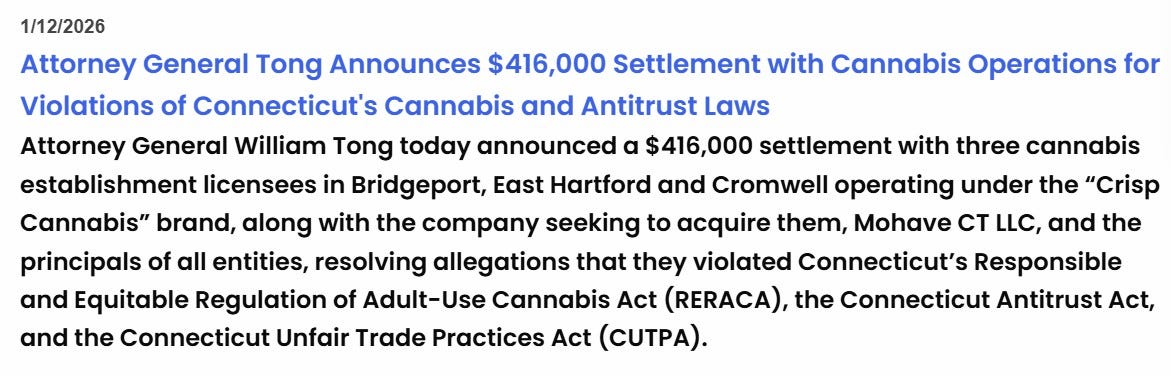
The Attorney General announced a $416,000 settlement with three cannabis establishment licensees in Bridgeport, East Hartford, and Cromwell operating under the Crisp Cannabis brand, along with Mohave CT LLC and related principals. The state said the matter involved allegations of gun jumping, premature transfer of operational control, coordinated branding and staffing, and exchanges of competitively sensitive pricing and operational data before required review.
Cannabis PAC Support for Rojas.
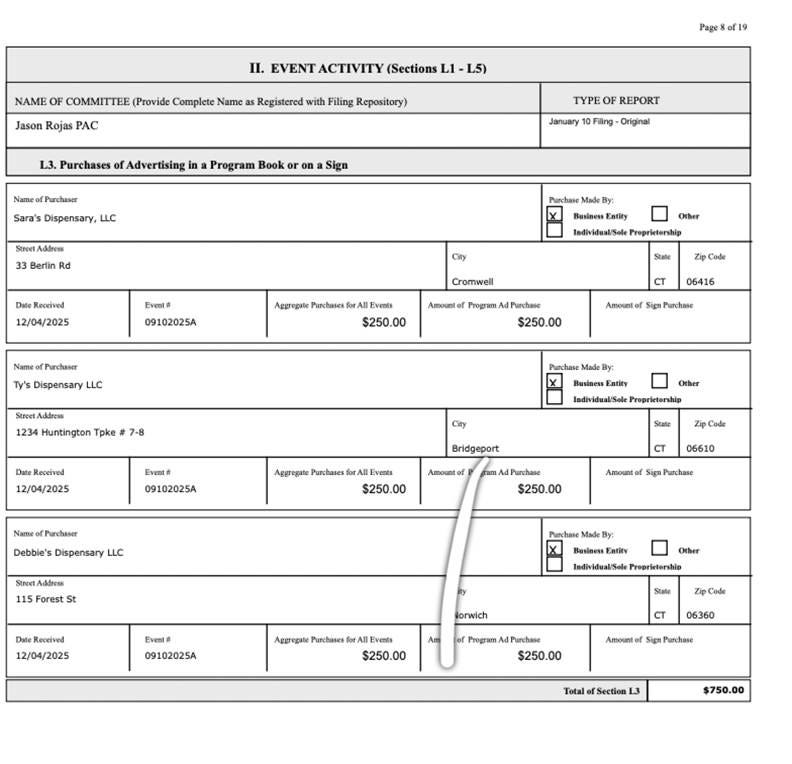
The event activity report for the Jason Rojas PAC shows Sara’s Dispensary, Ty’s Dispensary, and Debbie’s Dispensary listed as purchasers of advertising at $250 each, for a total of $750. Standing alone, the amount is not necessarily significant.
The point, however, is that the same dispensary entities appearing on the PAC report were later tied to the state settlement announced by Tong, while Rojas submitted testimony supporting a bill that would loosen barriers in the cannabis market and Crisp itself was actively lobbying on the bill.
That sequence does not prove bribery or a quid pro quo. It does, however, create a serious appearance question. Why was a top legislative leader pushing HB 5350 while businesses later wrapped into one of the state’s most serious cannabis enforcement actions were in his PAC orbit, and while a related operator was advocating on the same legislation?
The issue is not three $250 PAC purchases by themselves.
The issue is the pattern: Jason Rojas supported HB 5350, Crisp Cannabis also testified on H.B. 5350, and Rojas’s PAC report reflects support from the same three dispensary entities later tied to the state’s cannabis and antitrust settlement.
What About the Science? Or At Least the Health Concerns of the DPH and Others.
As April is Cannabis Awareness Month, Connecticut’s own public-health data makes the timing more troubling. The Department of Public Health’s 2025 Cannabis Health Statistics Report found that adult cannabis use increased from 2021 to 2023, that 14.5 percent of adults reported past-month use in 2023, and that cannabis-related poison-control cases among children under six increased sharply from 2019 to 2023 (see graph). The report also found elevated concern around youth outcomes, depression, and adverse exposure trends.

That same body of data cuts directly against any attempt to dismiss youth exposure as a side issue. A Norwalk youth survey reported that the average age of first marijuana use among local youth who use marijuana is 14, that 69 Norwalk youth went to the emergency department from marijuana use in a single year; this was roughly double the number from five years earlier.
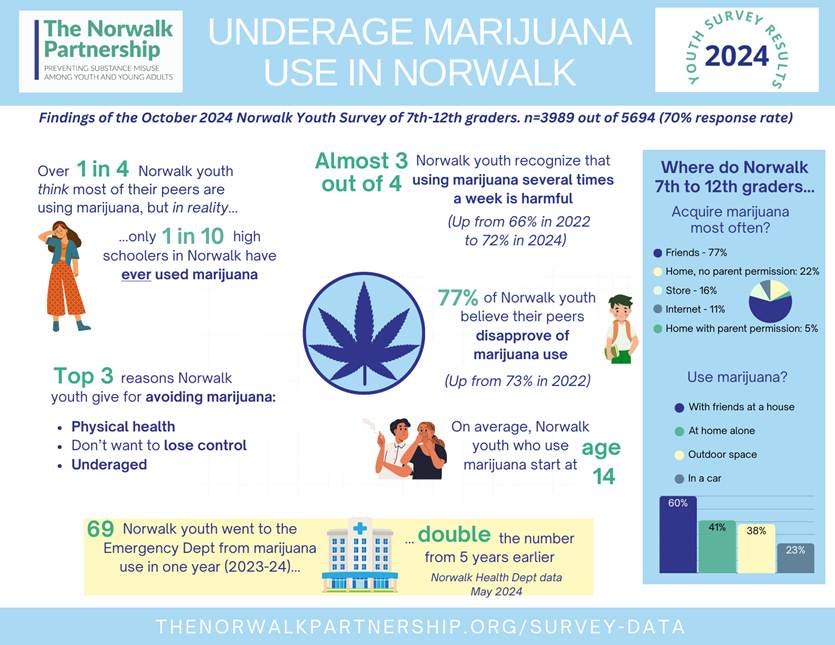
The potency issue is not academic. Connecticut’s 2025 Department of Public Health report does not itself prove that raising THC concentration caps will increase psychotic episodes. But it does document a rising-use environment, substantial repeat use, and enough cannabis-related public-health concern that the state is planning future analysis of cannabis-related mental-health visits and cannabinoid hyperemesis syndrome. Against that backdrop, broader national evidence points in a clear cautionary direction.
The U.S. Surgeon General has warned that the risk for psychotic disorders increases with frequency of use, potency of the marijuana product, and younger age at first use. The National Academies likewise have concluded that cannabis use is likely to increase the risk of schizophrenia and other psychoses, with heavier use associated with greater risk. Federal coding materials also recognize cannabinoid hyperemesis syndrome, or CHS, as an emerging condition marked by cyclical nausea, vomiting, and abdominal pain after prolonged, frequent cannabis use, and explain that higher THC concentrations have not been tied to CHS directly but are likely to increase chronic use, which in turn increases CHS risk.
Many of these issues were raised on a panel by The Norwalk Partnership with four community leaders discussing the impact of cannabis legalization in our communities.

When lawmakers talk about lifting concentration caps, they are not just talking about more consumer choice. They are talking about a policy change that may intensify the exact pattern of heavy, high-potency use associated in the medical literature with greater psychosis risk and with the chronic-use profile linked to CHS.
The contradiction is hard to miss. The Attorney General says this market needs competition safeguards. The Department of Public Health says cannabis-related risks remain serious. Yet H.B. 5350 is promoted as a bill to make the market more flexible, more commercially attractive, and more socially normalized.
The Bottom Line.
Rojas backed the bill. Crisp lobbied the bill. Rojas’s PAC report reflects support from the same dispensary entities later tied to the settlement. That may not establish wrongdoing, but it is more than enough to justify harder scrutiny, direct questions, and a demand for full transparency.





Stay updated with the latest in the Constitution State with The CT Centinal