


Please Follow us on Gab, Minds, Telegram, Rumble, Gettr, Truth Social, Twitter, YouTube
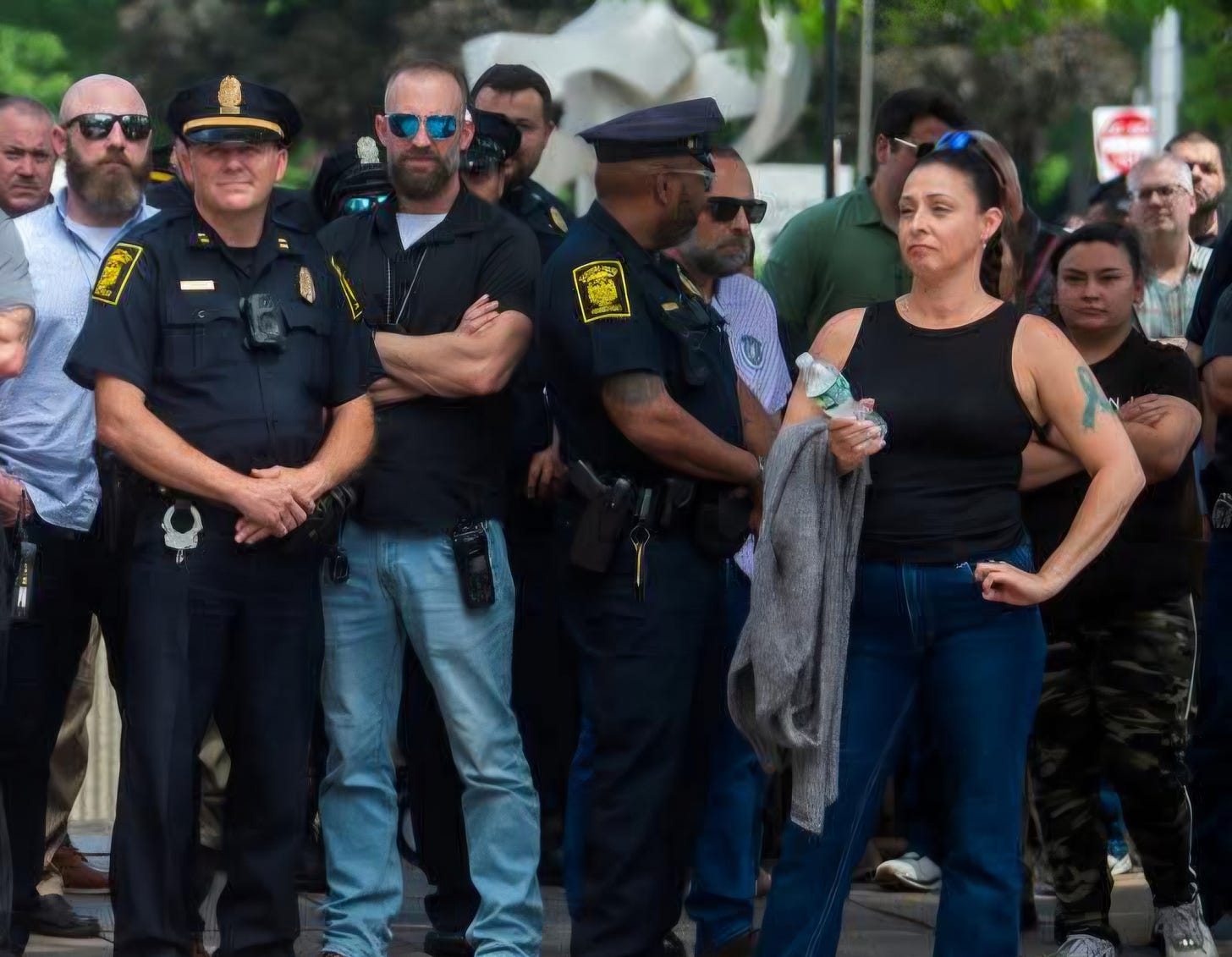
On June 5, 2026, former Hartford police officer Joseph Magnano stood briefly before a judge in Superior Court, facing a first-degree manslaughter charge for the February 27 shooting death of Steven “Stevie” Jones. Dozens of fellow officers lined up outside in support. Inside, the proceeding lasted under a minute. The charge stems from an Inspector General investigation that concluded Magnano’s use of force was not justified. Yet the arrest warrant and the broader public narrative pushed by national and local activists reveal more about political pressure than about the split-second realities captured on body camera.
The facts of the encounter are not in serious dispute. Jones’s sister called 911 at approximately 11:03 a.m. reporting that her 55-year-old brother was in an acute mental health crisis, had cut himself, was bleeding, and was holding a knife while off his medication. Officers responded to a man armed with a deadly weapon who had already demonstrated he could move aggressively. Body camera footage shows the first officers on scene deploying a taser multiple times without effect. Jones chased one officer around a cruiser before slowing. Other officers formed a perimeter, repeatedly called Jones by name—“Steve”—and issued dozens of commands to drop the knife while attempting rapport. A request went out for additional less-lethal options.
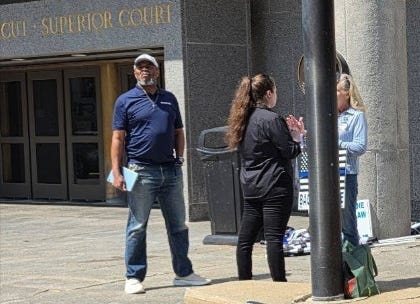
Magnano, 23 and still in his probationary period with roughly seven to eleven months of experience depending on how training time is counted, arrived after hearing radio traffic describing a man running at an officer with a knife and a failed taser deployment. He approached, stopped roughly 17 feet from Jones, drew his firearm, and issued clear verbal commands. Jones continued walking toward him. Magnano fired nine rounds. Jones fell and later died from complications of his wounds on March 3. The medical examiner ruled the death a homicide.
The Inspector General’s case rests on several contestable assertions. The warrant claims Magnano failed to de-escalate, failed to use available non-lethal force such as pepper spray, had ample space to create distance, and that his own actions precipitated the need for deadly force. It further states that even if Magnano subjectively believed Jones posed an imminent threat, that belief was not objectively reasonable. The warrant notes shots fired after Jones was on the ground and criticizes Magnano for not moving bystanders or seeking cover.
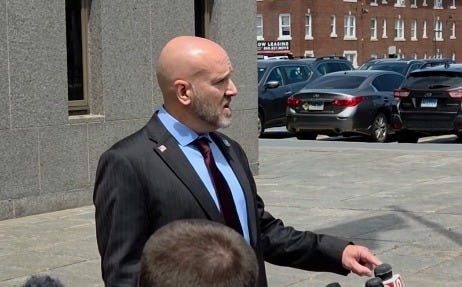
Hartford Police Union President James Rutkauski has called the warrant “crap”—heavy on assertion and opinion, extremely light on facts. He points to specific inaccuracies: the document misstates Magnano’s age and miscalculates his time on the job by excluding field training. It describes Jones as “only loosely gripping the knife” near the end—an observation Rutkauski says cannot be reliably made from the video. Most critically, the union argues that issuing repeated commands to drop a knife in the presence of an armed, non-communicative subject is de-escalation when the person is not responding to verbal engagement. Pepper spray at two to three feet against an advancing knife threat is not a realistic or safe alternative. Other officers had already tried less-lethal force and maintained distance; Magnano arrived into an active, unresolved threat.
These are not minor quibbles. They go to the heart of the constitutional standard established in Graham v. Connor: whether the force was objectively reasonable from the perspective of a reasonable officer on the scene, without the benefit of 20/20 hindsight. Jones was armed with a knife. He had chased an officer. He ignored repeated commands. He was advancing. At 17 feet, he was well inside the distance officers are trained to recognize as creating an imminent threat—the practical reality often discussed in law enforcement as the “21-foot rule,” where a determined individual with an edged weapon can close the gap faster than an officer can reliably react, draw, and stop the threat. The presence of other officers with guns drawn did not eliminate the immediate danger to Magnano or to civilians in the area; it simply meant multiple officers were managing an unpredictable, mentally ill subject who had already shown he could move suddenly.
The post-fall shots are another flashpoint. In dynamic, rapidly evolving encounters, officers are trained to continue firing until the threat is neutralized. The IG’s after-the-fact frame treats the sequence as calm execution rather than the chaos of a subject falling while still potentially capable of movement. Union voices and standard use-of-force analysis treat this differently than a static, deliberate execution.
The firing of Magnano and the subsequent charge carry the clear imprint of external political pressure. Mayor Arunan Arulampalam terminated Magnano on March 27, 2026—shortly after Jones’s funeral. At that service, the Rev. Al Sharpton delivered the eulogy. Civil rights attorney Benjamin Crump, representing the Jones family, stated that Jones “needed a helping hand from the Hartford Police Department, but instead he got nine bullet holes in his body” and that “the status of your mental health and the color of your skin should not equal the death sentence.” Sharpton called the firing “a necessary first step” but insisted the family and Hartford deserved “full justice.” Greater Hartford NAACP President Corrie Betts framed the court proceedings as accountability for officers who fail their oath to protect and serve. Connecticut NAACP President Scot X. Esdaile expressed being “really, really, really upset,” vowed to “organize, mobilize and galvanize individuals on the national stage,” and referred to Magnano as an “outlaw” and a “cowboy.”
These statements are not neutral observations of evidence. They presuppose from the outset that the shooting was an act of unjustified violence driven by race or indifference to mental health, rather than a response to an armed subject advancing on an officer after less-lethal options had already failed. Crump’s language—“nine bullet holes”—emphasizes volume of fire over the context of a rapidly closing threat. Esdaile’s “outlaw” and “cowboy” rhetoric casts the officer as rogue rather than one participant in a multi-officer response to a 911 call the family itself initiated. Betts’s appeal to the oath is fair in principle but elides that the other three officers on scene, whom the mayor himself praised for de-escalation efforts, were also managing the same armed subject without resolving it before Magnano arrived. Sharpton’s framing of “full justice” has, in practice across multiple cases, meant sustained pressure until charges are filed and settlements follow.
This pattern has a predictable financial and operational consequence. Attorneys like Crump routinely secure multi-million-dollar settlements from municipalities in police-involved deaths. Those payouts are funded by taxpayers. The same activists and organizations that amplify the narrative and demand “accountability” (often defined as conviction or resignation rather than due process) benefit from the resulting visibility, donations, and leverage. Hartford, like many cities, ends up paying twice: once through direct settlement costs and again through the erosion of police morale and recruitment. Union leadership has already warned that morale is “in the tank” and that it will become harder to attract officers willing to work in an environment where split-second decisions under threat are second-guessed through a political lens.
The downstream effect is not theoretical. When officers internalize that engaging a knife-wielding subject in mental crisis—especially in certain neighborhoods—can end their career or land them in court regardless of the objective threat, hesitation becomes rational self-preservation. Hesitation in those moments does not produce more “de-escalation.” It produces standoffs that allow the subject to harm himself further, to attack bystanders or officers, or to disengage and continue posing danger elsewhere. The communities that activists claim to champion bear the heaviest cost when proactive policing retreats. The data on violent crime victimization shows who suffers most when deterrence weakens.
The Magnano case is not an isolated tragedy. It is a case study in how a narrative-driven process—national figures descending, local officials moving quickly under pressure, an investigative report heavy on conclusion and light on contextual facts—replaces the Graham standard with a presumption against the officer. The arrest warrant’s documented inaccuracies and omissions matter precisely because they reveal an investigation shaped to fit a predetermined outcome rather than one that grappled with the full record: the knife, the failed taser, the dozens of ignored commands, the subject’s advance at close range, and the radio traffic that framed Magnano’s arrival.
True accountability requires judging officers by what a reasonable officer could perceive in real time, not by what activists or investigators can construct after the fact with the luxury of slow-motion review and political incentives. When that standard collapses, the result is not safer streets or better mental health outcomes. It is fewer officers willing to do the job that the public still expects them to do when the 911 call comes in. Hartford’s residents—particularly those in neighborhoods where mental health crises and weapons intersect most often—will pay that price in ways the settlement checks and press conferences never capture.




Stay updated with the latest in the Constitution State with The CT Centinal



Yes indeed.
----------
Invariably, though, there are divisions in the perception of what constitutes justice, even within what we consider established and grounded values circles.
It is deeper than merely discerning the truth or facts of a person or an event or a paradigm and affording your support (or not).
One could argue that perceptions are solitary, always emerging, and somewhat cautious, with a measure of uncertainty.
Many will refute that, insisting that they are steadfast - faithful and true to American and Christian principles. Really?
Tell me, what was the impetus to the American Revolution? What was an ancillary but significant dynamic of Christ’s ministry?
Was it not a distrust of authority? Of questionable authority? Of perceived ‘illegitimate’ authority?
Now bring it forward.
The distrust today is as relevant AND valid as ever.
How many false teachers are in the world today? How many in authority are operating under a false pretense? How much of authority itself has been coopted to serve a pretentious agenda?
I could argue that any individual that seeks any office to levy their sense of justice on the world, however ‘righteously’, is by default, untrustworthy. Why? Because the principal reason for seeking office is to exact control. Inarguably.