Please Follow us on Gab, Minds, Telegram, Rumble, Gettr, Truth Social, Twitter, YouTube, Instagram
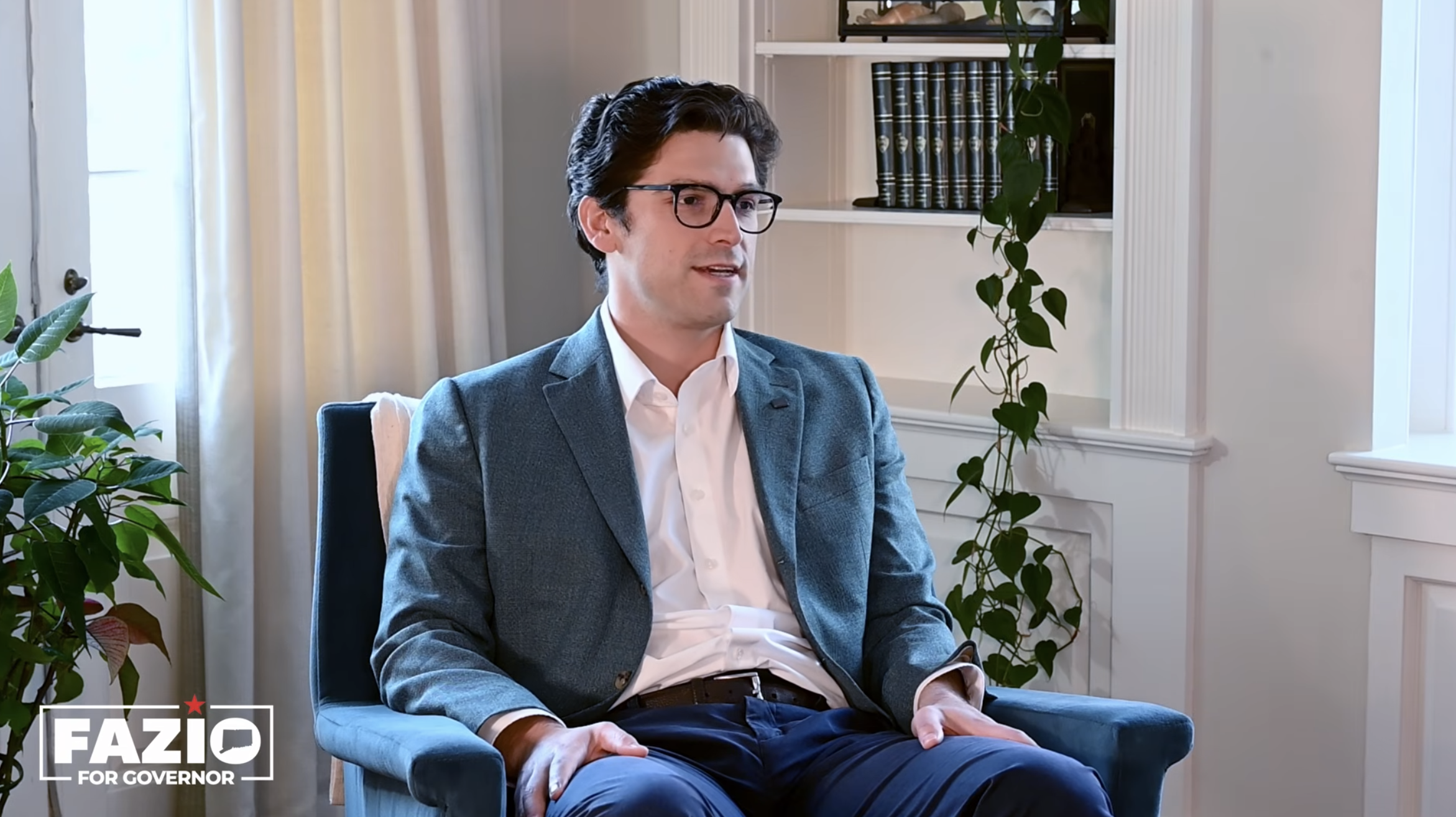
Ryan Fazio says he has a long history of learning from people with whom he disagrees.
The Republican and Independent candidate for governor in Connecticut told former State Rep. Terrie Wood (R-Darien) during a recent interview that – from a young age – he has always been pulled more so toward those who disagree with him, rather than those who share his views.
“I always would get in these debates and discussions with teachers, but also my peers, the vast majority of whom disagreed with a lot of my views,” Fazio said, describing his inner circle of friends:
To this day, my closest friends in the world are almost all Democrats. My closest five friends are, or six friends are, maybe one or two are Independents, and the rest are Democrats, and they're all more liberal. I love that because I love understanding what makes people believe what they believe, like at their core. And I am attracted to and interested in differences. I think that's what makes us human. That, that nobody's perfect. That everyone's a little different from one another, but everyone is special in their own way. And … you can learn something from everyone. Like, don't just talk, listen, because you can learn something for free from anybody … And when you talk to, and with, people you disagree with, first of all, you might learn more about what you believe than ever before.
Fazio spoke to the sense of divisiveness – and refusal to engage with those who have different views – that many people are experiencing during this election season, in particular.
“It's not a threat if someone disagrees with you, and it's not a threat to what you believe,” he told Wood. “It's really an opportunity to learn more, and you know maybe by acting in a way that is accepting and civil, and treating other people as equals and thoughtful people in their own right, even when they disagree with you, then you might actually have a greater opportunity to maybe influence their point of view than ever before.”
The state senator from Greenwich said he could not have accomplished as much as he has already if he had only surrounded himself with people who agree with him.
“I've been in the senate for five years, and, despite being in a small political minority, two to one, us as Republicans in the state senate, I was able to co-author and pass seven new laws, many of, you know, major substance,” he said, underscoring that “it was because … I like to understand … differences and views that my colleagues on both sides of the aisle have, even within the caucuses.”
“I love that kind of texture of … the human experience, and to spend the time to listen and understand what other people believe,” he added. “Then you could find the common ground.”
“When you listen to another point of view, it makes the policy – end result policy – often much stronger,” Wood commented.
“It's not a compromise at all,” Fazio wholeheartedly agreed. “It's about finding there's so many different ways to skin a cat. They say it's about finding the ways you can fit together. It's, it's not compromise even … it's just finding the right answer.”
But Wood then asked Fazio what the difference is “between standing on principle and knowing when to compromise.”
“The old saying that you know if you're offered half a loaf, take it,” he responded. “Don't, don't make perfect the enemy of the good. You know, try to make things better. Perfection is not for this world. It's just not, and so being intransigent and being stubborn is going to result in things being worse than when you even started.”
Still, Fazio said “it's important to be principled: honesty, transparency, a belief in the dignity of other people.”
“Those are principles that should not be violated,” he asserted, adding:
Negotiation on details and practicality, and finding the common ground, is necessary to go towards the principles, the basic values that you hold. So, my view is, you need to spend your time in politics negotiating, working with people you disagree with, and you can do that without compromising the basic principles that you hold. You know, I view it as a negotiation, and I view it as an opportunity to make everybody better off. Sometimes things come into conflict, and that's difficult. But you can hold principles and work with people who even hold different principles and make things better.
Fazio credits his relationship with his grandmother, who came from an immigrant Irish family in Philadelphia and with whom he shared not only “a love of country and a love of government and politics,” as central to the values he now holds.
His grandmother – who died the day before he was sworn in as state senator – taught him, he noted, “the sense of a servant leadership that, you know, people come to you because of how you treat others and your concern and your heart for others, and she was really the, you know, focal point and the uniting factor in our family on my mom's side for so many decades.”
The gubernatorial candidate added that while his grandparents would often tell him that they lacked the education to truly weigh in on political or world issues, he never felt that way about them, and always valued their wisdom.
“I think wisdom is something that's so much deeper, and it comes from listening and a strong moral compass,” Fazio said. “And they had that, and I always felt that, you know, whether they were highly educated or not, they had greater wisdom and judgment than anyone else because their heart and their morals were in the right place.”
Traveling across the state of Connecticut during Fazio’s campaign for governor, he observed, has allowed him to appreciate the local pride each town and city in the state has in their individual community.
Connecticut is one of only three states in the nation with no county government.
“There is such a special thing about our state that everyone is proud of and invested in the town or the city they're from,” Fazio reflected. “I guarantee you, it is not that way in other states, in other countries. There is a localism. There is a community orientation to the people in Connecticut. And if you think, you know, it's just in your part of the state, it's not.”
The candidate said that, when he began his campaign, many people told him he would be surprised by “how different everyone across Connecticut is.”
“My impression has been the exact opposite,” he said, however. “People have so much in common in the state,” even though “the towns and the cities are different.”
“But what's really special about the state is the people really care, and they're really proud, and they're really invested in their community,” he added. “And we just have this great history that I think has made our people this way, and … that's why, you know, I feel this kind of special connection, especially 15 months into this campaign more than ever, and I would feel so lucky and privileged to represent the whole state, and be the governor of the state for that reason more than any other.”





Stay updated with the latest in the Constitution State with The CT Centinal