


Please Follow us on Gab, Minds, Telegram, Rumble, Gettr, Truth Social, Twitter, YouTube, Instagram
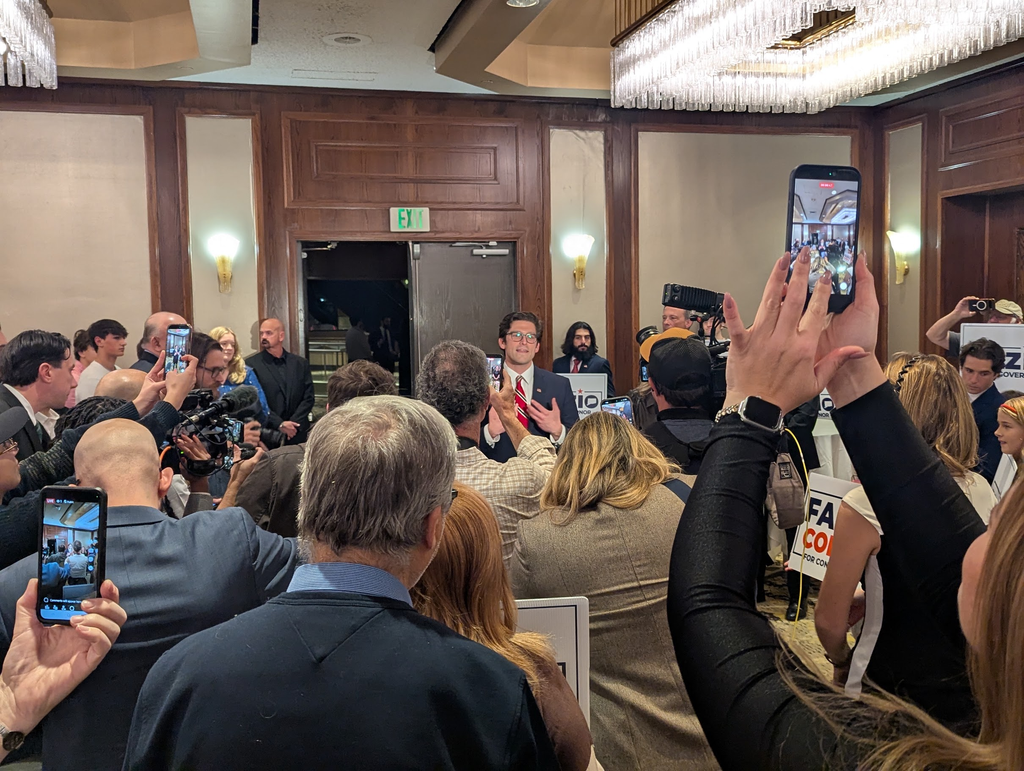
The blue wave swept Connecticut on November 3, 2026, handing Gov. Ned Lamont a third term, retaining every statewide constitutional office and all five U.S. House seats, and expanding already lopsided majorities in the General Assembly.
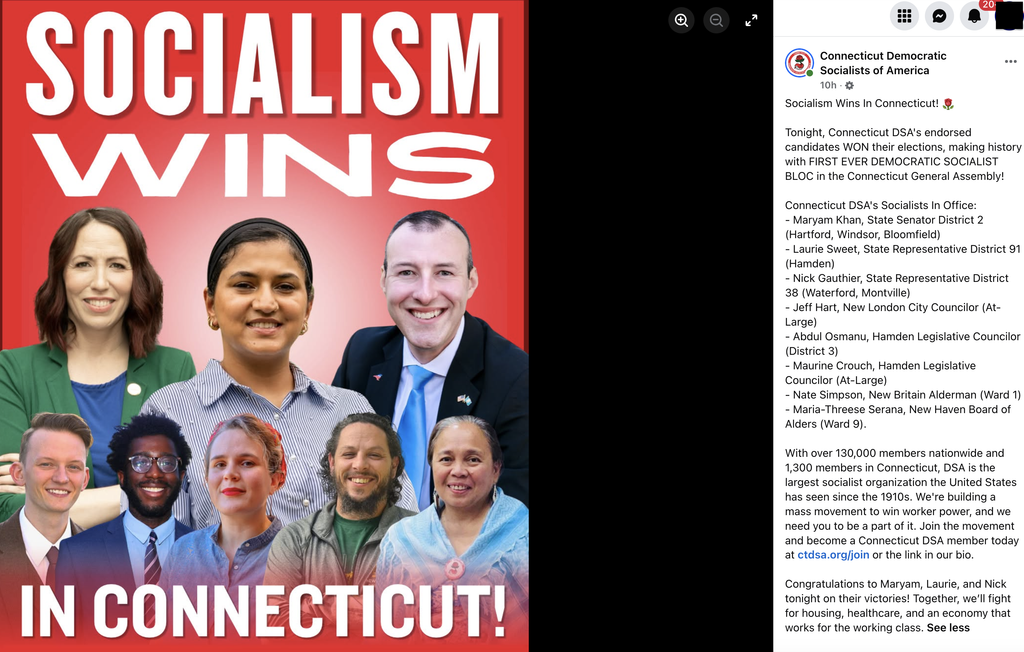
Progressives and Democratic Socialists of America (DSA)-aligned voices quickly claimed the results as validation, declaring “SOCIALISM WINS IN CONNECTICUT!” while longtime Republican lawmakers lost seats in numbers not seen in decades. At the same time, documented polling problems—from ballot shortages requiring hand-counts, to a voter caught trying to cast a second ballot, to reports of students bused to same-day registration sites—have fueled questions about process integrity in a state that has not elected a Republican statewide or to Congress since 2006.
Lamont defeated state Sen. Ryan Fazio by roughly 17–18 points (about 58–59% to 41–42% with the bulk of votes counted), the widest gubernatorial margin in 20 years and larger than his prior wins over Bob Stefanowski. Secretary of the State Stephanie Thomas, Attorney General William Tong, Treasurer Erick Russell, and Comptroller Sean Scanlon all won reelection comfortably. Democrats also held every U.S. House seat: Luke Bronin (replacing longtime Rep. John Larson after a primary), Joe Courtney, Rosa DeLauro, Jim Himes, and Jahana Hayes. Republicans have now gone two full decades without a statewide or congressional victory.
The legislative results were more punishing for the GOP.
Democrats entered with a 25–11 Senate majority and expanded it dramatically. Longtime incumbents fell: Sen. John Kissel of Enfield (34 years in office) lost to David Kiner in the 7th District; Sen. Heather Somers of Groton lost to Joe de la Cruz in the 18th; Sen. Jason Perillo of Shelton was unseated by Carolann Reid in the 21st (a seat long in Republican hands); and Sen. Jeff Gordon of Woodstock lost to Ethan Werstler in the 35th.
Senate Democrats also captured open seats previously held by Republicans, including the 36th (Fazio’s old district) won by Jill Oberlander and the 28th. Projections put the Senate at roughly 30–6 or as high as 32–4 once remaining races are resolved—the smallest GOP presence in the upper chamber in modern memory, possibly only three assured Republican survivors (Berthel, Martin, Sampson). Three CAIR CT-backed Democrats won state senate seats (MD Rahman, Saud Anwar, and Maryam Khan).
House Democrats, already holding a large majority, gained at least nine seats toward a projected 111–40 or wider edge, flipping districts in places like Shelton (first Democrat there in over 50 years), Newtown, and others. Close races and potential recounts remain, but the trend is clear.
Progressive and Socialist Gains
Connecticut’s DSA chapter has grown more active, endorsing legislative candidates (including some incumbents such as Nick Gauthier) and pointing to municipal successes in prior cycles in places like Hamden, New Britain, and New London. The "socialism wins" graphic reflects the national DSA narrative around progressive primary and general-election victories elsewhere (AOC, Tlaib, and new DSA-backed House members) and the broader blue-wave environment dominated by opposition to President Trump. Working Families Party cross-endorsements further boosted several Democrat tickets.
In a state already deep blue, the results amplify progressive influence inside a supermajority legislature. Speaker of the House Matt Ritter, however, remains unconcerned about the CT DSA’s growing influence.
Election-Day Irregularities and Concerns
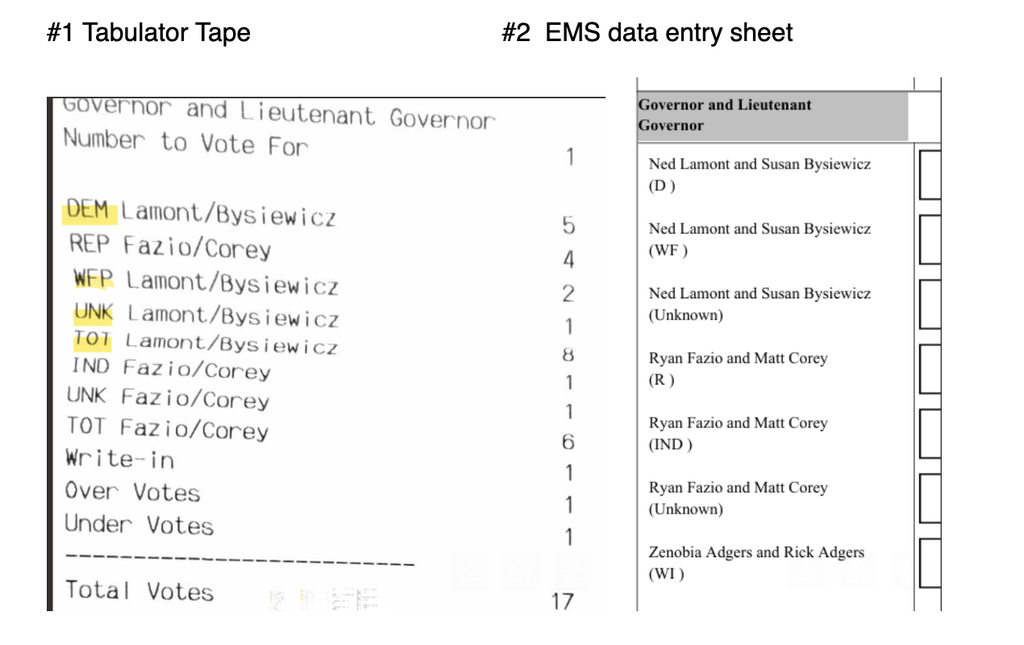
Secretary of the State Stephanie Thomas described the election as largely smooth, but multiple problems emerged—exactly the sort of issues that undermine confidence when one party dominates outcomes so thoroughly.
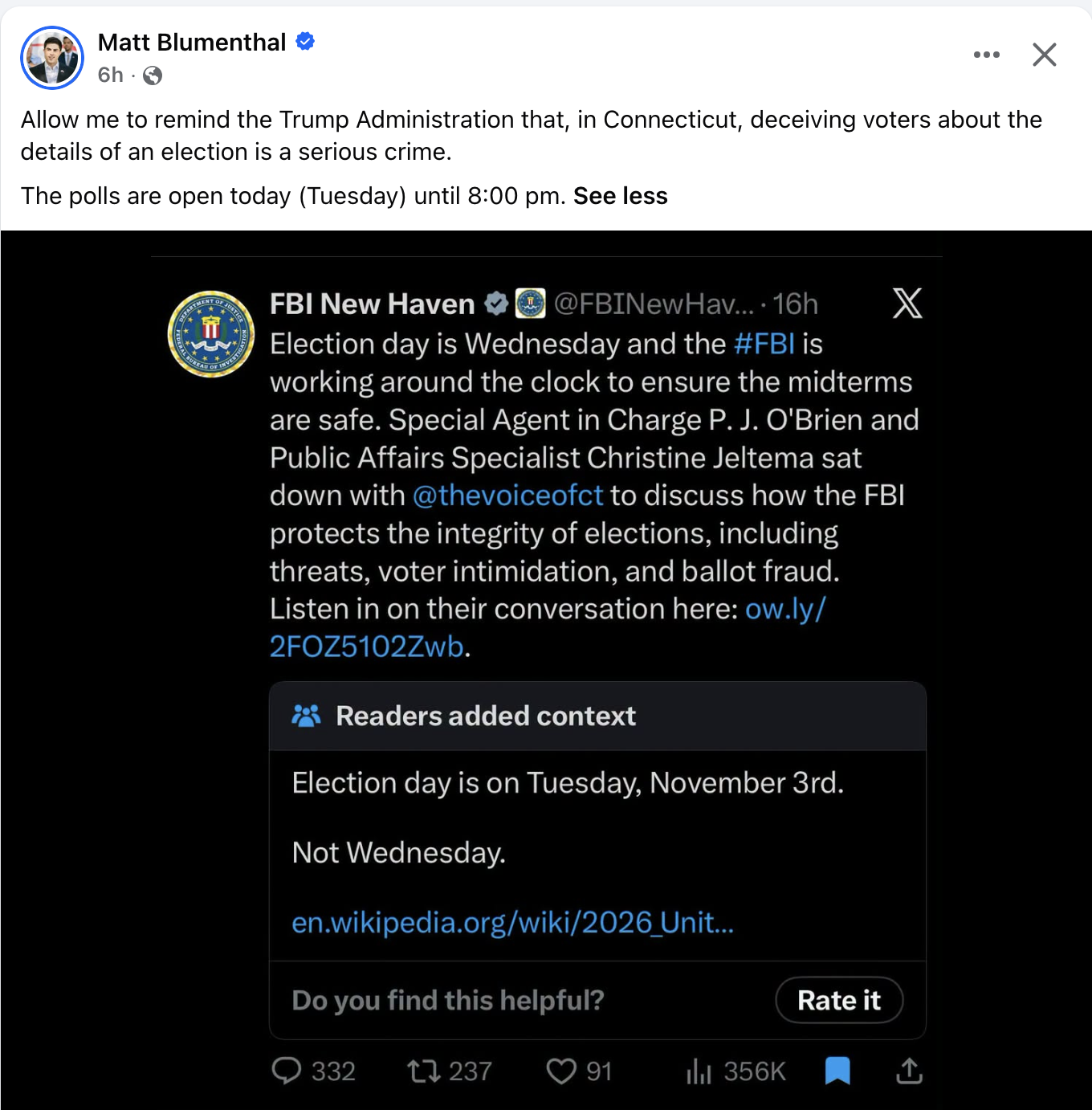
Additional friction came from an FBI New Haven post that erroneously listed Election Day as Wednesday (promptly corrected via a community note). FBI New Haven Public Affairs Specialist Christine Jeltema told the Centinal, “The only thing we can say is the post was taken down,” and then directed us to the national FBI press office for any further comment.
Then there's the experience described in a recent social media post—where a Connecticut voter reported walking into a polling place, signing a waiver, and receiving a ballot without presenting any form of identification—which raises legitimate questions about the strength of the state’s verification safeguards. If individuals can cast ballots under such minimal checks, how secure can our elections really be?
And the last, perhaps most important question of all for conservatives in Connecticut—with a CT GOP that is basically on life support—what are you going to do about it? What are you going to do about the failed leadership that has repeatedly watched election-integrity concerns, campus registration surges, and progressive organizational gains go unanswered? How many more cycles will you accept as “unwinnable,” so the CT GOP doesn’t even bother running a candidate, before demanding real accountability from your own party? And if the answer is still nothing, what exactly are you conserving?



Stay updated with the latest in the Constitution State with The CT Centinal

And your focus is on election integrity?
As the Republican gubernatorial candidate tells you that all of his inner circle is Democrat and his personal motivation is ‘learning from counter-cultural perspectives’ and ‘compromise’?
As Republican leadership maintains this smug, holier-than-thou, pseudo-authority on propriety?
Open your eyes!!!
The CT public has what it wants.
Abandon your fantasy that the government is the solution and storm the culture, conservatives.