Please Follow us on Gab, Minds, Telegram, Rumble, Gettr, Truth Social, Twitter, YouTube, Instagram
Ericka Barnes looked at the homework, and then she asked a question the school would rather not answer in public.
Her child is in AP Art History in Bethel. The packet was labeled a “Western and Central Asia Responsibility Sheet.” Students had to define, in their own words, Allah, Mecca, the Quran, Muslim, Imam, minaret, qibla, mihrab, minbar, salat, zakat, sawm, hajj, and shahada. A second page showed the plan of the Great Mosque of Kairouan in Tunisia and asked them to label the qibla wall, the courtyard, and the mihrab dome.
Then she wrote this, on Facebook:
“Please tell me why my Christian child is learning about ISLAM in Bethel Connecticut’s Public Schools?!?!? Are we teaching Christianity also? Are all the Muslim kids getting their lessons in Christianity? What do the 5 pillars of Islam have to do with AP art History? Why is this a part of the curriculum?”
Those are not crank questions. They’re the test of whether a public school is teaching about religion or playing favorites.
Here’s the thing, just so we understand each other. I’m not going to pretend Islamic art is off-limits in a serious art history class. It isn’t.
The College Board’s AP Art History course is built around 250 required works. That list includes the Kaaba, the Dome of the Rock, the Great Mosque of Isfahan, and the Great Mosque of Cordoba. Students are expected to know the qibla wall, the mihrab, the minbar, the minaret, and that Muslims pray facing Mecca. Pilgrimage is in the official framework. So is Christian art, and plenty of it: Chartres Cathedral, the Sistine Chapel, the Lindisfarne Gospels, the Last Supper, Hagia Sophia. There are Hindu and Buddhist works too, and a major Jewish manuscript, the Golden Haggadah.
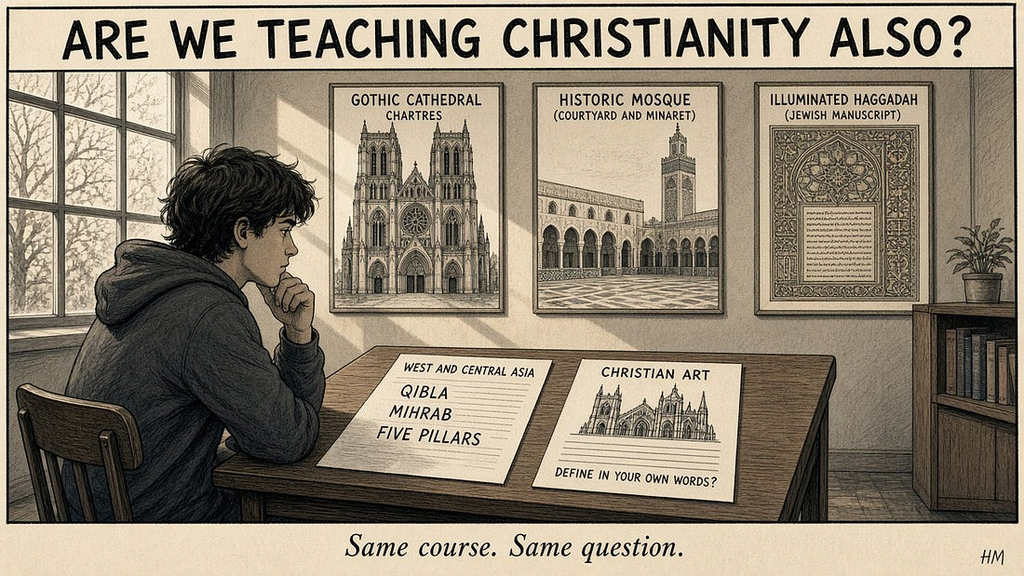
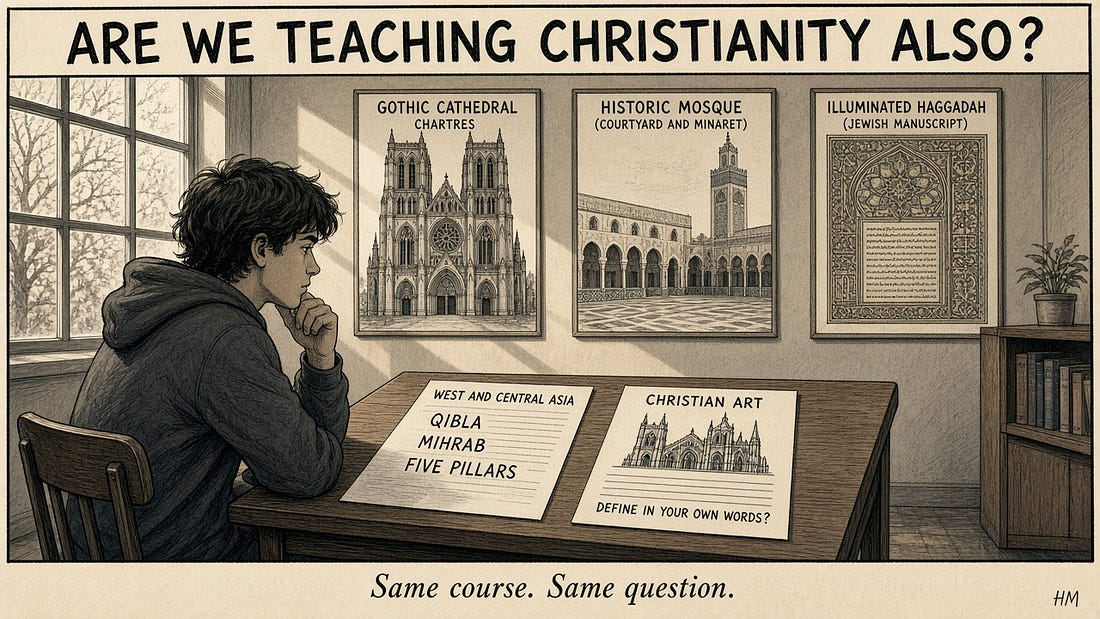
Look, the Great Mosque of Kairouan itself is not one of those 250 required works. Teachers may use other examples to teach the concepts. The stronger question is not why a mosque is on the worksheet. It’s the one Barnes asked. Are we teaching Christianity also? At the same depth. With the same expectation that students define core beliefs in their own words.
Salat, zakat, sawm, and shahada are not architectural terms. They’re pillars of Islamic practice and faith: prayer, almsgiving, fasting, and the profession of belief. Hajj is pilgrimage, which belongs in art history, same as relics and the function of a cathedral. The College Board says medieval art “derived from the requirements of worship,” Jewish, Christian, or Islamic. Then show me the Bethel worksheets for Chartres and the Sistine Chapel. Do those students have to define the Apostles’ Creed, the sacraments, and the Lord’s Prayer in their own words? Do they have to explain the Mass the way this sheet explains the Five Pillars?
If the answer is yes, produce the pages. If the answer is no, then this isn’t balance. It’s a double standard with a College Board cover sheet.
As of this writing, Bethel Public Schools hasn’t publicly responded to the specific worksheets.
The folks listening know this state’s habits by now. Connecticut will lecture you about inclusion, then flinch when the faith in question is the one most of its own history was built on.
In New Britain, teacher Marisol Arroyo-Castro was told to take a crucifix down from the wall near her desk. She refused. The district reprimanded her, suspended her for two days without pay, put her on leave, and later moved her into a non-teaching job with no student contact. A federal judge denied her request to be returned to the classroom while the case proceeds. She’s appealing. A crucifix about a foot high was too much religious expression for a public school. A worksheet asking students to define the shahada in their own words is, so far, just curriculum.
Let that sit for a second.
In Enfield, members of the Board of Education used to open meetings with prayer. The Freedom From Religion Foundation sent a complaint in 2023. The board dropped the prayer and went to a moment of silence.
Now look at what the state is building in the other direction.
This summer, Public Act 26-1 took effect. The provision was folded into a large education bill after a stand-alone version had a hearing in 2025. Section 24 added “Islamic and Arab studies” to the list of subjects the State Board of Education must make curriculum materials for, and must assist and encourage local districts to include. Districts don’t have to adopt them. But the state is supposed to create them and push them. Christianity is not on that list. There is no comparable “Jewish studies” subject either, except that Holocaust education is already there. The same act creates a working group on antisemitism that may also produce Jewish heritage resources.
Chris Healy, executive director of the Connecticut Catholic Conference, said the curriculum “validates, endorses the teaching of public religion in a public school, which is a clear violation of the First Amendment.”
Freedom of Information records show CAIR-Connecticut’s chairman emailed the State Department of Education in July and August with recommended names for the curriculum design team. A state planning spreadsheet listed four of those candidates, plus a CAIR National consultant. Texas and Florida have designated CAIR a terrorist organization. That’s a state designation, not a federal one.
In April, Bethel’s board voted to recognize Eid al-Fitr as an official school holiday. Now look, I’m going to be fair, because that’s what separates this show from the people I criticize. Bethel already closes for Rosh Hashanah, Yom Kippur, and Good Friday. Adding Eid is not, by itself, a scandal. If inclusion is the standard, the test is whether Christianity and Judaism get the same academic treatment.
Norwalk is further down the road. At a November 16 meeting, district staff described plans for an optional high school elective in Islamic and Arab studies for the 2027-28 school year, depending on enrollment and state materials expected as early as January. I haven’t seen a comparable state push for Christianity, Sikhism, Buddhism, or Judaism beyond the Holocaust unit Connecticut already requires.
So I’ll ask Barnes’s questions again. Are we teaching Christianity also, at the same depth? Are Muslim students, and everyone else in the room, getting the same doctrinal detail when the work on the table is a cathedral, a Gospel book, or a chapel ceiling? If this is inclusion, where is the equivalent treatment?
Public schools can teach about religion. They should. You cannot understand art, history, or this country without it. What they cannot do is punish a crucifix in New Britain, strip the prayer from a school board agenda in Enfield, and then, in the same state, build optional Islamic studies materials, take nominations from CAIR, and hand AP students a define-the-pillars worksheet without showing the same work for every other faith in the course.
Don’t pull the mosque off the curriculum. Put the Christianity unit on the table next to it. Same depth. Same beliefs, named and defined. Same honesty. If the district can do that, the class is legitimate. If it can’t, this isn’t inclusion. It’s a preference.
And a public school doesn’t get to have a preferred faith.



Stay updated with the latest in the Constitution State with The CT Centinal