
Please Follow us on Gab, Minds, Telegram, Rumble, Gettr, Truth Social, Twitter, YouTube, Instagram
Connecticut prides itself on a highly educated workforce. Navy veteran, small business owner, and 2026 Republican candidate for lieutenant governor Matt Corey is asking the obvious follow-up that too many in Hartford and Washington prefer to dodge: what skills are employers actually seeking through the H-1B program, and are qualified Connecticut workers getting a fair shot?
In a recent video, Corey highlighted the tension between the state’s education boasts and the reality of specialty-occupation visa hiring. The data supports the skepticism.
The Numbers in Connecticut
Connecticut employers filed approximately 2,168 H-1B petitions so far in 2026, according to data downloaded from the U.S. Citizenship and Immigration Services (USCIS) H-1B Employer Datahub, with a 97.4% approval rate—near the national average. In 2025 the figure was 2,912 H-1B petitions, with a 97.5% approval rate, and in 2024 the figure was about 2,956 petitions with a 98% approval rate.
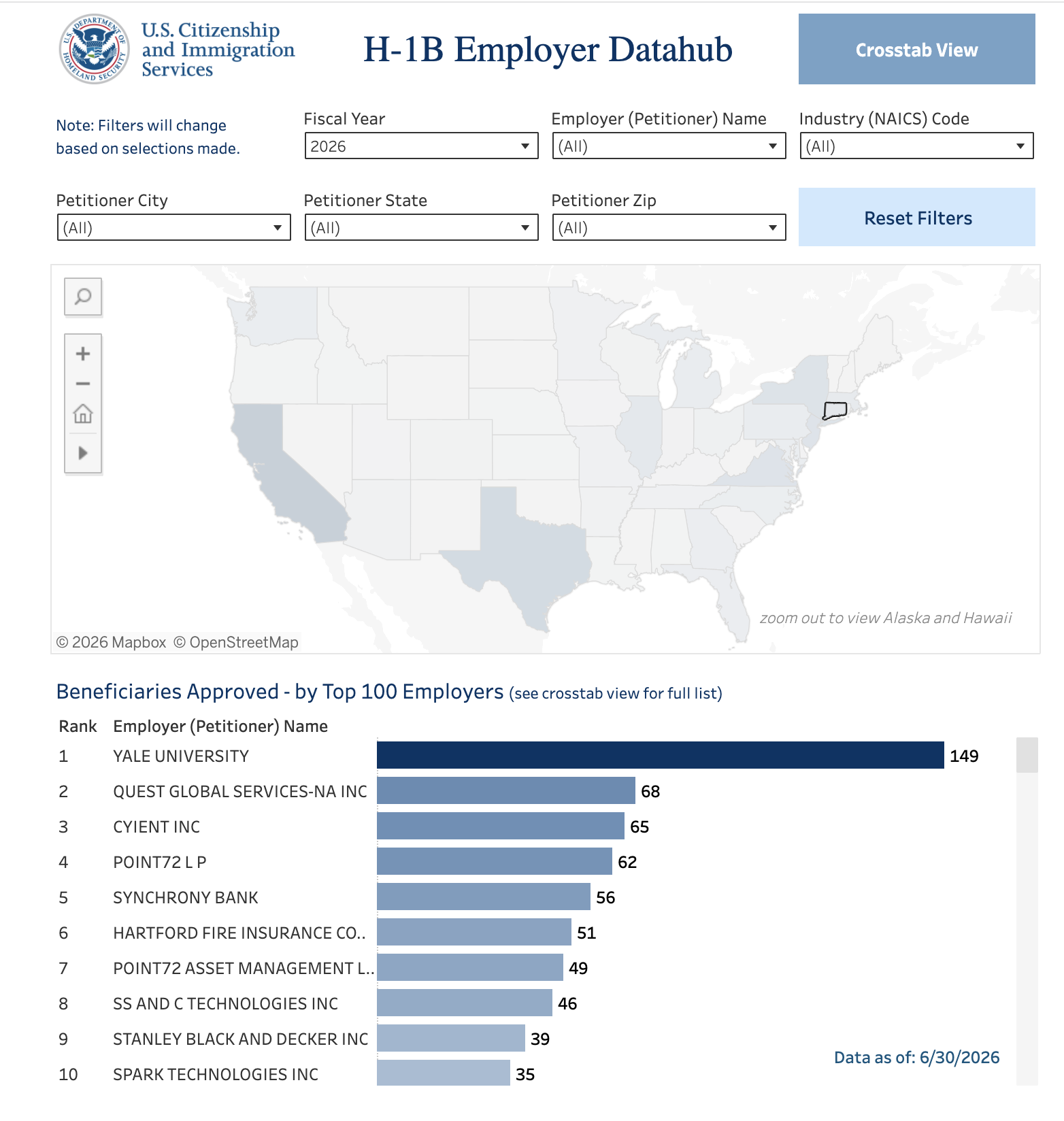
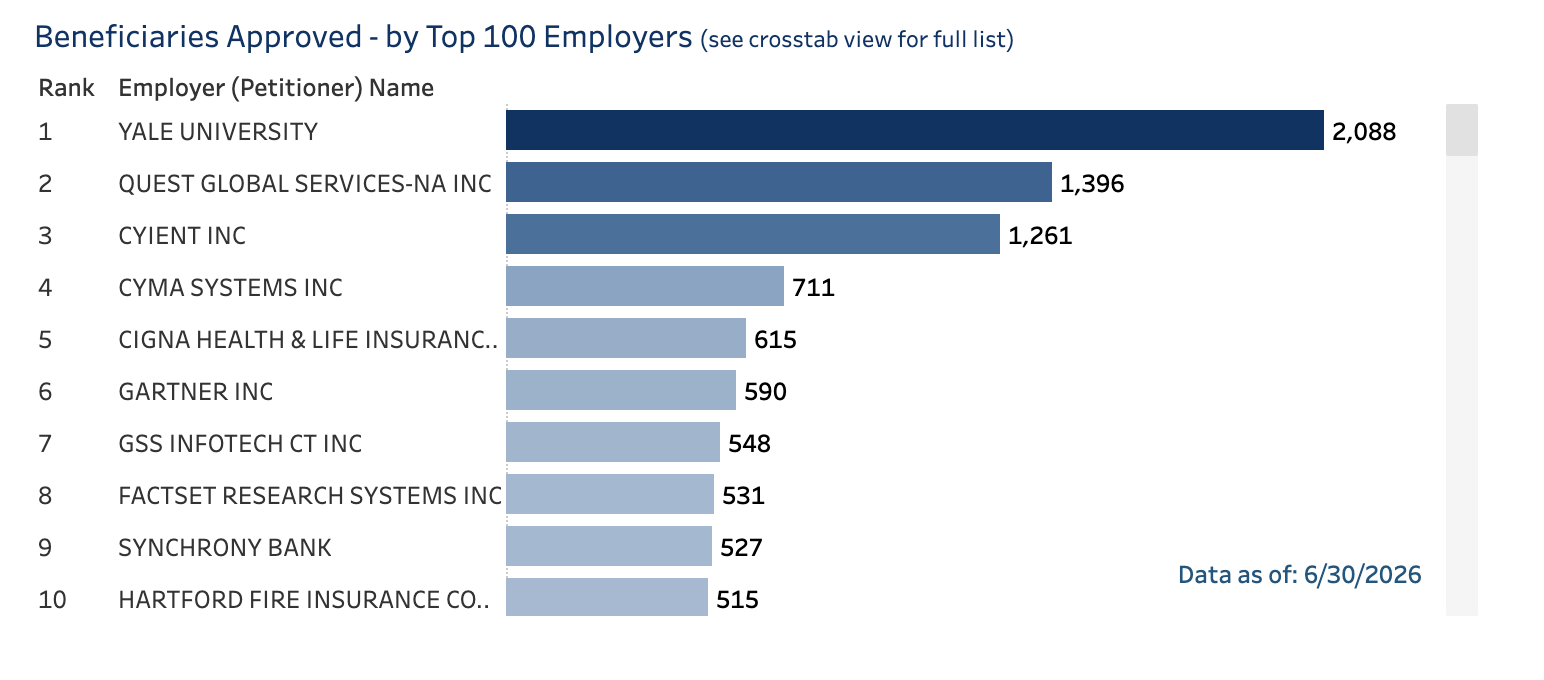
Over the last 10 years, Yale University has benefited the most from the H-1B program, with 2,088 beneficiaries approved. Quest Global Services, with 1,396, and Cyient Inc., with 1,261, came in second and third, respectively.
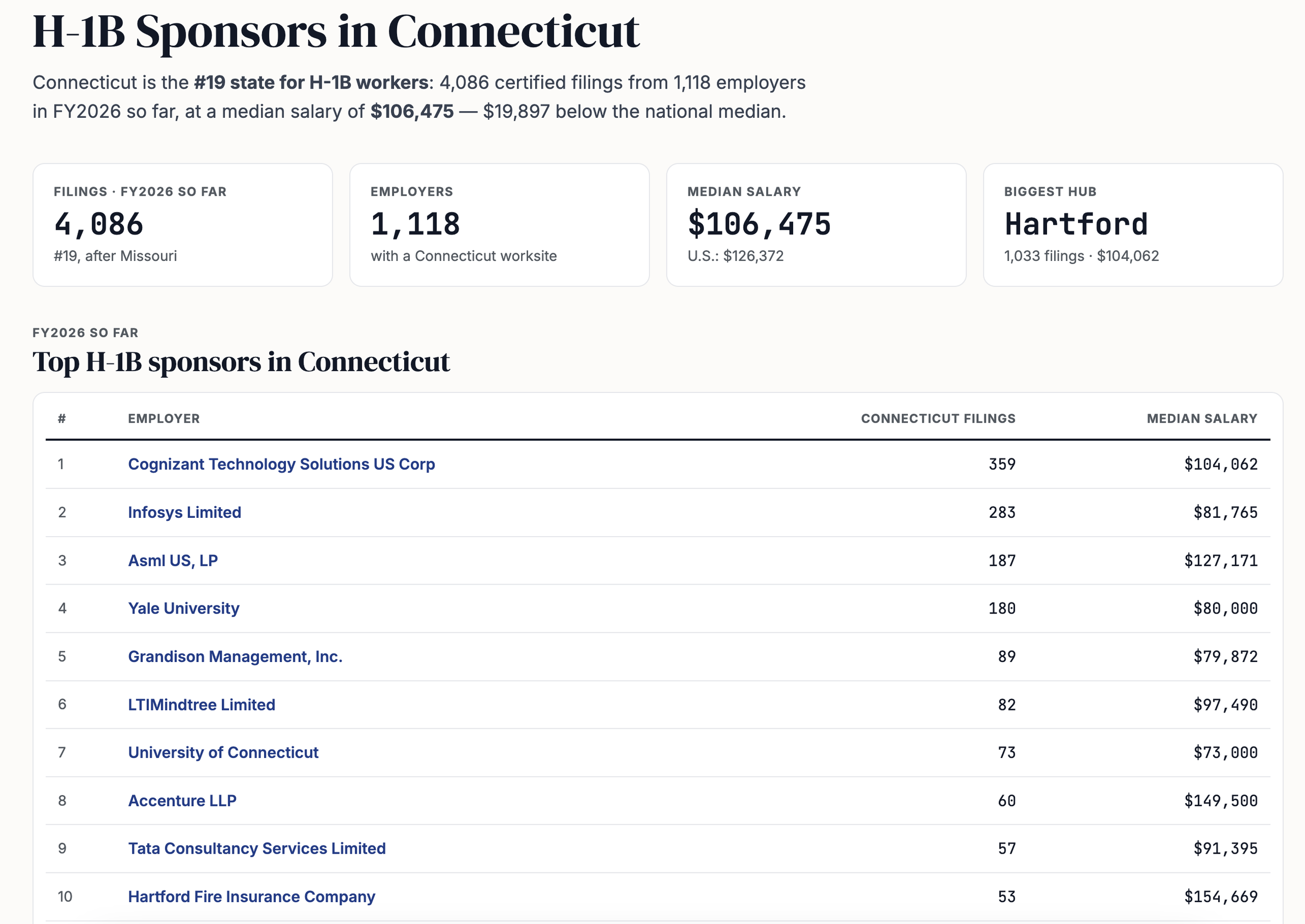
Separately, Department of Labor Labor Condition Application (LCA) data tracking worksites in the state (which can be filed by out-of-state firms) shows higher volume. Recent analyses put certified LCA filings for Connecticut worksites at about 4,086 in FY2026 so far (through mid-2026), ranking the state around #19 nationally. Longer recent windows show figures in the 6,000 range. Historical cumulative LCA records for the state exceed 100,000 H-1B-related filings over the years tracked by public datasets, with peaks earlier in the last decade followed by some moderation.
Top roles remain heavily concentrated in technology: software developers, computer systems engineers/architects, programmers, systems analysts, and related IT project and quality roles. Median offered wages in recent LCA data often land in the $80,000–$110,000 range depending on the source and period—respectable but frequently below the national H-1B median in high-cost tech hubs, and in some IT outsourcing cases lower still.
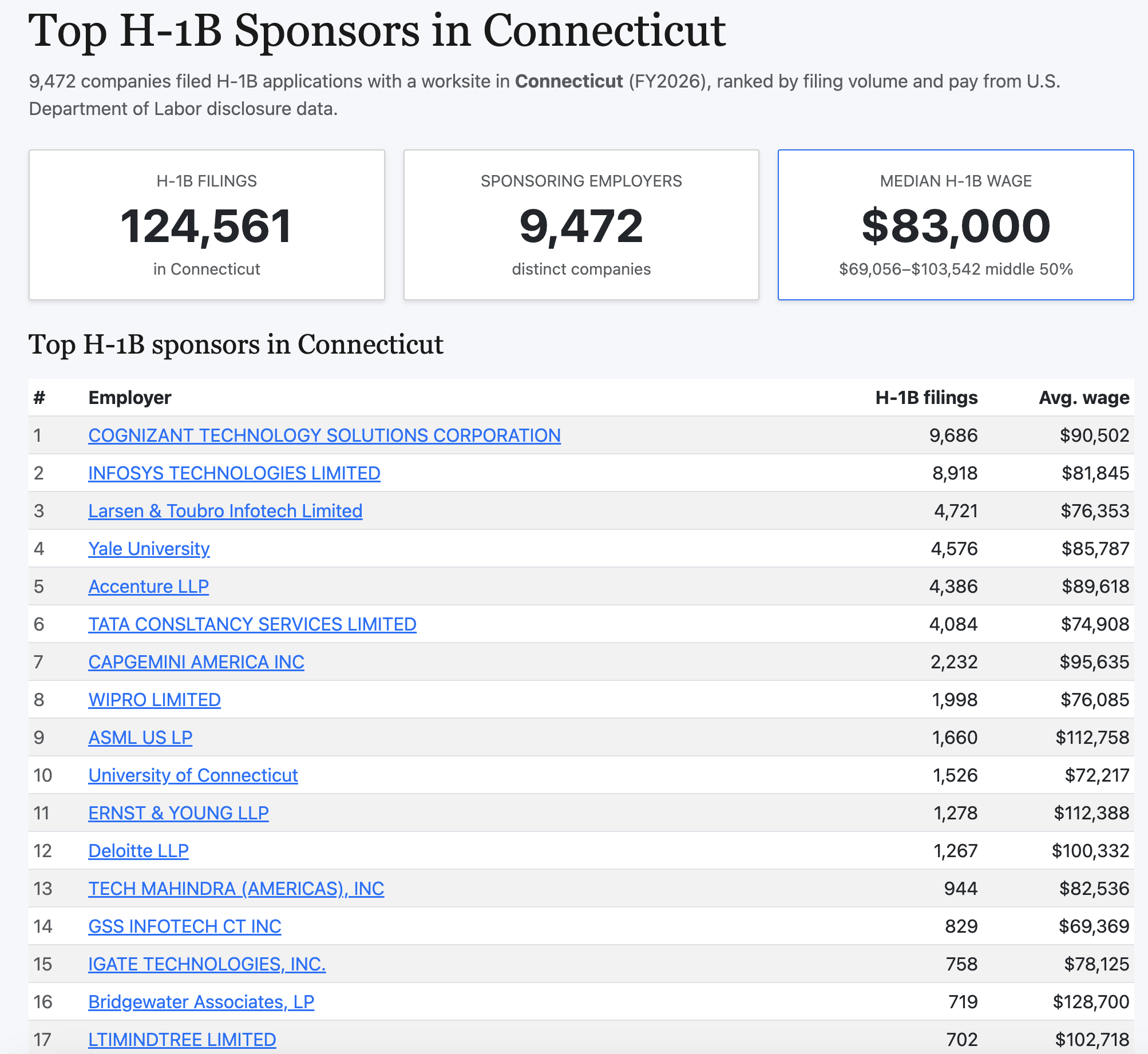
Leading sponsors for Connecticut worksites consistently include Cognizant, Infosys, Yale University, ASML, Accenture, Tata Consultancy Services, the University of Connecticut, and various finance, insurance, and healthcare entities. Indian IT services and staffing firms dominate the volume rankings for many tech roles.
How Connecticut Compares
California, Texas, New York, New Jersey, Washington, and Illinois account for the bulk of national H-1B activity. Connecticut sits in the middle of the pack by absolute volume—significant for a state of roughly 3.6–3.7 million people and a labor force of about 1.88 million, with nonfarm employment around 1.73 million, but far from the scale of the largest coastal and Sun Belt hubs.
Hartford, New Haven, and Stamford concentrate much of the activity. Relative to the state’s size and its concentration of insurance, finance, education, and advanced manufacturing, the reliance on H-1B for routine IT and professional services work stands out. Cumulative historical figures place Connecticut in the top 20 by total LCA activity over the long term.
Trump Administration Actions and Employer Impacts
The Trump administration has moved to raise the cost and scrutiny of the program, particularly for new hires brought in from abroad via consular processing. A September 2025 presidential proclamation imposed a $100,000 fee on certain new H-1B workers entering from outside the United States. This hit consular-heavy employers hardest.
IT outsourcing and staffing firms such as Infosys, Tata Consultancy Services (TCS), and Cognizant—long among the top H-1B users nationally and active in Connecticut worksites—saw sharp drops. Registrations for the FY2027 lottery fell dramatically: Infosys down roughly 91%, TCS around 95%, and Cognizant effectively to zero in some reported data. Broader analyses showed consular-processing petitions and registrations from major outsourcing firms plunging by around 90% in the relevant periods. The fee was designed to curb perceived abuse of the program by body shops and to favor higher-wage or more specialized roles over volume-driven outsourcing models. Additional reforms, including moves toward wage-weighted selection, further shifted incentives.
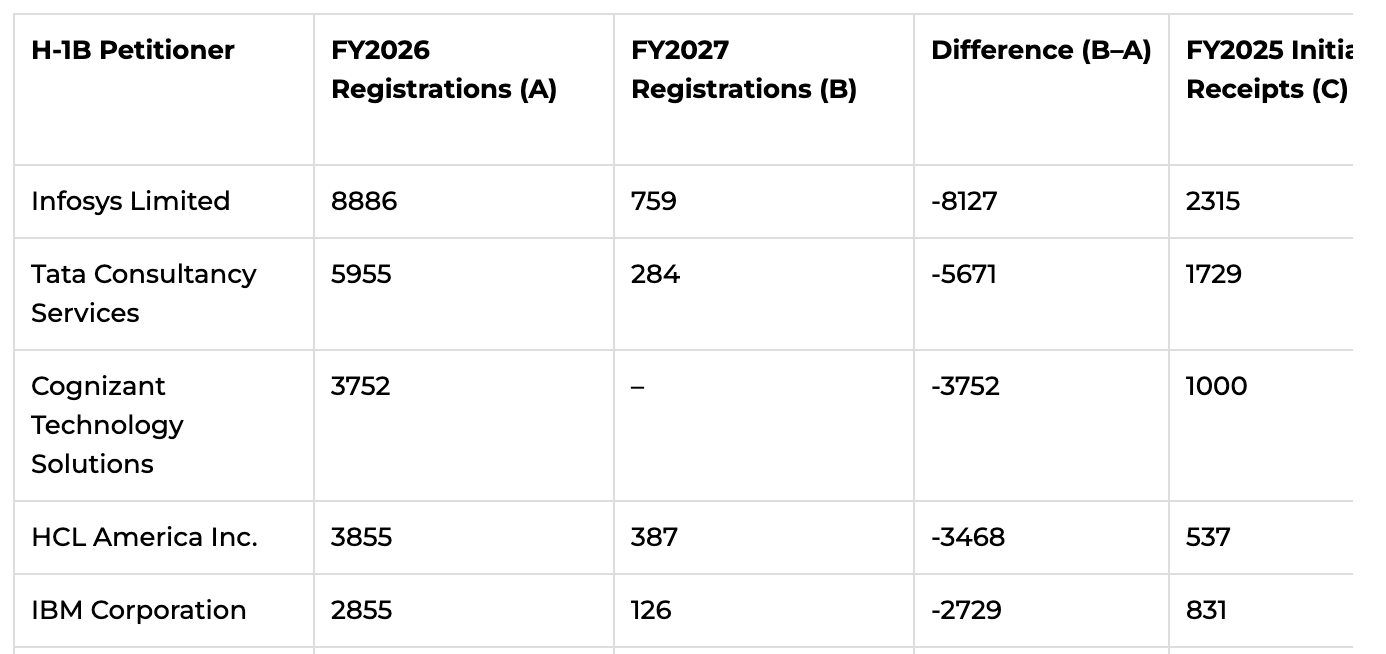
These changes directly raise the cost of importing foreign labor for employers that previously relied heavily on the H-1B pipeline for lower-to-mid-level IT work. Companies that already maintain large U.S. workforces or hire locally are less affected than those whose model depends on bringing large numbers of workers from abroad for temporary assignments.
The Local Question Corey Is Raising
Connecticut has universities producing computer science, engineering, and related graduates. It also faces persistent labor-force challenges, elevated unemployment relative to national levels in recent periods, and high costs that push talent elsewhere. When the top H-1B volume comes from outsourcing firms filling programmer, analyst, and systems roles—often at wages that do not scream extreme shortage—the fair question is whether employers have exhausted the local and domestic talent pool or simply found a convenient, scalable alternative.
State contracts and deals involving firms like Infosys have drawn separate scrutiny over value and where the work is actually performed. The H-1B data does not prove every petition displaces a Connecticut resident, but the scale, the concentration in IT services, the wage levels relative to high local costs of living, and the dominance of certain employers make Corey’s question unavoidable: if the state truly has a highly educated workforce, why is so much specialty-occupation hiring flowing through this channel rather than to people already here?
Reforms that make volume-driven foreign hiring more expensive force employers to recalibrate. That is precisely the point of policies aimed at protecting American workers first. Connecticut’s political class has spent years celebrating its education system while remaining largely silent on whether that system’s graduates are competing on a level field. Corey’s post simply asks for the numbers and the fairness check the data already invites.



Stay updated with the latest in the Constitution State with The CT Centinal