Please Follow us on Gab, Minds, Telegram, Rumble, Gettr, Truth Social, Twitter, YouTube
My family and I recently watched the stirring new movie, A GREAT AWAKENING, at the theater over Easter weekend. A dramatic buddy film, A GREAT AWAKENING reveals the unexpected humble friendship between the 18th Century English evangelist George Whitefield and Benjamin Franklin, the famed publisher and scientist who wasn’t known for his religious beliefs. The contrast between Franklin and Whitefield led me to watch several behind-the-scenes YouTube videos about the film. One interview caught my attention because it reminded me of something I wrote 19 years ago.

In this YouTube interview, actor Jonathan Blair reflected on playing George Whitefield.
“Whitefield was such a simple man on what he dedicated his life to and how he didn’t let anything deter him from that,” Blair said.
The interview then featured a film clip of Whitefield speaking thunderously to a crowd.
“Does not your dead heart quicken to life at the thought that you were fashioned for some purpose?” Whitefield declared of his philosophy of living a purpose-driven life.
Blair explained that Whitefield never wanted to stop doing what he believed the Lord had given him to do, spread the gospel in Britain’s American colonies.
“At first approaching the character, I thought that sounded borderline crazy. I thought that sounded kind of fanatical. But I think there’s more to it than I initially gave him credit for. He changed the course of the world in no small way,” Blair explained.
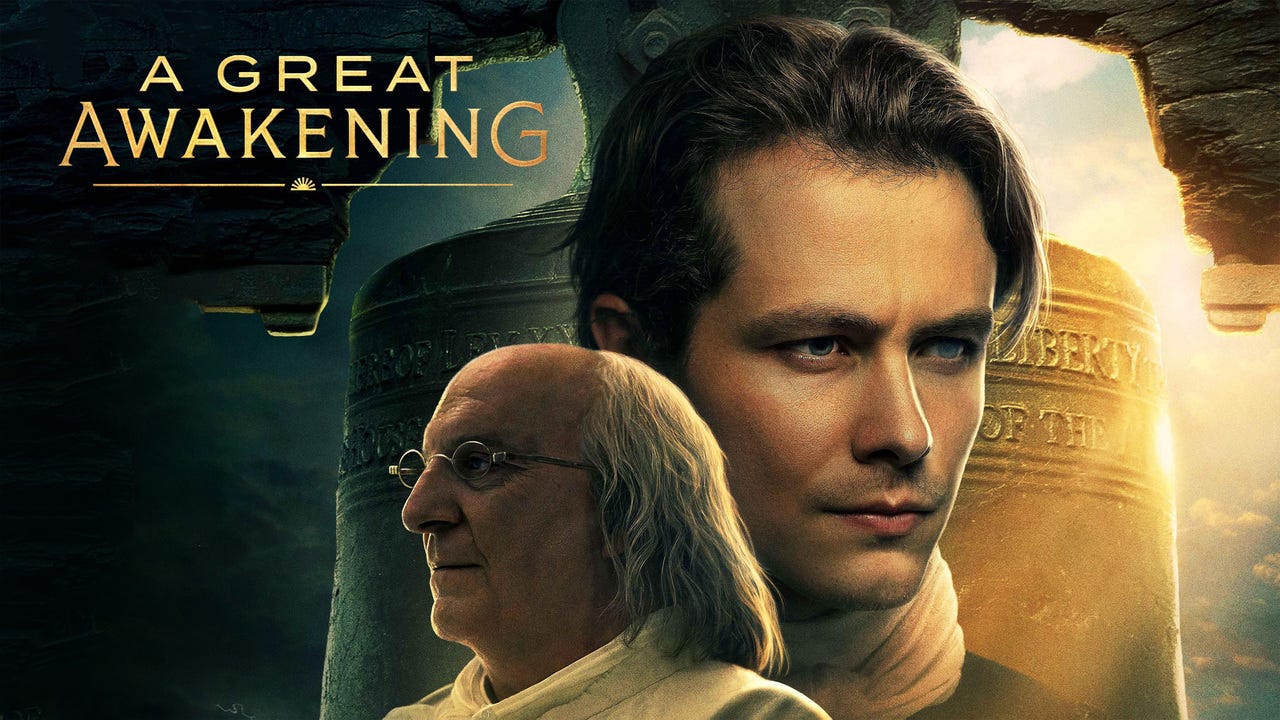
Whitefield was one of several ministers who personalized the gospel by promoting individual, new birth conversions. Their efforts created the revival movement known as the Great Awakening in America and Europe. Challenging traditional authority, the Great Awakening also fostered democratic ideals that paved the way for the American Revolution.
In the film, Whitefield underscored his desire to glorify God instead of himself when he said, “Tear down the name of Whitefield, if it means that your name remains.”
Blair, the actor, saw the contradiction.
“That’s the ironic thing about making a movie about someone who didn’t want to be remembered for the things they did,” Blair said, noting that Whitefield expressed this sentiment: ‘I don’t want anything named after me. I don’t want to be remembered.’”
This jumped out at me because it reminded me of the first time I wrote about Benjamin Franklin.
Though not overtly discussed in this enlightening film by Sight and Sound, Ben Franklin likewise once proclaimed that he wanted to live a life so quietly that he would die “unlamented.”
The irony for Franklin, of course, is that he was hardly unlamented. All of Philadelphia came out to watch his funeral procession, led by numerous clergymen and a rabbi. Today, Franklin is remembered for many accomplishments, including running the most successful newspaper in the colonies, writing a best-selling almanac for 26 years, experimenting with electricity and starting the first public library, among many, many more deeds.
Most importantly as we celebrate America’s 250th anniversary, Franklin played a crucial role in the American Revolution. A member of the committee that wrote the Declaration of Independence, he edited Thomas Jefferson’s draft and whispered jokes to help him relax while the Declaration of Independence was debated in the Continental Congress. Later, Franklin served as America’s top diplomat in Europe, where he convinced the French king to join America’s quest for independence from England by providing men, money, and muskets.
More than 19 years ago, I wrote my first book about the American Revolution called Stories of Faith and Courage from the Revolutionary War. At the time, I was on bed rest with preterm contractions for my middle son (who was delivered safely). Unable to go to the Library of Congress or other libraries while on bed rest, I devoured as many original writings as I could find online. A digital database of primary sources came to my rescue. When I came across Franklin’s wish to live a quiet but full life, I wrote about it.
Franklin shared Whitefield’s desire to live unlamented, though their reasons for doing so were different. Whitefield wanted to draw attention to Christ, not himself. Franklin was far from an evangelist, but he wasn’t a self-centered glory seeker, either. He was naturally curious and worked for the public good. Franklin and Whitefield shared the virtue of humility.
As the movie implies, Franklin explained in his autobiography that he ultimately rejected the philosophy of deism, the belief that God had created the world and abandoned it. Instead, Franklin saw God in nature, believing that the world was too beautiful and must have been created by an intelligent designer who still cared about humans. The film culminates with Franklin's call to prayer during the Constitutional Convention in 1787.
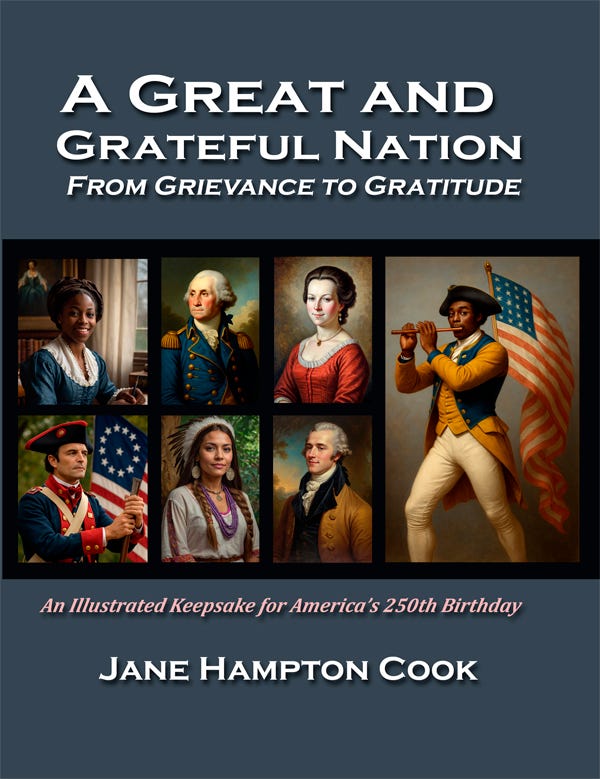
In my new 2026 book about the American Revolution, an illustrated keepsake for America’s 250th called A Great and Grateful Nation: From Grievance to Gratitude, I wrote about Franklin’s private liturgy that he read weekly instead of attending church.
“I had some years before compos’d a little liturgy or form of prayer for my own private use, viz, in 1728 entitled Articles of Belief and Acts of Religion.”[i]
Seeing God in nature, Franklin thanked his Creator for life’s essentials: “For peace and liberty, for food and raiment, for corn and wine, and milk, and every kind of healthful nourishment—Good God, I thank thee.”
Fittingly for the father of American free speech, he also focused on God’s gift of words, which he loved. “For knowledge and literature and every useful art; for my friends and their prosperity, and for the fewness of my enemies,—Good God, I thank thee. For all thy innumerable benefits; for life and reason, and the use of speech, for health and joy and every pleasant hour,—my Good God, I thank thee.”
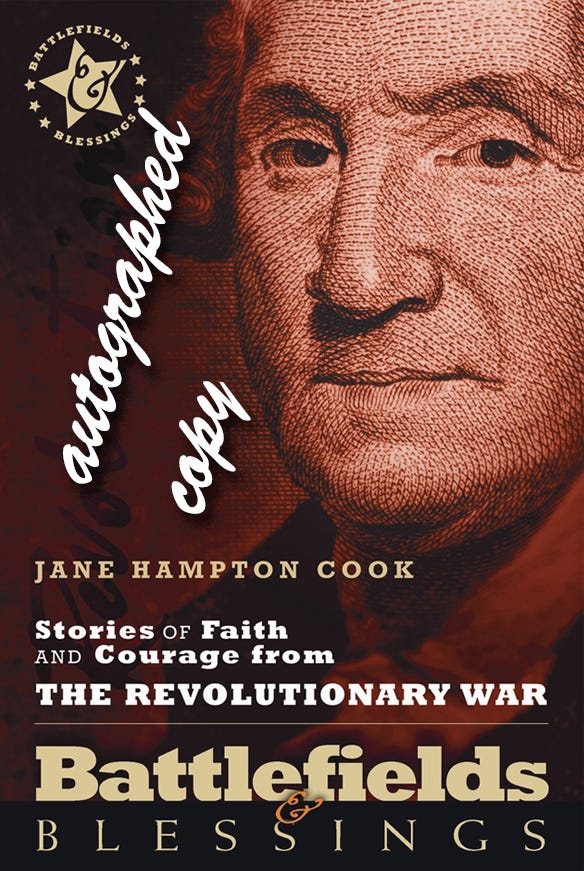
Below is Franklin’s “Let me die unlamented” devotional, excerpted from Stories of Faith and Courage from the Revolutionary War. Enjoy!
Years before George III wore the king’s crown and George Washington wore a soldier’s hat, another man searched for just the right hat, one that would bring him contentment. “Happy the man whose wish and care, a few paternal acres bound, content to breathe his native air, in his own ground,” the poet wrote.
This life philosophy was carefree. Time passed more easily when a man or woman found contentment in life’s simple pleasures. “Whose herds with milk, whose fields with bread, whose flocks supply him with attire, whose trees in summer yield him shade, in winter fire,” he continued.
“In health of body, peace of mind, quiet by day, sound sleep by night; study and ease together mixt.”
All these, along with sweet recreation and meditation, were the poet’s recipe for tranquility. He exalted one of humanity’s deepest desires—the pursuit of happiness. He believed the best reward for a quiet life was an even quieter death.
“Thus let me live, unseen, unknown, thus unlamented let me die, steal from the world, and not a stone tell where I lie,” he concluded.
Alexander Pope penned this poem. When this literary English giant died in 1744, another author paid him homage. The editor of America’s best-selling almanac chose to print this poem as a eulogy to Alexander Pope. By omitting Pope’s name and naming it “The Countryman,” he gave Pope the gift of dying “unlamented,” as he wished.
But the editor’s connection to Pope the poet was more than a mutual love of the smell of a book’s binding or a whiff of ink from a freshly printed page. This man identified with Pope’s desire for contentment. He also dreamed of living such a tranquil life that he could die “unlamented” with “no stone to mark his grave.”
However, when this editor died decades later, he hardly left earth unnoticed. More than 20,000 attended his funeral. Today, thousands throw pennies on his grave every year. The stone marking this “countryman’s” life bears the name of Benjamin Franklin.
Franklin employed his pen and press to publish Poor Richard’s Almanac from 1732 to 1758. Using the pseudonym of Richard Saunders, Franklin published pithy sayings, poetry such as The Countryman, prose, weather predictions, a calendar, and other useful information. Franklin’s almanac was second only to the Bible in many households for its authority on practical matters.
Poor Richard’s sold 10,000 copies annually, which made Franklin an unparalleled celebrity. It was unclear who loved Franklin more, the lords of London or his fellow American colonists, that is, until the king blamed Franklin for the Boston Tea Party. After receiving a tongue lashing by the king's private council, Franklin joined the Continental Congress as a full-blown patriot.
Benjamin Franklin would have been content to die unlamented. Living a life of hard work mixed with good health was the perfect menu for his palate. But as sometimes happens in life, this countryman’s country called him into a different pursuit. His purpose in life became not to die happy, but to live loudly for liberty.[i]
“A man can do nothing better than to eat and drink and find satisfaction in his work. This too, I see, is from the hand of God, for without him, who can eat or find enjoyment?” (Ecclesiastes 2:24, 25).
Prayer: Father, I thank you for the basics in life. Through you I can find satisfaction in my work and my recreation.
[i] Benjamin Franklin, “The Countryman,” Poor Richard, 1744. An Almanack, etc. Philadelphia. Printed from http://www.originalsources.com [accessed June 2006].
[i] Benjamin Franklin, Articles of Belief and Acts of Religion, November 20, 1728, https://founders.archives.gov/documents/Franklin/01-01-02-0032.


Stay updated with the latest in the Constitution State with The CT Centinal