Please Follow us on Gab, Minds, Telegram, Rumble, Gettr, Truth Social, Twitter, YouTube, Instagram
If you’ve seen the new movie, Young Washington, you’ve discovered George Washington’s heroism in the French and Indian War. I watched the movie three times in eight days because I wanted to see the reactions of my friends and family to this story that I’ve written about in some form in at least four books. Young Washington captures the spirit and essence of George Washington, especially showing his determination to put his men first.
I provide the most details of Washington’s heroism in his 20s in my book, War of Lies: When George Washington Was the Target and Propaganda Was the Crime. In this post and future posts, I am excerpting the book’s chapters that show Washington’s mistakes and triumphs during the French and Indian War. The book is a true crime history-mystery about a propaganda campaign the targeted Washington by publishing counterfeit letters in his name. He never knew who was behind it, but I think I’ve figured it out and flesh out the story through four suspects. At the end, I reveal my opinion of who done it.

The invasion on the border had to end. “Mr. Washington, the ambassador,” the Boston Gazette began in its report on March 5, 1754, “is returned” from his nine-hundred-mile journey from the western territory of Ohio (Pennsylvania) to Williamsburg, Virginia. Virginia’s Royal Governor Robert Dinwiddie had sent twenty-two-year-old Major George Washington on a diplomatic expedition to discover if Frenchmen were building forts in English territory and violating their treaty. He ordered Washington to deliver cease-and-desist letters to commanders of every French fort.
What had Washington discovered? His mission had confirmed the worst fears of the king of England, King George II.
“It is undoubtedly affirmed for truth, that the French have settled and fixed several forts near the Ohio tract, especially one upon (a) French River,” the Boston Gazette continued of Washington’s discovery. Just as the English sought to expand their colonial territory to the west, so the French also sought to extend their territory to the south from Canada. Their paths crossed in land named after the Iroquois word for great river, O-Y-O, or Ohio.

During this dangerous mission, Washington had come across three French forts at the intersection of three rivers—the Ohio, Allegheny, and Monongahela. The commanders of the first two forts had rejected Dinwiddie’s letter. Despite their hostility, Washington had observed their posts’ size, the number of men they housed, and their defensive capabilities.
“Mr. Washington was received in a polite genteel manner by the commandant of the fort,” the Boston Gazette explained of his reception at the last fort, which was the largest boasting five hundred men and twelve cannon. After reading Dinwiddie’s letter, the French commander revealed that his orders to build and defend these forts came from France’s king. The commandant “added, that he had expected an army to be sent for 12 months past by the English, and that they were prepared for them,” the Boston Gazette reported of the ominous news that France was expecting to go to war against England. The question was this: Were the English ready and willing to go to war, too?
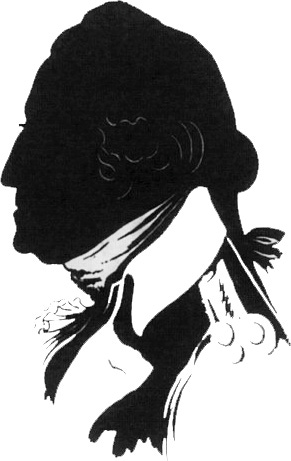
Why did Governor Dinwiddie choose Washington for this important mission? After all, Washington was part of the middle class, known as the mid-gentry, and not the upper class. Though he was at least six feet in stature, if not taller, Washington knew that he wasn’t a standout for his education. He didn’t have a status-making degree from Virginia’s university for those with higher social pedigrees, the College of William and Mary.
He didn’t come from a wealthy family, such as the Randolphs, with connections to royalty. Virginia Attorney General Peyton Randolph and his brother John Randolph could brag that their ancestor, Sir Thomas Randolph, had been an advisor to Queen Elizabeth. Little did Washington know, but one member of the Randolph family would emerge as a suspect in the War of Lies’ forgeries years later.
The stigma he carried over not having as high a social status as the Randolphs and other families also stemmed from a childhood tragedy. If his father, Augustine Washington, had not died when George was eleven years old, George might have had the same educational opportunity as his half-brother Lawrence, who was fourteen years older. Like their father, Lawrence had been educated at a respectable school in England before returning to the colonies. Instead, George had to study at home, under the influence of his mother, Mary Ball Washington, who was loving and overbearing at the same time.
Without a formal education and a high social ranking, how did Washington stand out to Dinwiddie? Taking pride in his best assets, he leveraged two important qualifications: his experience as a land surveyor and his good manners.
As a youth, Washington had used a quill pen to make a copy of all of the social rules in the must-have book for up-and-coming modern-day gentlemen, 110 Rules of Civility and Decent Behavior in Company and Conversation. Beyond practicing good handwriting, duplicating these guidelines deepened Washington’s understanding of how to behave in social situations. The first rule provided a foundation for how to treat others. “Every action done in company ought to be with some sign of respect to those that are present.”
While in the presence of someone of higher social rank, such as Governor Dinwiddie or Attorney General Randolph, Washington made sure that they spoke to him first and not the other way around. Likewise, he also extended courtesy to those of lesser social rank. Washington’s good manners and polite behavior would be his best passport in delivering letters to hostile Frenchmen on the Ohio frontier. If need be, Washington’s manners just might save his life.
How did George become a surveyor with six years of experience by age twenty-two? When he was fifteen, he moved in with Lawrence and his wife, Ann Fairfax Washington, at their Potomac River home called Mount Vernon. Lawrence taught him the precision of hunting, art of horseback riding, finesse of fencing, and joy of dancing. Waking up to the cock-a-doodle-do of the rooster and slumbering under the music of crickets at Mount Vernon had given the young George much happiness.
Mount Vernon had also expanded his social network by giving him a chance to know Lawrence’s father-in-law, Colonel William Fairfax. Impressed by his manners and work ethic, the colonel asked George to survey his extensive land holdings. At age sixteen, Washington took on the respectable trade of surveying.
For six years, George developed important skills that would prove valuable in the years to come. He learned how to prepare for long journeys, arrange for supplies, and live off the land. With stamina to ride a horse for long periods of time, he also developed and honed the mathematical skills needed to calculate and measure terrain.
While Washington’s good manners and surveying skills stood out to Governor Dinwiddie, why would Washington risk his life to find out if the French were building fortifications on England’s claims? He had personal, financial, and patriotic reasons for accepting this duty. Lawrence was a shareholder in the Ohio Company of Virginia, the land speculation business that had bought land from the king and had sold it to settlers in the Ohio River territory.
Loyal to King George II, Washington saw the opportunity as a stepping stone to what he most wanted, an officer’s commission in the Royal Army like his brother. While serving as the military adjutant and training officer for Virginia, Lawrence had received a brevet officer’s commission in the regular British army from King George II.
Success in Dinwiddie’s mission could bring a commission to Major Washington, who was part of the Virginia militia but not the Royal Army. Despite his lack of social status, George knew he had what it took to be an excellent officer and diplomat.
Washington may not have realized it, but when the Boston Gazette, Pennsylvania Gazette, and London’s Gentleman’s Magazine reported on his first Ohio mission, he became a newsmaker and a reporter at the same time. How was that possible?
After returning to Williamsburg on his first mission in early 1754, Washington had given his journal to Governor Dinwiddie, who had needed an opportunity to boost his own sagging popularity. A year earlier in 1753, Dinwiddie had enforced a fee for new land grants in Virginia. Though approved by the Board of War, this tax had incensed the upper class and the House of Burgesses, Virginia’s legislative body. They had sent Attorney General Randolph to London to plead with King George II’s Privy Council to overturn the tax. Randolph’s cousin, Thomas Jefferson, would reflect decades later that Dinwiddie and the crown’s overuse of taxing power was done “without the sanctions of any law.”
Dinwiddie quickly arranged to print Washington’s journal as a pamphlet to widely spread the news of the French fortifications in British territory. This news would also distract from the fallout of the tax.
On May 14, 1754, the Boston Gazette published Washington’s journal in installments to its six hundred subscribers to relay what had happened on his first Ohio mission. Boasting a motto of “Containing the freshest advices foreign and domestic,” the Boston Gazette, like other newspapers, could not afford to hire staff reporters. Instead they relied on citizens sending them information. Washington’s journal proved to be a goldmine of concerning information to fill newspaper columns.
“And they told me that it was their absolute design to take possession of the Ohio,” Washington wrote in his journal. “And by G--, they would do it,” he added, quoting the French commander while being careful not to spell out God’s name lest he be accused of using the Lord’s name in vain. The 110 Rules of Civility taught gentlemen to only use words of respect when speaking of God.
As other newspapers published his journal, readers throughout the colonies soon discovered Washington’s day-by-day account of his mission, which spanned from October 1753 until mid-January of 1754. Not only did he break the news of emerging French fortifications, but he also provided rich details of the roadless Ohio territory, its native tribes, and its natural resources. Washington’s journal also revealed his good manners as he interacted with the indigenous people and Frenchmen. With each new installment, the colonists from New England to Georgia learned that they were in danger of losing their western territory. They also became more and more smitten with Washington.
In June 1754, people in England were also introduced to Major Washington in Gentleman’s Magazine, which had reprinted a part of his journal. English readers discovered Washington’s Lancelot-like athleticism, such as when he guided a raft on an icy river.
“In this distress, the major put out his setting pole, that , if possible the ice might pass clear of his raft, but the rapidity of the stream drove it with such violence against the pole, that being unwilling to quit it, he was jerked into ten feet of water. He fortunately saved himself by catching hold of one of the raft logs.”
Readers on both sides of the Atlantic were developing a fondness for George Washington in his dual role of reporter and newsmaker. Infatuated some were.
Among those readers in London were two brothers, John and James Rivington, who were about ten years older than Washington. As English as English can be, they ran their deceased father’s publishing business at a shop long known by its white signboards of Rivington or Bible and Crown at St. Paul’s Churchyard in London. John and James often advertised their new publications in the Gentleman’s Magazine. A month before publishing his journal, this advertisement appeared in the magazine’s May 1754 edition. “Sermons before the Governor of the London hospital, by the Archbishop of Oxford, 6d Rivington.” One of the Rivington brothers would soon become so smitten with America that he would make a life-altering decision and would play a significant role years later in the Revolution’s War of Lies.
While readers’ fingers became stained with ink and their tongues made bitter by English tea in 1754 as they read about his exploits, Washington returned to the Ohio territory for a new mission. This journey would lead to an unusual test of his good manners and, worse, result in the most sensational news yet about him.
Governor Dinwiddie sent Washington and other militiamen to support Englishmen who were constructing a new English fort at the Monongahela River. Arriving in mid-April in 1754 with a party of nearly one-hundred-sixty men and supplies, Washington learned the devastating news that the French had already captured this post. Many of the English survivors joined Washington, as the editor of the Pennsylvania Gazette reported on May 9, 1754.
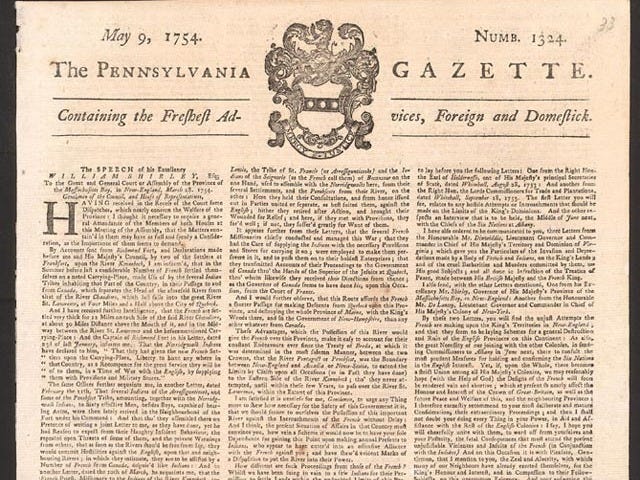
“Friday last an express arrived here from Major Washington, with advice that Mr. Ward, ensign of Captain Trent’s company, was compelled to surrender his small fort in the forks of the Monongahela to the French, on the 17th past (April),” the editor relayed with one technical error. By this time, Washington had received a promotion to the rank of lieutenant colonel in Virginia’s militia. While this was honorable and well-deserved, he still didn’t have the regular British army commission that he wanted.
What stood out the most about this article were repetition and a new icon. First, the editor used the word join or joined three times. “Mr. Ward having but 44 men and no cannon to make a proper defense was obliged to surrender and they had accordingly joined Major Washington,” the Pennsylvania Gazette’s editor reported, noting that the French outnumbered the English with a fleet of three-hundred and sixty canoes, a thousand men, and eighteen pieces of artillery.
“The Indian chiefs, however, have dispatched messages to Pennsylvania and Virginia, desiring that the English would not be discouraged, but send out their warriors to join them and drive the French out of the country before they fortify, otherwise the trade will be lost, and to their great grief an eternal separation between the Indians and their brethren the English,” the Pennsylvania Gazette’s editor continued, using join a second time.
He very purposefully used the word join a third time to describe French reinforcements. More than four hundred Frenchmen and six hundred of their native allies had come from a lake “to join them.” The article switched from facts to opinion, revealing the writer’s purpose.
“The confidence in the French of this undertaking seems well grounded,” he wrote. Then he pointed out the lack of cohesion in the colonies. “In the present disunited state of the British colonies and the extreme difficulties of bringing so many different governments and assemblies to agree in any speedy and effectual measures for our common defense and security, while our enemies have the very great distinction of being under one direction with one council and one purse.”
The editor reminded his readers that the great distance of England from its colonies allowed the French Canadians to “presume that they may with impunity violate the most solemn treaties subsisting between the two crowns, kill, seize and imprison our traders, and confiscate their efforts at pleasure (as they have done for several years past) murder and scalp our farmers, with their wives and children and take easy possession of such parts of British territory as they find most convenient for them.”
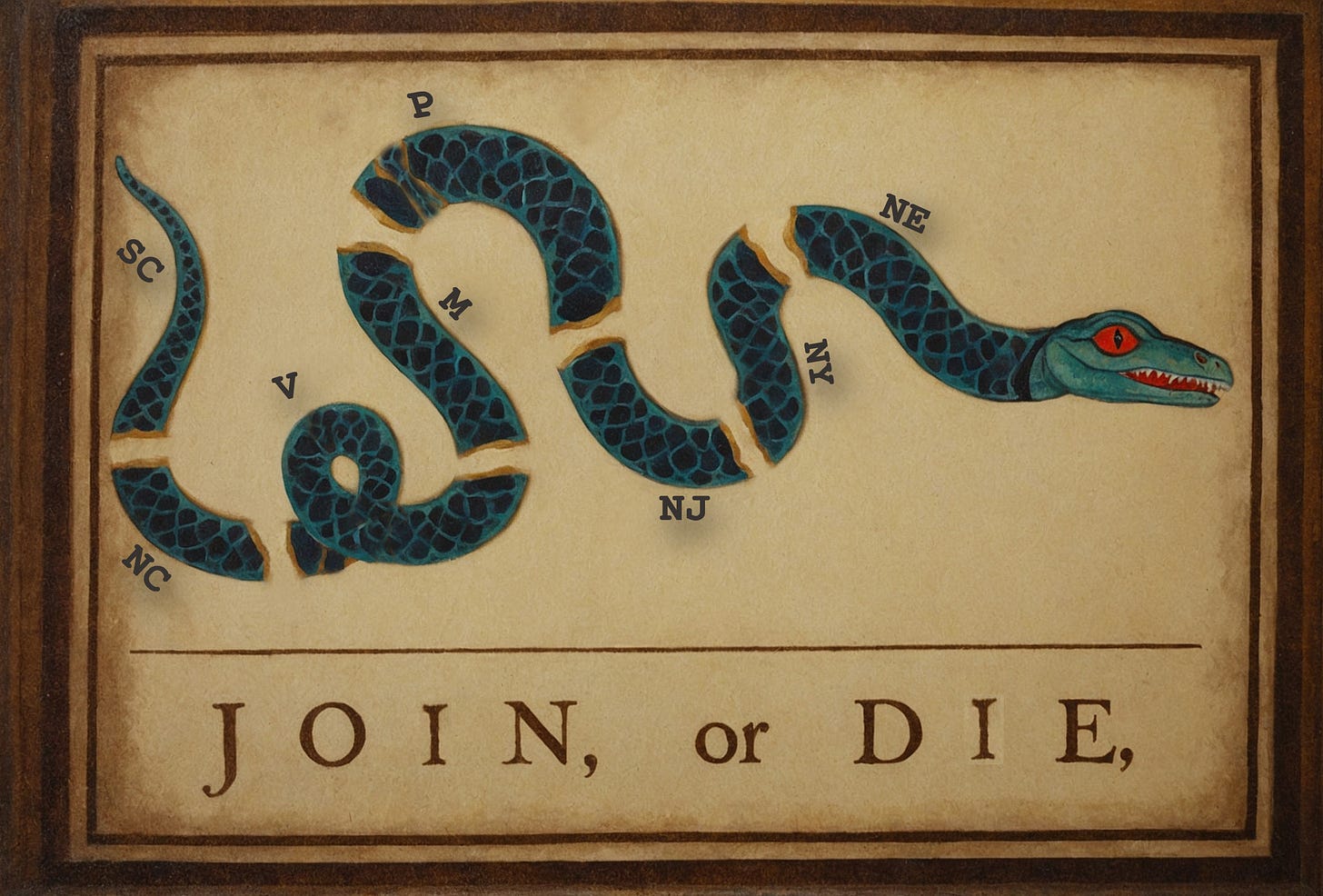
His conclusion was dire, “which if they are permitted to do, must end in the destruction of the British interest” in America. This news article turned editorial was followed by a second stand-out item, which had long lasting effects. Except for the reusable, engraved masthead, rarely did publishers include pictures in their papers. Why? Because it took too much time to whittle an image into a woodcut or etch a sketch for each edition. This crisis, however, was so concerning to this gentleman, that he’d taken time to draw a picture and carve it into a block of wood to set into his frame in between the typeset.
Directly below this article was an image of a snake divided into eight pieces with the initials of the other colonies on each piece. New England, which represented the northernmost colonies, was the head, while South Carolina was the tail. In between were New York, New Jersey, Pennsylvania, Maryland, Virginia, and North Carolina. This woodcut included a slogan about the current crisis: Join or Die. The writer of this article and his supporting visual statement clearly conveyed that the colonists were going to have to join together to fight the French or lose their status as Britain’s American colonies.
Who wrote this article and designed the first political visual cartoon ever printed in an American newspaper? Who concluded that this news from Colonel Washington, this suave and heroic newsmaker, was vitally important to everyone in the colonies, not just to those living in the West? Who was the brains behind this radical idea of bringing the colonies together under one government in the name of national security?
The author was the celebrated publisher, Benjamin Franklin. Little did the forty-eight-year-old Franklin realize that not only had he created America’s first political cartoon, but by connecting Washington with the snake image, he had also elevated the young military diplomat into stardom. Franklin had turned George Washington into a media darling, the chivalrous knight fighting for English rights against their centuries-old nemesis, the French.
Although he showed his patriotism in this join-or-die political statement, Franklin adhered to a higher principle, one tattooed on his heart. Franklin first and foremost was a passionate proponent of freedom of speech and its cousin, freedom of the press. The reason? Censorship had nearly cost him his family.


Stay updated with the latest in the Constitution State with The CT Centinal