Please Follow us on Gab, Minds, Telegram, Rumble, Gettr, Truth Social, Twitter, YouTube, Instagram
Below is the third of four excerpts from my book, War of Lies: When George Washington Was the Target and Propaganda Was the Crime. The book is a true crime history-mystery about propaganda campaigns that targeted Washington. The movie Young Washington brought George Washington’s French and Indian War years to life. Now is a great time to revisit this relevant story.
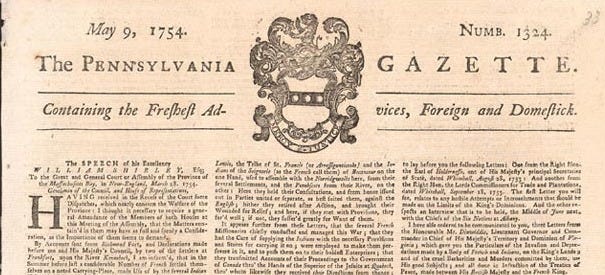
“Being frequently censur’d and condemn’d by different persons for printing things which they say ought not to be printed, I have sometimes thought it might be necessary to make a standing apology for myself, and publish it once a year,” Ben Franklin had published decades earlier on June 10, 1731, in the Pennsylvania Gazette.
Franklin, who was twenty-five-year-old at the time, had printed an advertisement from a captain seeking passengers for Barbados. At first, the advertisement had seemed as innocent as a carrier pigeon returning home. But the ad had concluded with a line discriminating against transporting the clergy, who need not apply. Worst of all, the announcement had compared preachers to loud birds.
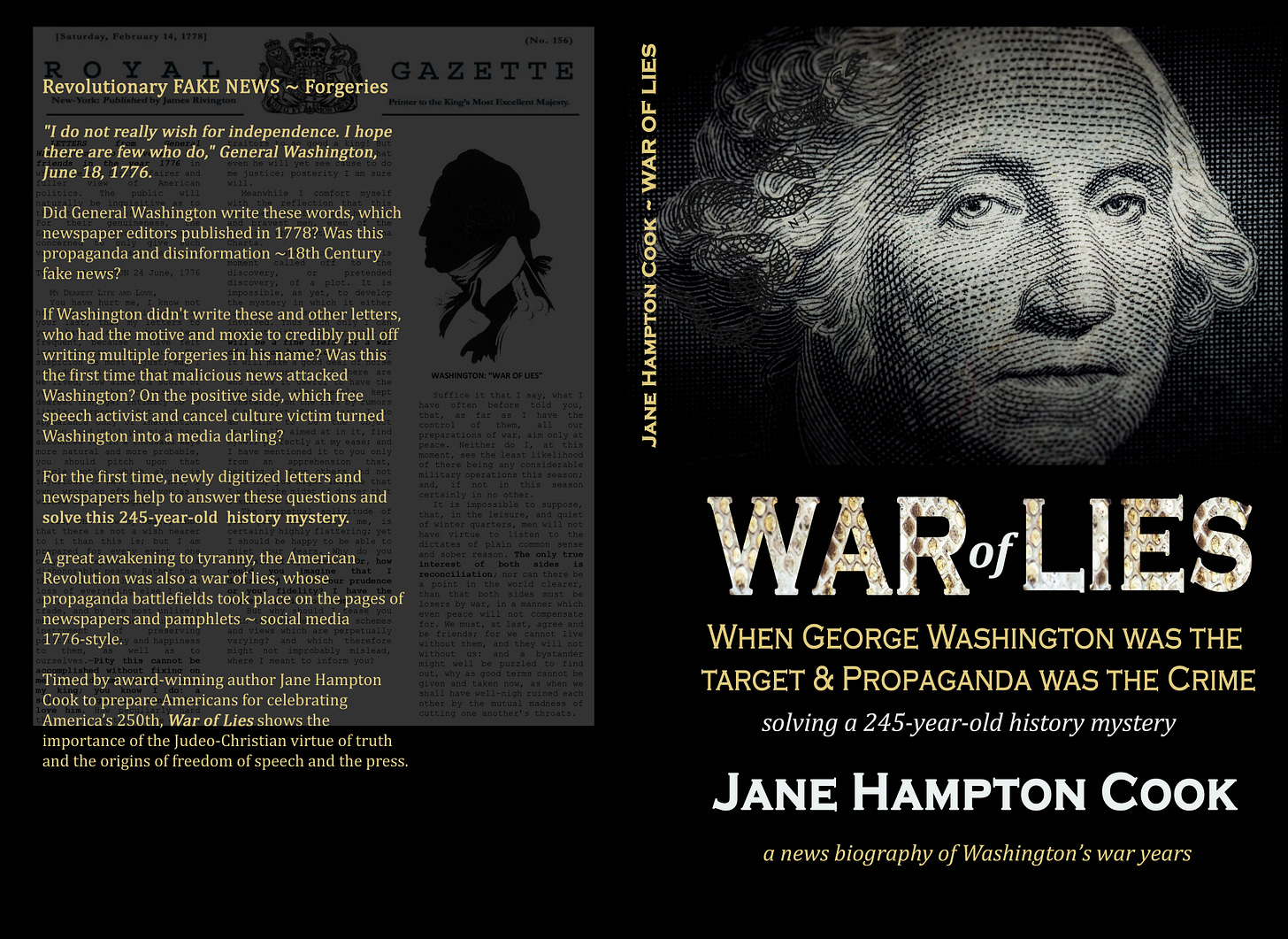
Some readers were so infuriated that they vowed to stop buying the Pennsylvania Gazette. How did Franklin respond to their censorship, the colonial form of cancel culture? He published an essay called Apology for Printers.
“Men are very angry with me on this occasion,” he wrote, showing his fear and worry about losing customers. “That if they were printers they would not have done such a thing on any consideration; that it could proceed from nothing but my abundant malice against religion and the clergy: They therefore declare they will not take any more of my papers, nor have any farther dealings with me; but will hinder me of all the custom they can. All this is very hard!”
Denying him custom meant that they were socially ostracizing him. Despite his anxiety, he took the occasion to present a rational argument. Little did he know that his response would be as relevant in 1731 as in 2021. “I request all who are angry with me on the account of printing things they don’t like, calmly to consider these following particulars,” Franklin had written with the skill of the best attorney in town.
“That the opinions of men are almost as various as their faces; an observation general enough to become a common proverb, so many men so many minds.” He’d then written a set of ethics that would shape the guardians of freedom of the press in America for centuries.
“That the business of printing has chiefly to do with men’s’ opinions; most things that are printed tending to promote some, or oppose others,” he’d explained, noting that other professions and trades, such as carpenters and shoemakers ,sold their products to everyone, people of all persuasions, without risk of offending them or “suffering the least censure or ill-will.” When it came to commerce, a person’s political opinion shouldn’t matter as long as he had enough shillings to pay for the product.
Franklin’s colonial common sense could apply to any generation. “That it is as unreasonable in any one man or set of men to expect to be pleas’d with everything that is printed, as to think that nobody ought to be pleas’d but themselves.”
“Printers are educated in the belief, that when men differ in opinion, both sides ought equally to have the advantage of being heard by the public,” he wrote, believing that truth and evidence would win in the end. “That when truth and error have fair play, the former is always an overmatch for the latter.”
“Hence, they cheerfully serve all contending writers that pay them well, without regarding on which side they are of the question in dispute.” As a printer and publisher, Franklin was not the arbiter of truth. His printing presses were neutral.
“Being thus continually employ’d in serving all parties, printers naturally acquire a vast unconcernedness as to the right or wrong opinions contain’d in what they print; regarding it only as the matter of their daily labor,” he explained, noting that this practice led to publishing controversial ideas that may be hostile to some.
“They print things full of spleen and animosity, with the utmost calmness and indifference, and without the least ill-will to the persons reflected on; who nevertheless unjustly think the printer as much their enemy as the author, and join both together in their resentment.”
Franklin’s view on freedom of speech and debate set publishing standards for testing and proving truth. “That it is unreasonable to imagine printers approve of everything they print, and to censure them on any particular thing accordingly; since in the way of their business they print such great variety of things opposite and contradictory.”
He knew what would happen if publishers printed only items that reflected their opinion.
“It is likewise as unreasonable what some assert, that printers ought not to print anything but what they approve. . . an end would thereby be put to free writing, and the world would afterwards have nothing to read but what happen’d to be the opinions of printers.”
Freedom of speech would end and the world would only know one point of view: the view of those controlling publications. “That if all printers were determin’d not to print anything till they were sure it would offend nobody, there would be very little printed.”
Although he was good friends with members of the clergy and didn’t intend to offend them by publishing the captain’s advertisement, he had avoided publishing items that would promote vice or immorality or would “do real injury to any person, how much soever I have been solicited, and tempted with offers of great pay.”
Remembering his brother’s stint in jail for publishing essays that questioned the government, he’d often avoided offending either the church or the state in his essays.
“I consider the variety of humors among men, and despair of pleasing everybody; yet I shall not therefore leave off printing. I shall continue my business. I shall not burn my press and melt my letters.”
Soon another printer in South Carolina published Franklin’s essay as a defense for something controversial that he’d printed. Franklin’s common-sense approach helped his readers sort fact from fiction, to let truth win the day.
After being accused of being an assassin in 1754, Washington had to channel his inner-Franklin and promote the truth in the newspapers without being self-promoting.
Within a couple of weeks, an officer in Washington’s regiment came to his public defense by asking newspapers to publish a letter he wrote. Following rule number 50 in the 110 Rules of Civility, “Be not hasty to believe flying reports to the disparagement of any,” this unnamed officer stepped forward to defend Washington.
“As the articles of capitulation and as the English mention in your Philadelphia newspapers, are censored and thereby seem to reflect dishonor on Colonel Washington, who is a brave and worthy gentleman, as well as all the corps then present,” the Virginia officer defended in a letter to the Pennsylvania Gazette, published on August 22.
Taking issue with the term assassination, the officer explained that they had relied on a man named, Jacob Van Braam, as their translator. Van Braam had been a lieutenant in the Dutch military and had recently come to the American colonies. He was recruited to join Washington’s men.
“We were obliged to take the sense of them from his mouth (Van Braam’s words); it rained so hard that he could not give us a written translation of them,” the officer wrote, explaining that they had very little candlelight available to read anything in writing and relied on oral communication.
“Every officer there is ready to declare, that there was no such word as assassination mentioned; the terms expressed were, the death of Jumonville. If it had been mentioned, we would by all means have had it altered, as the French during the course of the interview, seemed very condescending and desirous to bring it to a conclusion,” the officer wrote to combat the intense public scrutiny. Noting that those who were criticizing them didn’t understand their dire situation, he specifically defended Washington’s predicament as a leader.
“Let any of those brave gentlemen, who fight so many successful campaigns over a bottle (of wine), imagine himself at the head of 300 men, whose lives in a great measure he is answerable for, laboring under all the disadvantages above-mentioned, and environed with four times his number of an active enemy, and would he not be glad to accept of worse terms than Colonel Washington did?” he wrote, claiming the surrender terms were well-conducted and citing that the French were instructed to pay their native friends with “our scalps and spoils.”
“They call it an assassination; for my part, I call it a brave little action, and after hearing the whole, I doubt not but you will be in my opinion,” the gentleman concluded.
With help from an intermediary, a relieved Washington began a habit of letting others come to his defense in the press. Such was an honorable approach, but would it always work?
Though he didn’t defend himself in the newspapers, Washington privately conveyed his opinion about the assassination controversy.
“That we were willfully, or ignorantly, deceived by our interpreter in regard to the word assassination, I do aver, and will to my dying moment; so will every officer that was present,” he privately reflected, writing in an unpublished document that their Dutch interpreter didn’t understand enough English to properly catch the tone and meaning of certain words.
“But, whatever his motives were for so doing, certain it is, he called it the death, or the loss, of the (Mon)sieur Jumonville. So, we received and so we understood it, until, to our great surprise and mortification, we found it otherwise in a literal translation.”
Reflecting on the events at Great Meadow, he didn’t believe that Jumonville was a diplomat or that the motives of his party were honorable.
“And instead of coming as an ambassador, publicly, and in an open manner, they came secretly, and . . . they encamped, and remained hid for whole days together, and that, no more than five miles from us: From thence they sent spies to reconnoiter our camp,” Washington had defensively written in his journal. “Besides . . . an ambassador has no need of spies, his character being always sacred.”
Hadn’t Washington conducted himself differently when he’d been an ambassador months earlier on his first mission? Yes. He’d not hidden his presence but had openly approached the French forts when he delivered the cease-and-desist letters for Governor Dinwiddie. He believed that Jumonville and his men had been following them with the goal of attacking or killing them to launch a war.
“And seeing their intention was so good, why did they tarry two days, at five miles distance from us, without acquainting me with the summons, or, at least, with something that related to the embassy?”
Washington had also relied on the judgment of his native allies, who had more experience with the French in this region.
“It was the opinion of the Half King in this case, that their intentions were evil, and that it was a pure pretense; that they never intended to come to us but as enemies; and if we had been such fools as to let them go, they (Half King’s men) would never help us any more to take other Frenchmen.”
In other words, the French had engaged in propaganda or a disinformation campaign by claiming that Jumonville was a diplomat and accusing Washington of assassination. Washington relied on others to defend him publicly while privately documenting his side of the story. While this misinformation crisis passed, a new one was brewing.
Washington had lost his journal. As part of the capitulation terms, the French had seized everything, including his diary. Little did he know that in the years ahead, his journal would become the source of another deceit and the subject of fake news.
«««««
Newspapers also published the response of government officials to the growing crisis in Ohio. The New York Mercury printed a speech by Horatio Sharpe, the royal governor of Maryland, to the general assembly. Sharpe’s conclusion was emotional.
“The designs of the French must now be evident to everyone: they have openly, in violation of all treaties, invaded His Majesty’s territories, and committed the most violent acts of hostility, by attacking and entirely defeating the Virginian troops under Colonel Washington,” Sharpe declared in a call to arms.
While Washington suffered the humility of being called an assassin and Sharpe called for war, Benjamin Franklin and representatives from seven colonies met in Albany, New York, to discuss Franklin’s plan to unite the colonies under a single central British government.
Franklin proposed a grand council made of representatives from the colonial governments. The British government would appoint a president general. With the power of taxation, the grand council would regulate the relationship between the colonies and native tribes as well as solve disputes between the colonies over territory and other issues. Though the Albany Congress adopted this plan on July 10, 1754, colonial governors and their assemblies rejected it.
The time for a united government for Britain’s American colonies had not yet come.
As part of his capitulation, Washington agreed to stay away from Ohio for one year. He did just that. However, when Washington returned to Ohio a year later, he would also meet, for the first time, two of the suspects in the Revolutionary War’s War of Lies. Yet, the false report that emerged in 1755 was enough to break his mother’s heart.



Stay updated with the latest in the Constitution State with The CT Centinal