Please Follow us on Gab, Minds, Telegram, Rumble, Gettr, Truth Social, Twitter, YouTube, Instagram
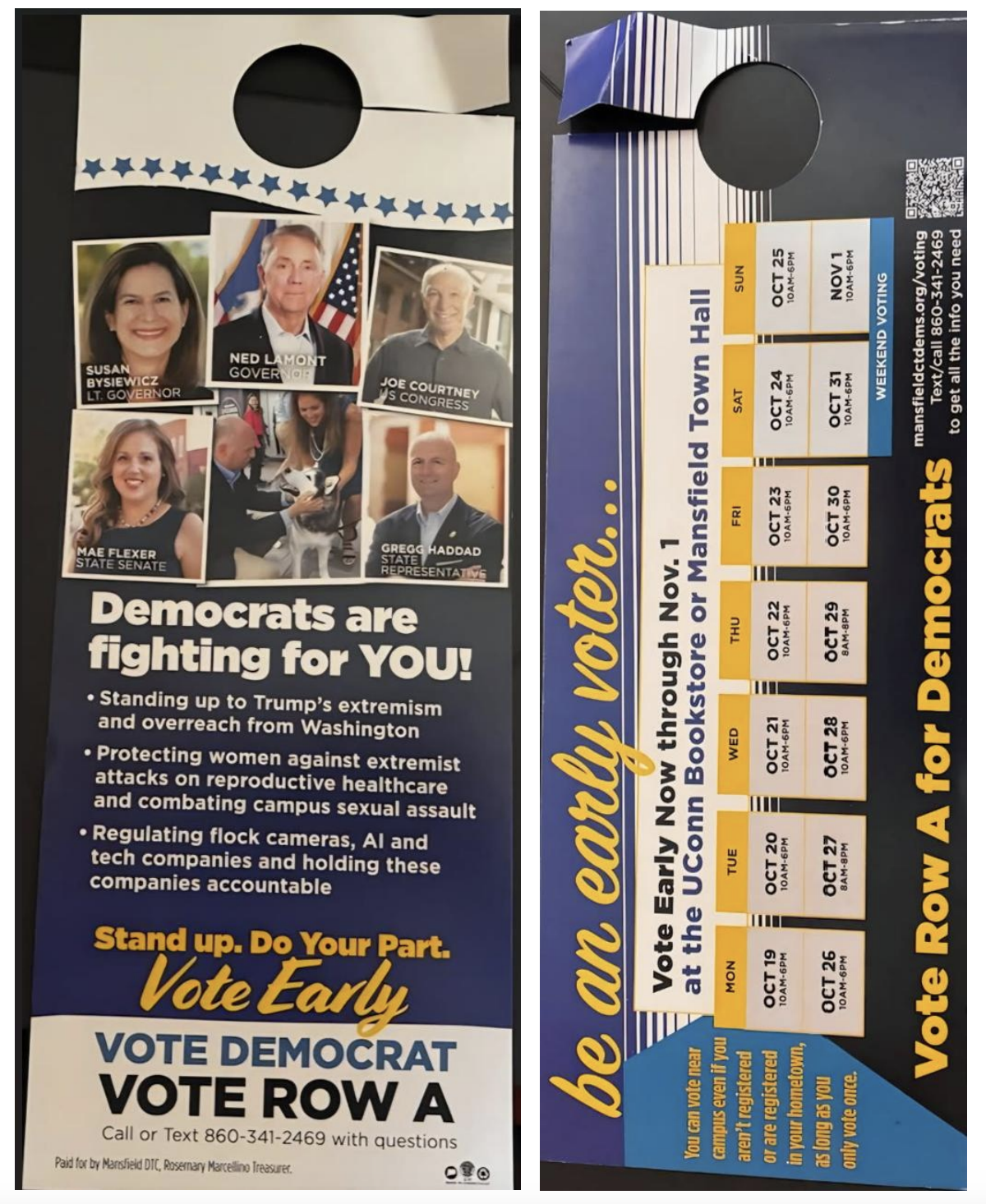
Connecticut Republicans are again pressing University of Connecticut President Radenka Maric for answers after Mansfield Democrat Town Committee (MDTC) political door hangers appeared on student dormitory doors earlier this month—reportedly around 10 p.m. in some buildings—raising immediate questions about policy compliance, equal access, and student safety.
In a letter dated October 26, 2026, Chris Coyle and Aaron Bowman, CT GOP State Central Committee representatives for the 29th Senate District, followed up on their October 15 correspondence. They described the recent placement of flyers paid for by the MDTC on UConn Storrs residence hall doors and demanded immediate clarification and enforcement of the university’s own rules.
The door hangers feature Democrat candidates including Lt. Gov. Susan Bysiewicz, Gov. Ned Lamont, U.S. Rep. Joe Courtney, State Sen. Mae Flexer, and State Rep. Gregg Haddad. They urge students to “Vote Democrat / Vote Row A,” highlight early voting, and list contact information for the Mansfield Democrats.
UConn’s Canvassing, Posting & Solicitation policy, maintained by Campus Housing / Residential Living and Education, explicitly restricts political activity in residence halls, except under certain circumstances. Recognized student organizations, university candidates, or local/state/national candidates may apply to canvass only by submitting a Political Canvassing Form at least three business days in advance. Access to buildings is arranged only after approval. The form itself notes limited timeframes (historically Monday–Wednesday, 7–10 p.m. in older versions of the policy).
Posting policies similarly require advance applications—often 15 business days—and prohibit posting on doors, walls, or outside designated areas. Door-to-door solicitation is otherwise banned. The policies exist, the university states, “to promote and enhance the safety, security and privacy of students living on campus.” Residence halls are locked 24/7; students use card access.
Coyle and Bowman asked President Maric five direct questions: Did the MDTC request and receive written permission on the required timeline? Can a copy of any approval be provided, including the specific policy allowing door hangers and hallway access? Why were Republicans not informed so they could do the same? What is being done about other pending political activities? And were staff aware but failed to act—or actively assisted?
The letter notes the university’s obligation for “consistent, fair and impartial application” of its policies and warns that legal and media initiatives are being prepared. If some activities are allowed, the representatives say, clear communications to all parties are required to avoid the appearance of bias.
Students reported the hangers appearing on dorm doors around 10 p.m. in some buildings. Several expressed concern about safety: Who was granted access to locked residence halls at that hour to distribute political materials? Residence halls are secured; unauthorized entry or propping of doors raises straightforward security questions.
The Connecticut Centinal contacted the Office of the President, the student living office, the Provost’s office, and campus police. Police told us they were unaware of the incident at the time of the call but would be happy to take a report from any concerned students, given that the activity appeared unusual. Student living directed inquiries to the Provost’s office, which directed them back to student living. No clear answers were provided on approval status or who was allowed into the halls.
In response, the Centinal has filed a Freedom of Information request for copies of all Political Canvassing Forms submitted to the university since September 1 under the school’s political canvassing policy.
This is not the first time the issue has arisen. During the November 2024 election, Republicans raised similar concerns about MDTC-funded door hangers on dorm doors, free bus transportation utilizing campus areas, and free food (including pizza) offered to induce students to register and vote—sometimes without regard to existing hometown registrations.
Those activities contributed to a record volume of same-day voter registrations in Mansfield that overwhelmed local systems and prompted a State Elections Enforcement Commission (SEEC) complaint. While the SEEC later dismissed the formal complaint after investigation, the underlying questions about policy adherence, inducements, and uniform enforcement remain relevant. The current letter explicitly references those 2024 events.
As of this writing, President Maric’s office has not publicly responded to the October 26 letter. The Connecticut Centinal will update this report if a response is received.






Stay updated with the latest in the Constitution State with The CT Centinal