
Please Follow us on Gab, Minds, Telegram, Rumble, Gettr, Truth Social, Twitter, YouTube, Instagram
Connecticut still owes billions for public employee pensions, but lawmakers have other plans for the state’s projected $363.1 million General Fund surplus. A law they passed last year directs that money to a fund for expanding child-care subsidies rather than paying down pension debt. Hartford’s appetite for new commitments continues to outpace its willingness to settle old ones.
The figures come from Comptroller Sean Scanlon’s Nov. 2 financial update, which puts the state’s rainy day fund at its legal limit of $4.48 billion. With that cushion in place, the surplus could further reduce pension debt. Instead, state law directs the projected surplus to the Early Childhood Education Endowment (ECEE).
Created in 2025, the endowment invests surplus dollars to finance more child-care spaces, higher payments to providers, subsidies for participating families and benefits for child-care workers, including health-insurance assistance. These commitments come on top of existing state funding. The fund can spend up to 12% of its balance annually through fiscal year 2027 and 10% thereafter, creating an ongoing source of spending outside the spending cap.
The cost of that choice adds up. A May analysis from Yankee Institute and Reason Foundation estimates that sending surplus money to the endowment year after year, rather than toward pensions, leaves taxpayers with roughly $300 million to $900 million in additional pension costs over 30 years. Those costs are adjusted for inflation.
The researchers modeled three scenarios: making no extra pension payments, paying an additional $1.8 billion annually, or reducing those payments to $1.5 billion to account for money going to the endowment. Comparing the last two shows the cost of diverting $300 million a year from pensions to the ECEE, with that amount rising with inflation. The smaller pension payments leave more debt unpaid and less money invested to cover future benefits.
If the pension investments earn their assumed 6.9% annually and there is no recession, the smaller payments add approximately $870 million to the taxpayer burden and push full funding back a year. With lower investment returns of 6% and no recession, the added cost is approximately $330 million. In a scenario that includes a recession and assumes 6.9% long-term returns, it is approximately $800 million. The totals include pension payments through 2053 and any pension debt still unpaid.
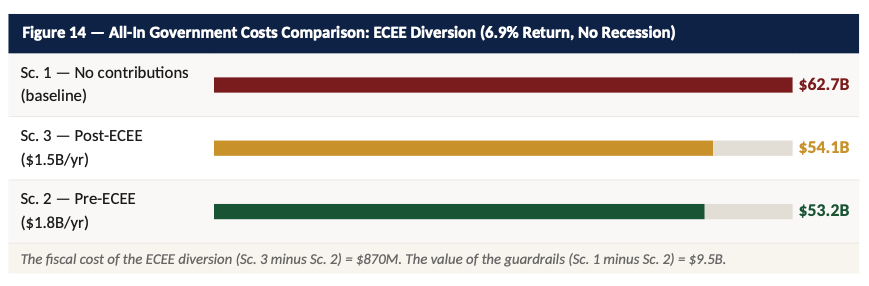
The May report predates Scanlon’s latest forecast, so it does not put a price on the projected $363.1 million transfer. It shows the long-term cost of the policy behind it: sending surplus money elsewhere while pension debt remains unpaid.
Paying down pension debt has already done something Connecticut taxpayers rarely see: helped bring a bill down. Inside Investigator reported in June that the state employee pension fund’s shortfall — the benefits it owes without enough money saved to cover them — fell from $18.9 billion to $16.7 billion between 2024 and 2025.
Additionally, the amount the state was required to contribute to that pension fund fell from $2.14 billion in 2023 to $2.01 billion in 2025—a $130 million reduction. That is how paying down old debt can help make future tax relief possible. Investment results and other factors affect those figures.
Connecticut is still making extra pension payments. Scanlon expects another $1.53 billion from tax collections that exceed the state’s limit on how much unpredictable revenue it can budget. With the rainy day fund full, that money is expected to go toward pension debt. But those payments could be larger if lawmakers had not sent the operating surplus elsewhere.
And that surplus was hardly pocket change. The Yankee–Reason report finds that year-end surpluses supplied 27% of extra pension payments in fiscal year 2023 and 35% in 2024. Lawmakers redirected a source that recently covered roughly a quarter to a third of those payments.
The problem goes beyond slower pension paydown. The endowment’s spending sits outside the spending cap, allowing the state to expand programs without fitting those expenses into its regular capped budget.
The spending also includes benefits for child-care workers. Scanlon’s November update lists $10 million for health-insurance subsidies for staff and owners, with eligible recipients receiving $1,000 to $1,200 annually toward coverage through Access Health CT. That is another expense taxpayers are financing outside the spending cap.
Now lawmakers have a model for the next spending wish list: create a special fund, feed it surplus dollars and keep the spending outside the cap. Repeat that often enough, and they can claim to support the guardrails while steadily stripping them of their purpose.
The projected $363.1 million transfer shows how much a single exception can redirect in one year. Add more special funds for other priorities, and pension paydown loses more ground. Each proposal will come with a worthy cause and people who would benefit. Taxpayers will still be responsible for the debt left unpaid.
The guardrails were adopted because Connecticut had spent decades making promises and leaving the bill for later. Weakening them — or creating special funds to evade them — invites more of the same. Announcing a new benefit makes for a better press conference than paying an old debt. The guardrails exist because taxpayers cannot afford to let the press conference decide which bills get paid.






Stay updated with the latest in the Constitution State with The CT Centinal