
Please Follow us on Gab, Minds, Telegram, Rumble, Gettr, Truth Social, Twitter, YouTube, Instagram
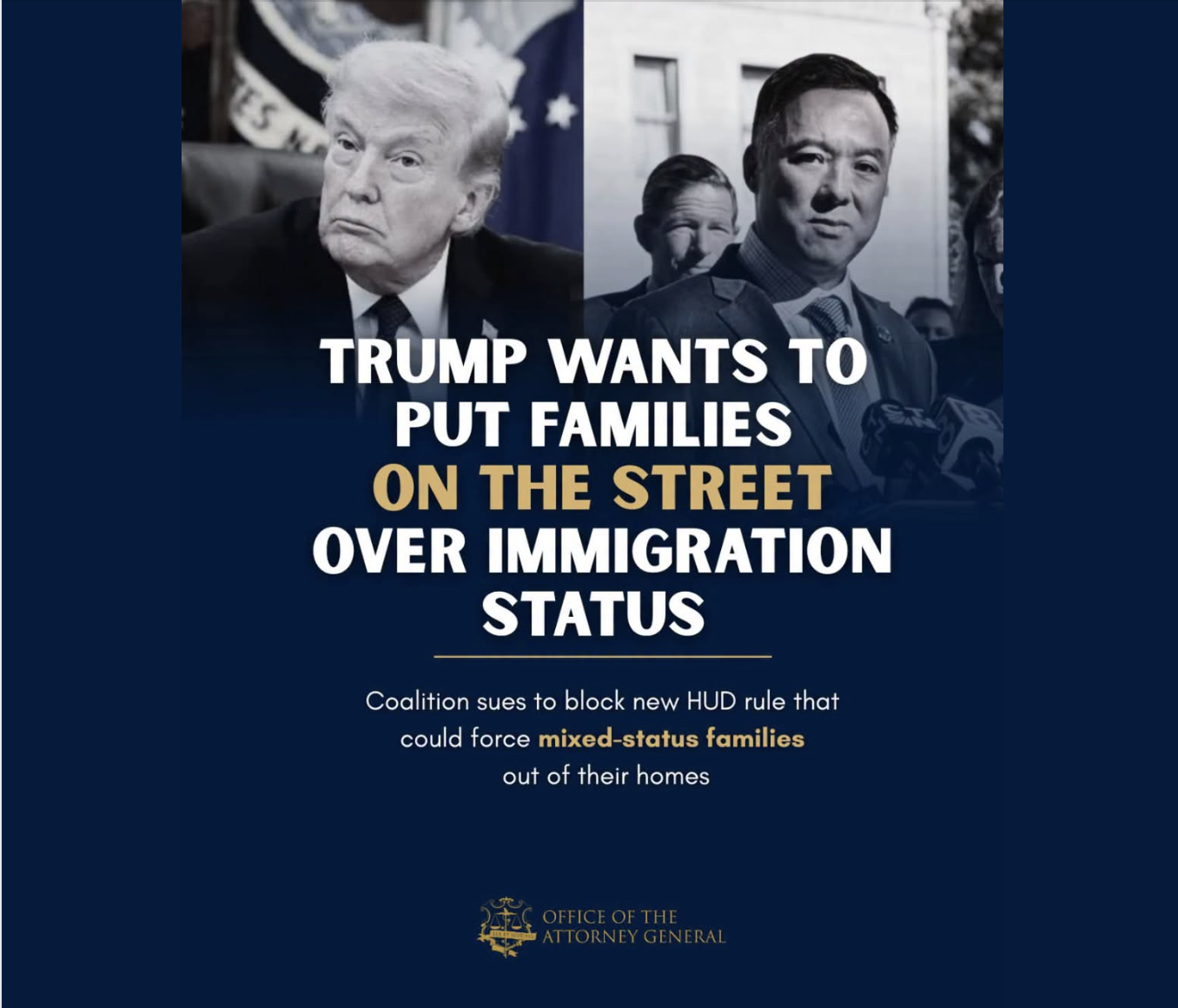
Connecticut Attorney General William Tong has joined a coalition of 21 other Democrat-led states and the governor of Pennsylvania in a federal lawsuit seeking to block a new U.S. Department of Housing and Urban Development (HUD) rule.
The rule, published in the Federal Register on November 12 and set to take effect December 14, requires every member of a household receiving HUD-assisted housing (public housing, Section 8 vouchers, and related programs) to verify U.S. citizenship or eligible immigration status.
Under longstanding policy, mixed-status families—households with at least one eligible member (U.S. citizen or qualified immigrant) and one or more ineligible members—could receive indefinitely prorated subsidies covering only the eligible individuals. The new rule ends that arrangement for ongoing assistance, makes proration temporary during verification, eliminates the “elect not to contend” option for ineligible members, and requires documentation (including for citizens, via Social Security numbers and the SAVE system when needed). HUD estimates it affects roughly 20,000 mixed-status families (about 78,100 people), including many eligible U.S. citizen children, and projects that ending indefinite proration could free up as much as $218 million annually for fully eligible households on waitlists.
Tong’s office and the coalition, in a suit filed in the U.S. District Court for the District of Massachusetts, claim the rule exceeds HUD’s authority, violates the Administrative Procedure Act, and reverses nearly 30 years of policy that allowed mixed-status families to remain together.
Tong stated: “We have a full-blown housing affordability crisis in this country right now. Trump’s response? Let’s throw entire families on the street if a single person doesn’t have their papers in order. This is a cruel and unlawful attempt to weaponize housing assistance for vulnerable, mixed-status families. We’re suing to protect Connecticut families and to ensure Trump cannot ignore the law in order to advance his extreme immigration agenda.”
HUD Secretary Scott Turner framed the change differently. He described it as closing a “decade-old loophole” of mixed-status arrangements and fully implementing Section 214 of the Housing and Community Development Act of 1980 so that “Anybody that is receiving taxpayer-funded housing from HUD has to verify that they are a legal citizen or an eligible tenant in this country.”
Turner emphasized that America’s homeless veterans, disabled, elderly, and domestic-violence victims should not remain on waitlists while ineligible non-citizens exploit the system: “American taxpayers will no longer foot the bill. Promises made, promises kept.” A prior HUD-DHS review identified large numbers of unverified, deceased, and ineligible tenants.
Opponents of the rule highlight risks of eviction, homelessness, and shifted costs to states (HUD’s own estimates put shelter costs at $20,000–$50,000 per person annually in some scenarios).
However, basic eligibility verification is standard for obtaining government benefits, and freeing up capacity for waitlisted, fully eligible families directly addresses the very affordability crisis Tong cites. While the plaintiff states argue that congressional amendments protect prorated aid, HUD contends the original 1980 statute restricts subsidies to verified eligible households. Ultimately, the coalition is asking the court to declare the rule unlawful and block its enforcement against the plaintiff states and their housing authorities.





Stay updated with the latest in the Constitution State with The CT Centinal