Please Follow us on Gab, Minds, Telegram, Rumble, Gettr, Truth Social, Twitter, YouTube, Instagram
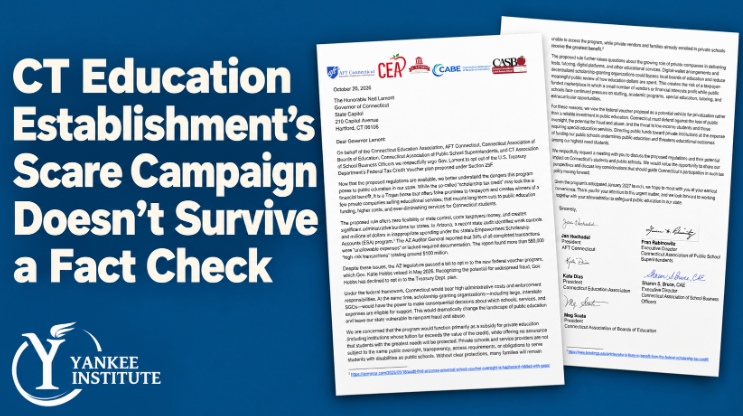
Connecticut’s two major teachers unions and the associations representing school boards, superintendents and school business officers want Gov. Ned Lamont to turn down scholarships for students. Their joint appeal gets an audit wrong, compares tuition with a donor’s tax credit and ignores the state’s power to hold scholarship organizations accountable. Families could lose help paying for tutoring, books, computers and more if Lamont takes their advice.
These are organizations whose members negotiate contracts, oversee budgets and manage public education. Before Lamont accepts their conclusions, he should check their homework.
The Oct. 20 letter comes from the Connecticut Education Association (CEA), AFT Connecticut, Connecticut Association of Boards of Education, Connecticut Association of Public School Superintendents and Connecticut Association of School Business Officers.
They describe the program as a “Trojan horse that offers false promises to taxpayers” and benefits a few private companies. Participation, they declare, means “long-term cuts to public education funding, higher costs, and ever-diminishing services for Connecticut students.”
Apparently, five education organizations can predict Connecticut’s financial future without showing their math.
Beginning in 2027, the Federal Scholarship Tax Credit allows individual taxpayers to claim up to $1,700 annually — or $3,400 for married couples filing jointly — for qualifying cash donations to approved nonprofit scholarship-granting organizations (SGOs). The credit reduces the donor’s federal income tax bill dollar-for-dollar, subject to applicable limits. SGOs pool contributions and award scholarships to eligible students in participating states.
The program can assist eligible students in public, private and faith-based schools. Families do not have to leave public schools to benefit.
Yet CEA declares in its own explainer: “Public Schools Don’t Benefit.” Its explanation rests on schools not receiving scholarship money directly. Students receive the scholarships. A public-school child can benefit even when the district doesn’t get the check.
The letter repeatedly invokes private schools, private vendors and privatization without clearly explaining what public-school students could receive.
Eligible expenses extend well beyond private-school tuition. Scholarships can help pay for tutoring, books, supplies, computers and qualifying special-needs services. The federal law also includes transportation, uniforms and extended-day programs when they meet the applicable requirements.
Citing an Arizona voucher audit, the five organizations tell Lamont that “34% of all completed transactions” involved unallowable expenses or missing documentation. That is not what the audit found.
Auditors actually selected 63 transactions and identified problems involving 34.4% of the dollars in that sample. Beneath the results, they stated: “Unless otherwise noted, the results of our testing using these samples were not intended to be projected to the entire population.”
A percentage of sampled dollars became a percentage of all completed transactions. The organizations sent that claim to the governor as a reason to reject scholarships.
The other headline number requires a different explanation. Auditors also identified 581,487 transactions totaling $99.7 million that ClassWallet — the program’s payment platform — had flagged for additional review. Arizona’s Department of Education lacked documentation showing it reviewed or acted on them. That is a serious oversight failure, not a finding that $99.7 million was improperly spent. Yet the figure follows an allegation of millions in inappropriate spending, without explaining what the auditors actually established.
Getting the numbers wrong is not the only problem. They are using findings about Arizona’s Empowerment Scholarship Account program, funded directly with state tax dollars, to argue against a federal tax credit for donations to nonprofit scholarship organizations. Arizona has separate tax-credit scholarship programs, but these findings are not about them.
Put simply, Lamont is being handed distorted numbers from a different program as a reason to reject this one.
Their warning about private-school tuition compares two different amounts: the cost of attendance and an individual donor’s tax credit. The $1,700 limit applies to the donor’s annual credit — not a student’s scholarship. Comparing tuition with that limit tells Lamont nothing about how much help a family could receive.
The exaggerations extend to Connecticut’s authority. Despite the warning of “zero flexibility or state control,” Connecticut can enforce its charity laws, require financial records and remove SGOs from its approved list if they fail the program’s requirements. Federal rules limit the state’s discretion. They do not leave it powerless.
The organizations predict cuts to public-school funding without identifying a Connecticut grant that would shrink or a service districts would have to eliminate. They give Lamont no Connecticut estimate to back their warning of higher costs and “ever-diminishing services.”
The program does not pay for scholarships by withdrawing money from Connecticut public schools. It offers a federal tax credit for donations to SGOs. That reduces federal revenue, but rejecting participation would not send those scholarship dollars to Connecticut districts instead. The organizations are asking Lamont to deny families access without identifying public-school funding his refusal would save.
Oversight and transparency deserve scrutiny. But the case for rejection offered here relies on audit findings the organizations get wrong, a misleading tuition comparison and an exaggerated claim that Connecticut would have no control.
They close with a request: “We respectfully request a meeting with you to discuss the proposed regulations and their potential impact on Connecticut’s students and public schools. We would value the opportunity to share our perspectives and discuss key considerations that should guide Connecticut’s participation in such tax policy moving forward.” Before offering the governor more guidance, they should correct what they have already sent him.
The signatories are entitled to oppose the program. Pressuring a governor to reject educational assistance while giving him misleading information is a bad look for organizations claiming to put students first. If their case is strong enough, they should be able to make it without the scare campaign.





Stay updated with the latest in the Constitution State with The CT Centinal