Please Follow us on Gab, Minds, Telegram, Rumble, Gettr, Truth Social, Twitter
Video footage reveals that clinicians in the transgender medical industry admit they work under minimal standards of care when they perform life-changing procedures on minors, joining with these vulnerable young people as “collaborators” in making their dream of having a body of the opposite sex – or even of no sex at all – come true.
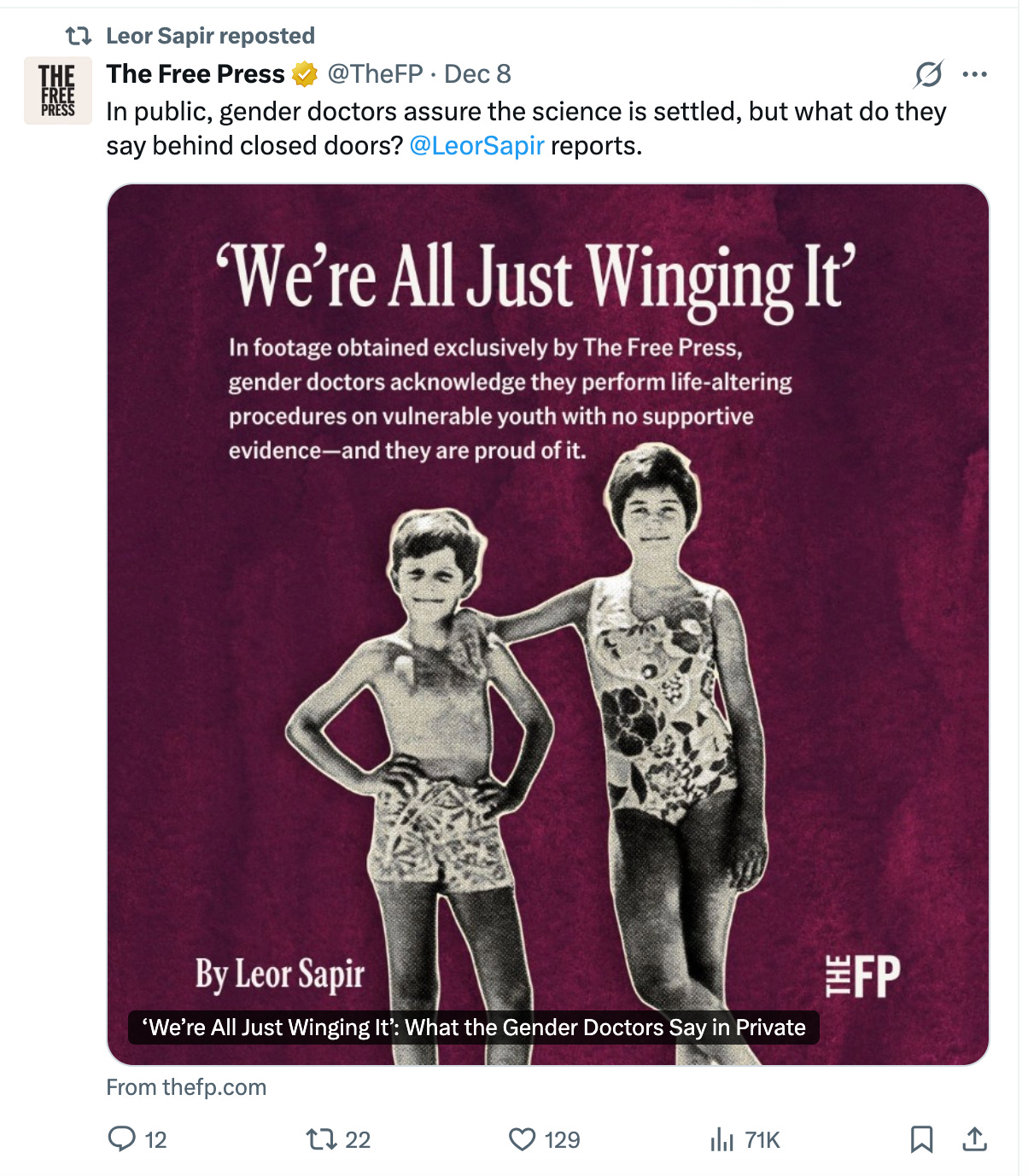
The recording, obtained exclusively by The Free Press, was exposed in a December 3rd piece by Leor Sapir, prominent expert in the field of pediatric gender medicine.
Commenting on one video from a 2021 conference of the U.S. Professional Association for Transgender Health, Sapir explained that Amy Penkin, an Oregon-based social worker, told her audience about Sky, an 18-year-old who said he wanted to “look like ‘a Barbie down there.’”
Penkin reportedly described Sky as “being asexual … and having no desire to have sex in the future.”
“Indeed, Sky did ‘not want to feel any pleasurable sensation and hope[d] removal of all erogenous tissue [would] be possible,’” wrote Sapir, who also observed that, in the recent past, a young person like Sky would have first been referred for a psychological assessment and offered psychotherapy or mental health counseling.
“But in the evolving world of gender medicine, clinicians now want to help young people like Sky achieve their gender goals,” Sapir explained, describing what sounds like blurred boundaries between trans doctors and their young patients.
“Penkin said that when confronted with a patient like Sky, existing ‘research’ and ‘standards of care’ are not enough to meet the needs of our patients, and we need to take it to the next level to really think about how we evolve and match the needs of our patients as their needs are being expressed to us,’” Sapir wrote.
Now, instead of objectively evaluating Sky’s expressed desires in the context of his medical history, his family life, social life, education, etc., Mair Marsiglio, a psychologist and colleague of Penkin, told conference attendees that mental health professionals in the trans industry must “reframe” their role to be a “collaborator” rather than a “gatekeeper.”
“That meant, Marsiglio explained, making sure that patients with serious mental health problems such as ‘multiple personalities’ and ‘psychosis’ are not excluded from gender surgery just because the team is ‘uncomfortable’ operating on them,” Sapir related.
“Marsiglio said that being a member of the surgical team provided the opportunity to ‘help the patient. . . navigate care,’” he continued, noting that the psychologist added this “reframing” of the role is especially critical when the young patient is requesting “a surgery that has not been performed before or is of higher risk.”
It would seem that, for such a vulnerable young person expressing a desire to totally transform his or her life, likely permanently, a truly “professional” mental health individual would help the patient assess the pros and cons of the procedures – and provide a truer version of informed consent.
Instead, Sapir explained the video revealed a transgender medical industry that appears proud to have divested of professional boundaries, choosing, instead, to get squishy on “guidelines” and standards of care. He wrote:
One of the biggest revelations from the recordings is how these clinicians acknowledge performing unproven, seemingly experimental treatments—only it appears there is often no protocol being followed, no formal research being conducted, and no ethics-board approval being sought. These practitioners say their goal is to fulfill the “embodiment” desires of their patients, whatever these may be, and doing this may require “deviat[ing] from guidelines.”
In fact, Sapir observed that one Utah-based clinician expressed that she described what she and her colleagues were doing as “we’re all just winging it, you know?”
“And which is okay, you’re winging it too,” she added. “But maybe we can just, like, wing it together.”
With broad public support, President Donald Trump signed an executive order titled “Protecting Children from Chemical and Surgical Mutilation,” a directive that led to the publication of the Department of Health and Human Services’ report titled “Treatment for Pediatric Gender Dysphoria: Review of Evidence and Best Practices.”
Sapir warned, nevertheless, that the World Professional Association for Transgender Health (WPATH) shows “no signs” of backing down.
“[N]or have the major U.S. medical associations that have embraced youth transition,” he pointed out. “Despite suffering loss after loss in the policy and public opinion arenas, WPATH continues to insist that ‘gender-affirming care is backed by rigorous research, expert consensus, and patient-centered values.’”


Stay updated with the latest in the Constitution State with The CT Centinal